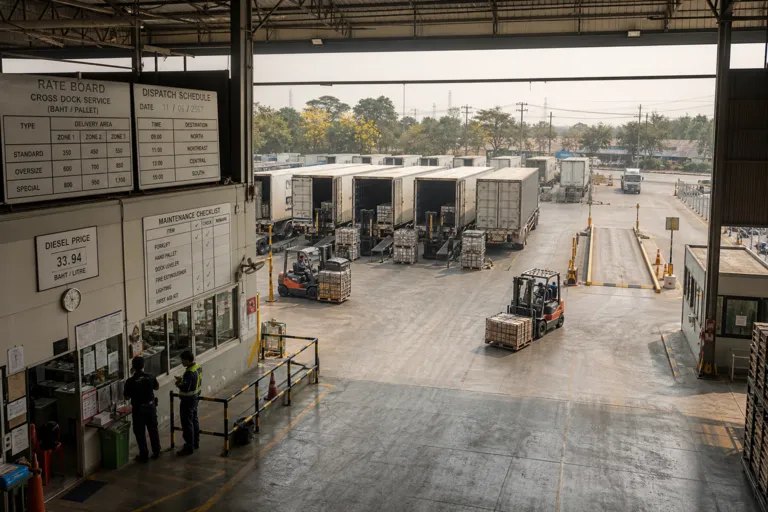
Rising diesel prices are forcing difficult pricing decisions across Thailand’s road freight industry. The Land Transport Federation of Thailand (LTFT) said road freight and logistics activity fell by an estimated 15-20% from a year earlier as high fuel prices and broader cost pressures hit demand. Diesel reportedly rose to as much as 50 baht per litre in April 2026, and while it later eased, it remained elevated. LTFT president Thongyu Kongkhan said operators initially raised service rates on April 1, 2026, when diesel was around 40 baht per litre, but most did not raise charges again after diesel climbed further and another adjustment was announced on April 6.
The rate response has been cautious even as costs keep stacking up. The Thailand News report cited diesel priced at nearly 39 baht per litre when the Federation of Land Transport of Thailand announced a 10% freight-rate increase starting April 1, alongside plans for phased increases of up to 30%. Operators described fuel as a dominant expense: the Northeastern Transport Association Thailand said fuel accounts for about 50% of transport costs. Beyond fuel, LTFT cited increases of up to 25% in items such as engine oil, lubricants, oil and air filters, and diesel filters. Tyre prices have risen by about 20-25%, with higher costs also reported for batteries, transmission oil, differential oil, and repair and maintenance parts.
Demand Mix Shifts While Competition Limits Pass-Through
The pressure is not just on the cost side. LTFT said the sharpest slowdown has been in agriculture, particularly rice and sugar, while durian shipments continued in line with the season. Construction-related transport also weakened, with lower movement of soil, stone, and sand as major state projects had yet to come through. Segments holding up better included consumer goods shipments to distribution centres and import–export cargo, which were described as essential to daily life and therefore less affected. In this environment, LTFT said it would avoid raising transport prices again in the short term to limit the impact on customers and household living costs.
Bank-linked industry analysis helps explain why many fleets cannot fully pass costs through. In the first half of 2026, diesel prices increased by 23.1% year over year, while freight service charge increases remained significantly lower than the rise in diesel prices. The same analysis noted intense price competition because the market has a large number of small operators, especially in general freight where differentiation is limited. It also said profitability differs sharply by size: large operators saw net profit margin (NPM) increase from 1.49% in 2020 to 8.72% in 2024, underscoring why smaller fleets can feel the margin squeeze first when fuel and parts costs rise quickly.
At the same time, structural shifts continue to reshape the Thailand road freight market even during a cost shock. Mordor Intelligence highlighted that wholesale and retail trade generated 37.11% of revenue in 2024, and the segment’s 6.87% CAGR for 2025-2030 reflects how more frequent, smaller orders support road-based networks. Infrastructure plans in the Eastern Economic Corridor also aim to change flows: Laem Chabang Port Phase 3 is set to raise container capacity from 11 million to 18 million TEUs by 2026, and policymakers aim to lift rail’s share of port-connected cargo from 7% to 30%. Those initiatives target a reduction in the logistics cost-to-GDP ratio from 14% to 12%, with direct savings of USD 7.1 billion, creating new incentives for fleets that can secure efficient turns and intermodal connections.
Why are trucking companies in Thailand raising freight rates in 2026?
How much has Thailand’s road freight and logistics activity fallen, according to LTFT?
What other operating costs are rising for Thai truck operators besides diesel?
What does 2026 data say about diesel inflation and the ability to pass it through?
What is changing structurally in the Thailand road freight market despite cost pressure?