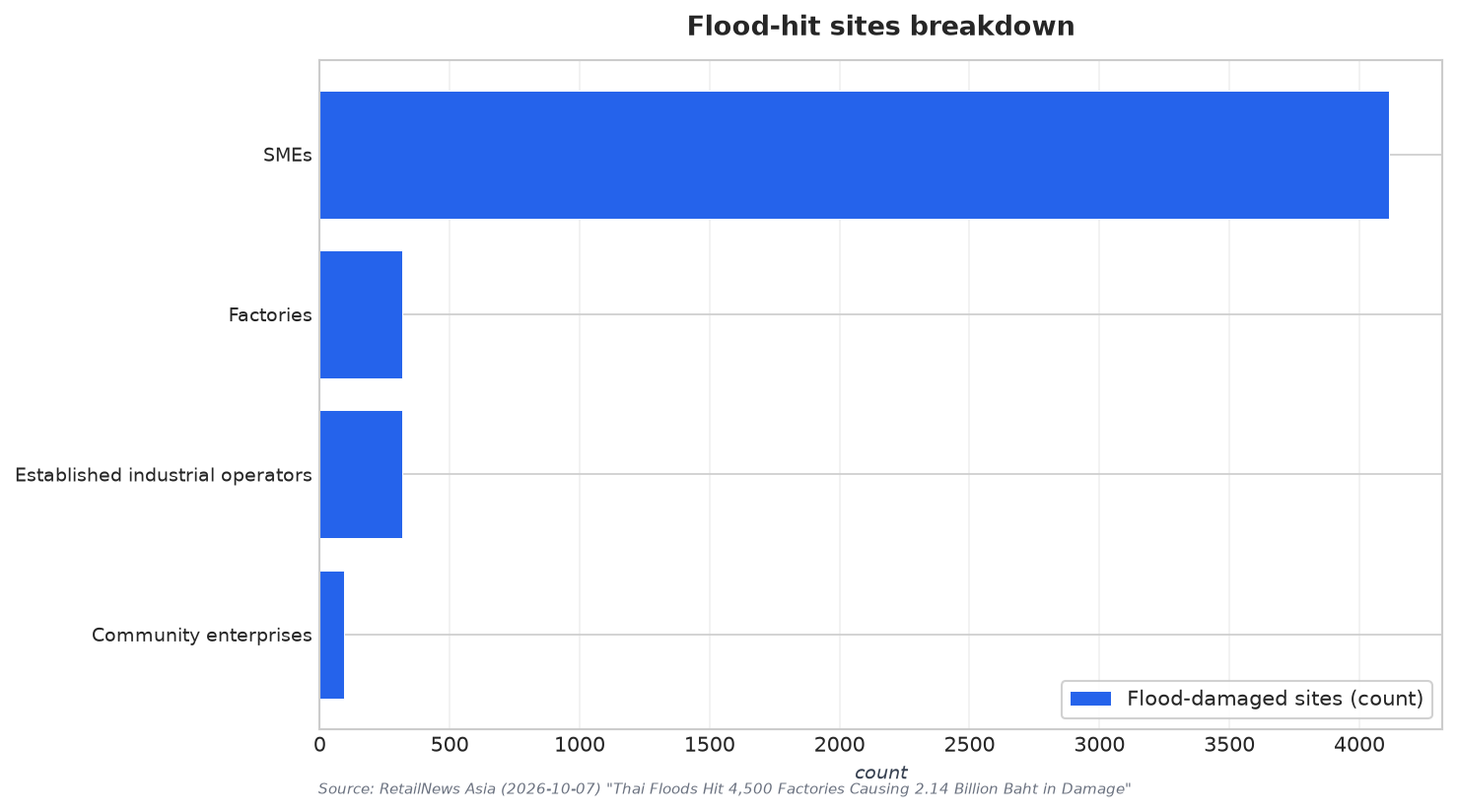
Thailand’s 2026 floods hit Bangkok and surrounding provinces and quickly became a live stress test for industrial estates and their supply networks. The Federation of Thai Industries (FTI) estimated initial manufacturing damage at $30.4 million (1.018 billion baht), while a separate national tally reported floods damaged 4,523 factories in 55 provinces with estimated losses of 2.14 billion baht. Small and medium-sized enterprises absorbed most of the site count, with 4,113 flooded locations in that same tally. For the Bangkok manufacturing belt, the story was not only water inside facilities, but stoppages that spread when parts, labor, and routes could not move reliably.
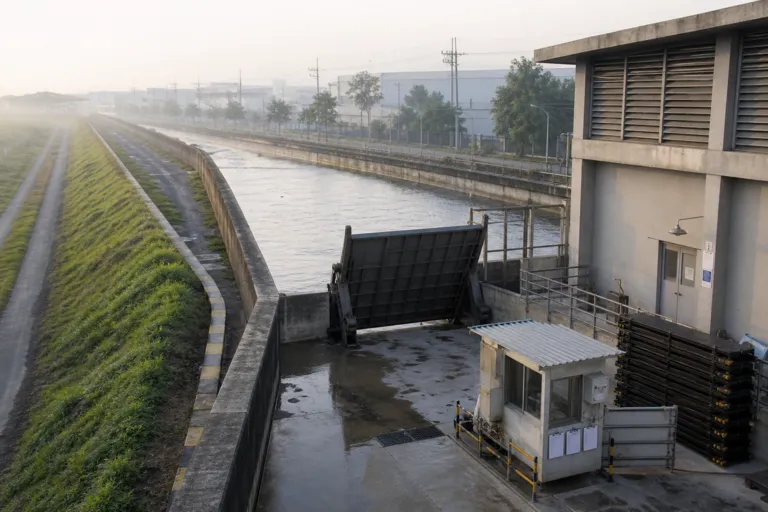
Industrial estates themselves showed uneven outcomes, which is now shaping how Thailand industrial estate flood protection is being discussed by operators and the market. The Industrial Estate Authority of Thailand (IEAT) reported that between 180 and 190 plants located within formal industrial estates took hits, accumulating between 1.7 billion and 1.8 billion baht in physical and operational damage. In Chonburi, Amata City Chonburi Industrial Estate was described as the most severely impacted zone after an earthen dyke breached, sending water 30–70 cm across phases 7, 8, 9, and 10. At least 34 factories sustained direct damage, and another report said 150 factories faced impacts there, forcing 34 to suspend production entirely.
From Barriers to Bottlenecks: Why Estates Are Retesting Systems
Authorities and operators responded with inspections and retesting aimed at finding weak points before the next surge. IEAT ordered full-system tests of flood defenses across all at-risk estates and dispatched officers to inspect off-site drainage channels. IEAT’s governor said water levels at Lat Krabang and Bangchan industrial estates had stabilized, and expressed confidence in existing flood barriers as runoff moved toward Phra Nakhon Si Ayutthaya, adding that internal water levels at Bang Pa-in, Nakorn Luang, and Hi-Tech estates remained well within safe thresholds. The IEAT board was also set to hold an extraordinary meeting to approve relief packages for operators.
Insurers and risk advisers are also signaling a shift from broad market reactions to more granular differentiation. Willis Re said the 2026 floods were not expected to cause the broad market hardening that followed the 2011 event, but were more likely to lead to sharper underwriting scrutiny and greater differentiation between risks. The specific focus areas included flood defence performance, industrial-estate accumulations, business interruption exposure, supplier and transport dependencies, sub-limits, deductibles, and the quality of exposure data. Willis Re also described the supply-chain disruption as primarily indirect and short term, noting that many downstream assembly plants, including those in Bangkok, were not directly flooded but still faced disruption when upstream suppliers could not deliver raw materials and logistics routes were temporarily constrained.
Beyond factory gates, flood risk is influencing investment decisions and development costs in ways that feed back into industrial location strategy. Cushman & Wakefield said recent flooding is prompting buyers to examine flood history, land elevation, drainage capacity, and project-level protection measures more closely, and warned that developers must account for the cost of embankments, land raising, drainage, and pumping systems. At the macro level, SCB EIC assessed the floods as shaving 0.05 to 0.1 percentage points from growth in a baseline scenario, after concentrated heavy rainfall that included a Bangkok “rain bomb” of 250 to 300 millimeters of cumulative rain, while reporting that over 1.1 million households remained impacted. With disruption spanning households, logistics, and supplier networks, industrial estates are being pushed to prove—not just claim—that their defenses and continuity plans work under real pressure.
How did the 2026 floods affect factories across Thailand?
What losses were reported for plants inside formal industrial estates?
What happened at Amata City Chonburi Industrial Estate during the floods?
How are insurers changing their approach after the 2026 floods?
What is changing in Thailand industrial estate flood protection after the 2026 test?