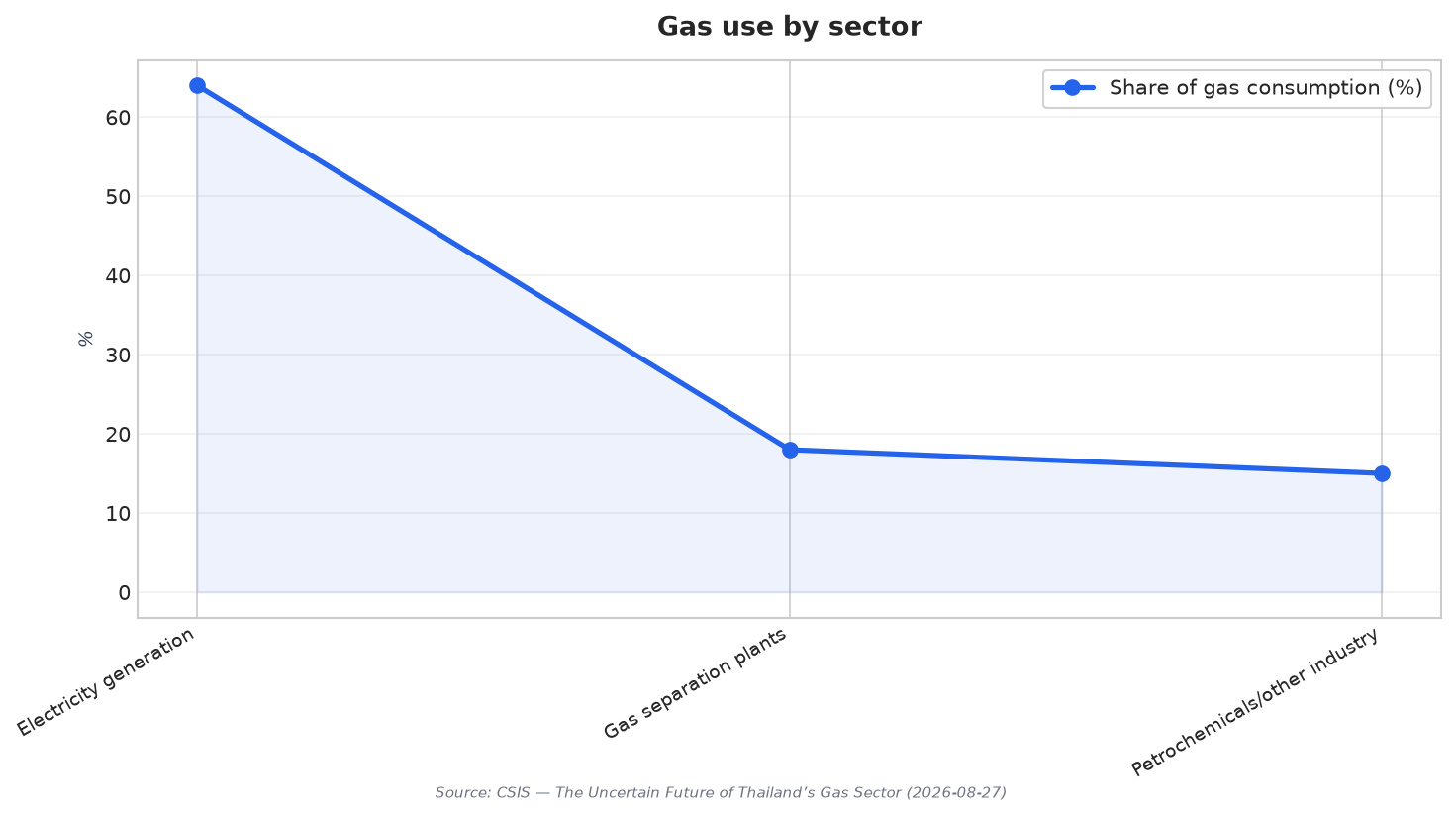
Thailand’s gas market is being forced to adapt to a new reality: domestic supply is shrinking, imported LNG is rising, and the old “single pool” approach is being reshaped by policy choices. CSIS describes how Thailand’s domestic gas resources have been in decline after peaking in the early 2010s, pushing up LNG imports with higher costs and more uncertainty for the power sector. In 2024, Thailand consumed 46.5 billion cubic meters (bcm) of gas, and nearly 30 bcm per year (64%) was used for electricity generation, with roughly 18% used for gas separation plants and 15% for petrochemicals/other industry. With gas still the foundation of the electricity system, changing how gas is priced and allocated quickly becomes a debate about who absorbs risk and who gets relief.
Within Thailand natural gas pricing reform, the May 2024 restructuring is a key inflection point because it changes how different user groups relate to the Pool Gas price. KASIKORN RESEARCH CENTER notes that the Pool Gas price is a weighted average of Gulf of Thailand gas, Myanmar gas, and imported LNG. It also reports that, under the new structure, the Pool Gas price decreases as the petrochemical sector shifts from using Gulf gas prices to partially adopting the Pool Gas price, making the 2025 Pool Gas price expected to be lower than in 2023. Looking ahead, KASIKORN projects Pool Gas prices to decrease by 3.7% in 2025 and 5.2% in 2026, reflecting lower Gulf gas prices following Dubai crude oil trends and expectations that Gulf of Thailand production will operate at full capacity throughout 2025.
Winners and Losers Under the New Utility Model
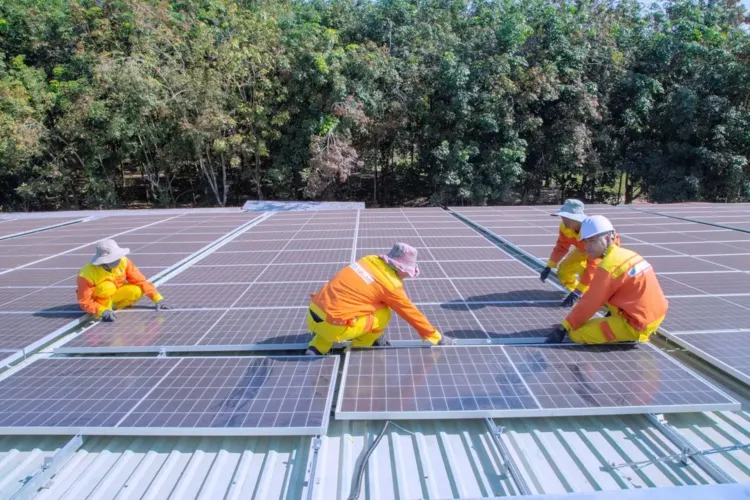
The winners are the groups positioned to gain from lower pool pricing and from reforms designed to shield smaller users. KASIKORN’s outlook implies a more favorable cost base for customers exposed to Pool Gas as it trends down in 2025 and 2026, even as it flags upward pressure from average LNG import prices in 2025 tied to Henry Hub and JKM and tighter U.S. supply conditions with higher Asian LNG demand in the first quarter. On the electricity side, Reccessary reports the country’s tariff reform is built around a principle that households consuming less electricity will pay less, while higher consumption will face higher rates, with the stated aim of easing the burden on ordinary consumers amid volatile global energy markets. The same reform is intended to widen price gaps between consumption tiers to encourage energy efficiency and improve the economics of rooftop solar.
The losers are often the actors stuck holding fixed costs and utilization risk, especially when demand is soft. KASIKORN projects Thailand’s natural gas demand to contract by 3.8% in 2025 and 3.0% in 2026, with the power sector expected to consume less gas due to rising electricity imports and growing reliance on renewable energy, while NGV demand continues to fall alongside a persistent drop in CNG vehicles. IEEFA adds that Thailand’s gas-fired power plants are significantly underused, and that the NEPC’s 4GW “power pause” is reported to save state-owned utilities THB3.5 billion (USD111 million) in operating expenses, yet idle plants still incur fixed costs that are passed to consumers through base tariffs as availability payments. This is the core tension: falling utilization can protect fuel burn but still raise the visibility of capacity and infrastructure charges.
Future distributional impacts will also be shaped by LNG infrastructure decisions and how service fees flow into pool pricing. Energy Tracker Asia reports that reliance on domestic natural gas declined to 59.84% in 2024 from 79.4% in 2011, affecting the average pool gas price, which includes offshore pipeline fees, Myanmar pipeline delivery fees, LNG import costs, and LNG terminal service fees. It warns that whether Thailand’s Energy Regulatory Commission standardizes demand charges across all three LNG terminals or uses station-specific calculations, overall pool gas costs would rise because the system must shoulder fixed investment costs and guaranteed returns associated with the third LNG terminal, with fixed costs borne by electricity consumers. In this model, industrial users and households can benefit from lower pool prices when they occur, but they can also face higher bills if terminal charges and other fixed components climb.
What is changing in Thailand’s natural gas pricing reform compared with a single pool approach?
What does KASIKORN project for Pool Gas prices in 2025 and 2026?
How much is Thailand’s gas demand expected to change in 2025–2026?
Who benefits from Thailand’s electricity tariff reform tied to gas reliance?
Why do LNG terminals matter for who pays in the power system?