The Thailand halal food industry is being pulled forward by two forces that reinforce each other. One is export growth into Organisation of Islamic Cooperation (OIC) markets. The other is a broader idea of halal that now spans products and services, and places more weight on safety, traceability, and production discipline. In 2024, Thailand’s food exports to OIC countries reached US$7.1313 billion, rising 6.3% year on year, according to Thailand’s Trade Policy and Strategy Office. Officials also point to a wider global shift: halal’s appeal extends beyond Muslim consumers because strict production principles are associated with cleanliness and hygiene, which helps widen demand.
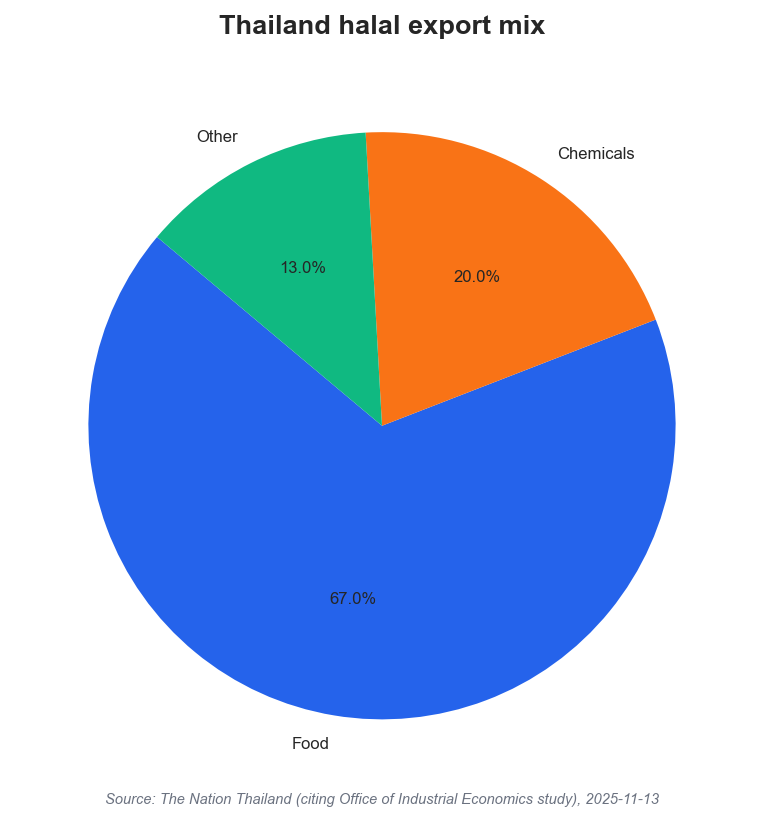
That widening demand sits inside a large global context. An Office of Industrial Economics (OIE) study cited in 2025 put the global halal market at US$1.36 trillion in 2023, with halal products at US$546 billion and services at US$815 billion. In that 2023 product mix, halal food led at 43%, followed by chemicals at 26% and medicine at approximately 11%. For Thailand, the same OIE remarks said Thai halal exports stand at US$8.85 billion, or 1.6% of the US$546 billion global halal product market. OIE added that food makes up 67% of Thailand’s halal export value (around US$6 billion), followed by chemicals at 20% (US$1.75 billion).
Export Growth Meets “Conscious Halal” Standards
Export performance also comes with clearer targeting and product focus. Thailand’s largest OIC food export markets are Indonesia, Malaysia, Iraq, the UAE, and Saudi Arabia, which together account for 68.5% of Thailand’s OIC food exports. Key products named by Thailand’s Commerce Ministry include rice, tinned tuna, sugar, pet food, and seasonings. On the global side, halal food and beverage exports to OIC countries totaled US$247.362 billion in 2024, up 6.9% from 2023. Thailand ranks as the 10th largest food exporter to the OIC market, behind major exporters such as Brazil, India, China, Turkey, and the United States, which frames both competition and headroom.
The “conscious halal” angle is increasingly about trust systems, science, and credibility, not only logos. Salaam Gateway notes Thailand has more than 160,000 halal-certified products and is aiming to position itself as a regional halal hub over the next four years. The same source highlights the role of the Halal Science Center, which has operated since 2003 and developed tools such as the HAL-Q quality management system and H-numbers, described as the world’s first database of chemicals used in the food industry. It is also looking to apply Shariah-compliant blockchain, artificial intelligence, and cloud computing, to build greater trust in the halal economy.
Meat remains a core pillar of Thailand’s halal economy, and market data shows measurable expansion. Straits Research estimates the Thailand Halal Meat Market was valued at USD 3983.96 million in 2024 and is projected to reach USD 4989.38 million by 2027, with a CAGR of 7.5%. In 2024, Thailand accounted for 1.61% of the global halal meat market size, and the same report notes fresh food led the type segment in 2024 while processed food is projected to grow fastest. Policy is also trying to keep pace. OIE has outlined a five-year halal industry plan (2024-2028) to elevate international standards, improve production and logistics infrastructure, and establish a “Halal Industrial Park” to attract investment.
How fast are Thailand’s food exports to OIC countries growing?
How big are Thailand’s halal exports, and what share do they represent globally?
What are Thailand’s main halal export categories by value?
What does the Thailand halal food industry export most to OIC markets?
What is the outlook for Thailand’s halal meat market?