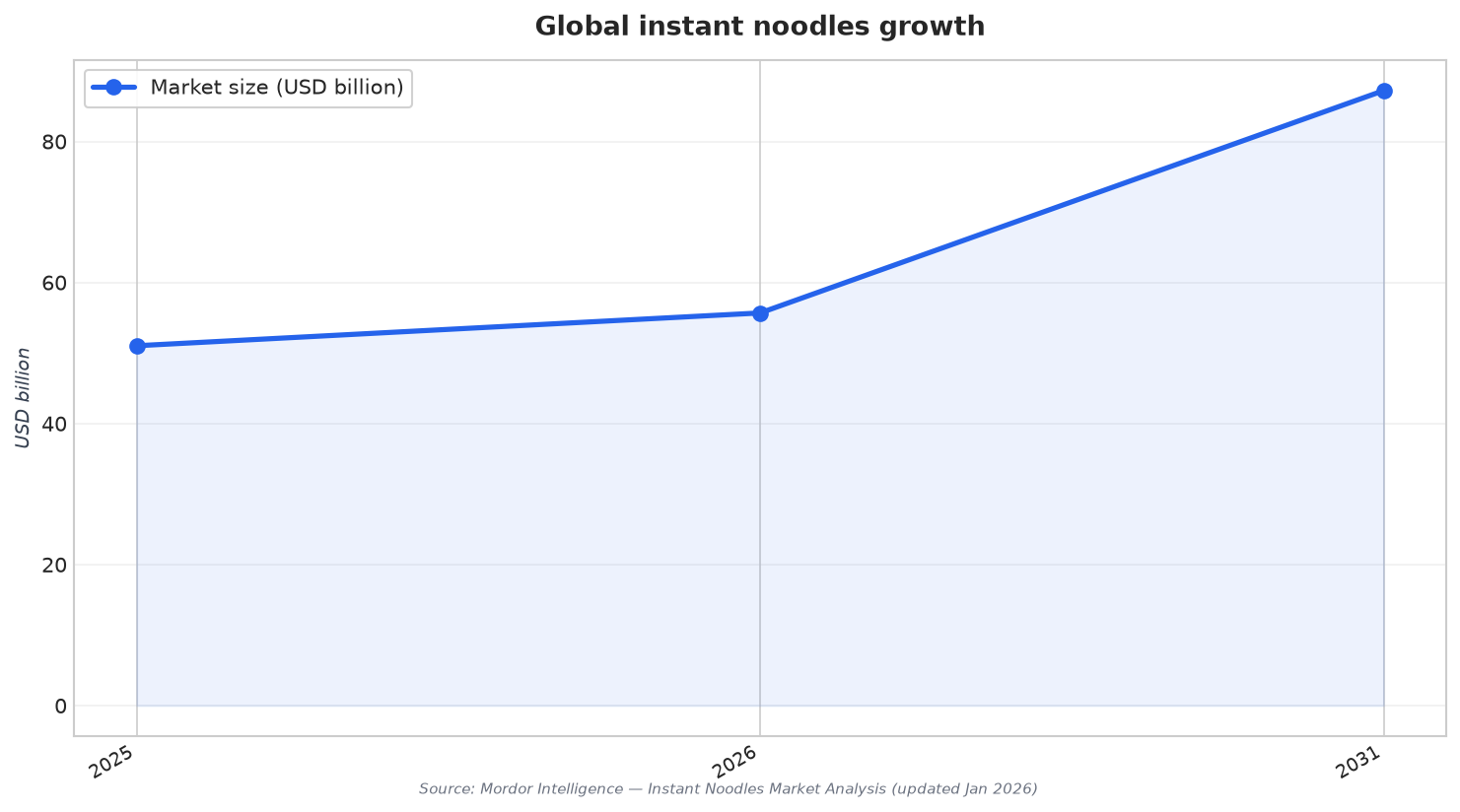
Thailand’s instant noodle makers sit inside a global market that is still expanding, but not without friction. Mordor Intelligence projects the global instant noodles market to grow from USD 51.03 billion in 2025 to USD 55.68 billion in 2026, reaching USD 87.21 billion by 2031, with a 9.39% CAGR over 2026–2031. Market Research Future, using its own framework, values the market at USD 54.60 billion in 2025 and projects USD 59.24 billion by 2026, rising to USD 123.45 billion by 2035 at an 8.50% CAGR. For Thailand-based brands, these forecasts provide demand headroom, but competition and costs can still squeeze margins in a low-priced, high-volume category.
Price pressure is not abstract in this category. Tridge notes that market dynamics are strongly influenced by input costs such as wheat flour, palm or vegetable oils, and packaging materials, while freight-cost spikes, container disruptions, and currency volatility can erode margins on relatively low-priced packaged foods. A broader noodles-market view also flags that maintaining cheap prices while protecting profits remains a major constraint. This is where the Thailand instant noodle industry has to balance value positioning with execution discipline, including stable sourcing, careful packaging choices, and logistics strategies that reduce the shock from trade and transport volatility.
Exports Grow as Asia-Pacific Stays the Demand Center
Thailand’s export story benefits from where production and consumption are concentrated. Tridge describes Thailand as an established manufacturing base with notable branded exports in global trade, alongside other major producers like China, Indonesia, India, Vietnam, Japan, and South Korea. On demand concentration, Mordor Intelligence estimates Asia-Pacific contributed 74.82% of global instant noodle value in 2025 and is on course for an 11.08% CAGR, while Market Research Future places Asia-Pacific at around 69.50% of 2025 value. These regional shares matter for Thailand because they signal deep nearby demand and dense supplier networks that can support both regional distribution and onward shipping into North America, Europe, and the Middle East, as Tridge outlines.
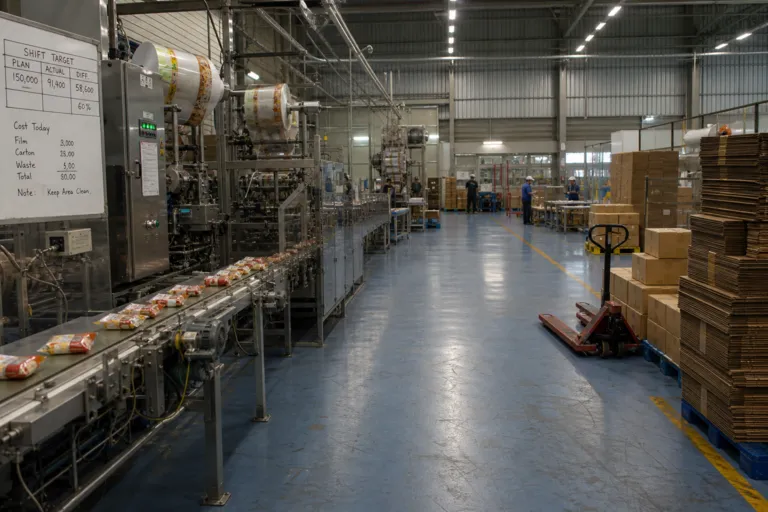
Channel and format choices also shape how exports and domestic sales can scale. Mordor Intelligence reports that, globally, supermarkets and hypermarkets captured 42.82% of 2025 sales, yet online retail stores are positioned to grow at an 11.01% CAGR through 2031. Packaging is part of the same equation: Mordor shows packets accounted for 63.72% of 2025 revenue, while cup and bowl formats are expected to register a 10.78% CAGR to 2031; Market Research Future similarly highlights cup and bowl growth (9.90% CAGR to 2035) and notes packets generated USD 32.10 billion in 2025 revenue globally. For Thai exporters, these signals support a two-track approach: cost-effective packets for price-sensitive shelves, plus premium-leaning cup formats that travel well in modern retail and e-commerce.
Innovation and compliance add another layer to export readiness. Market Research Future notes a shift in production techniques from traditional deep-frying lines to air-drying and steam-flash methods, which can lower oil content by up to 40% and reduce per-unit energy usage, alongside expected investments of USD 2.3 billion in retort packaging and smart-factory automation from 2023 to 2025. Meanwhile, Tridge highlights sustainability and regulatory pressures tied to palm oil sourcing and single-use packaging waste, and MarkWide’s rice noodles overview emphasizes how differing rules (such as US FDA allergen labeling and Europe’s EFSA contaminant checks) shape market access. Together, these factors push Thailand’s exporters to align product design, labeling, and packaging with the expectations of multiple end markets.
How is Thailand’s instant noodle sector balancing price pressure with export growth?
Which channels are most important for instant noodles, and what is changing?
What packaging formats are growing fastest in instant noodles?
Why does Asia-Pacific matter so much for Thailand’s export footprint?