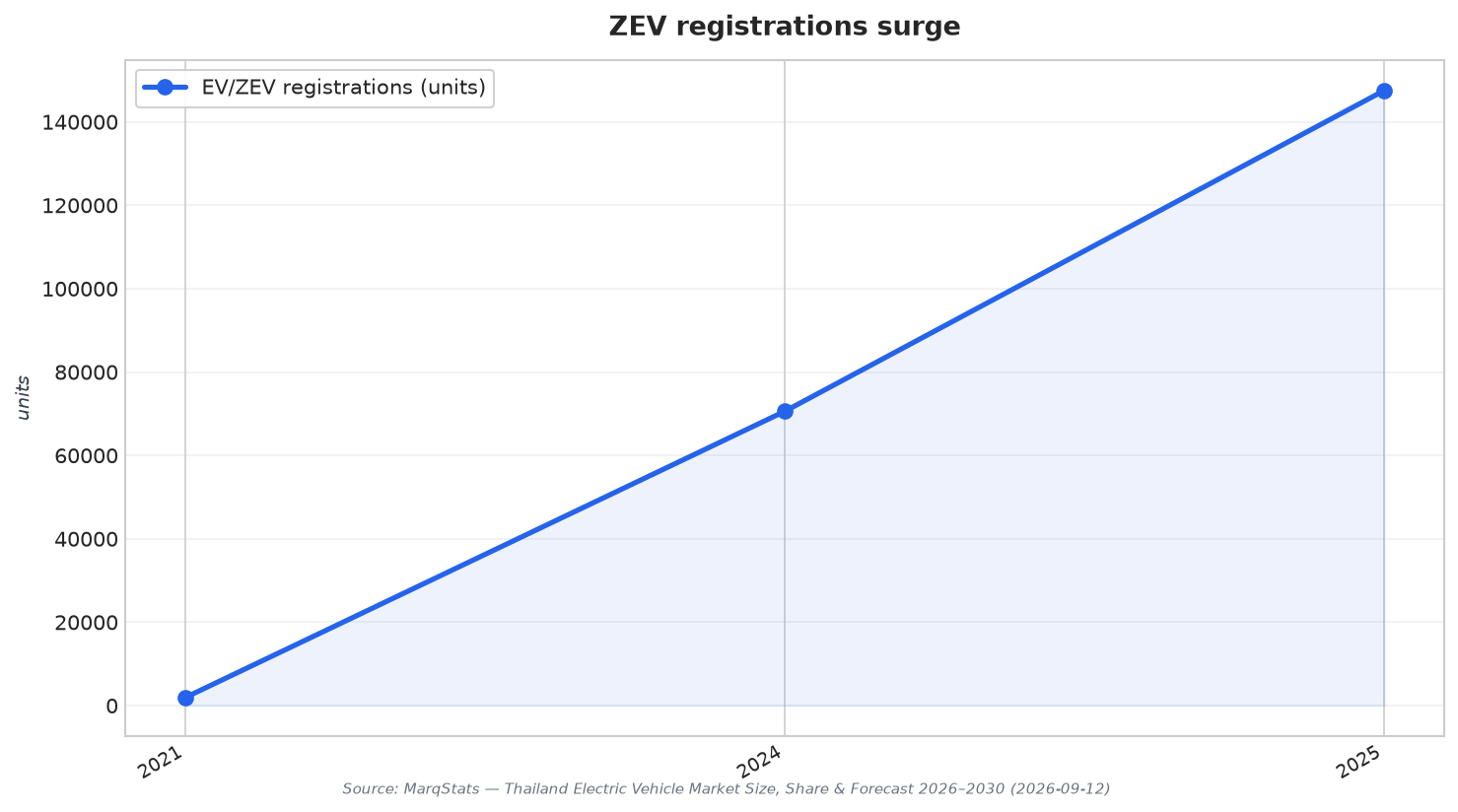
Thailand’s EV story is moving from demand-led imports toward manufacturing discipline, as EV 3.5 local production obligations begin to bite in 2026. The government’s stated direction is clear: imports should lead to domestic investment, production should expand enough for Thailand to become an EV export hub, and Thai suppliers should move into higher-value components and systems. This builds on EV3 and EV3.5 support measures that brought eight to 10 factories into the programmes, including BYD, MG, and GWM. In parallel, administrative registration data shows how fast the market formed. ZEV passenger car and pickup registrations rose from 1,958 units in 2021 to 70,582 in 2024, while market share climbed from 0.25% to 10.87% even as the total passenger car and pickup market contracted sharply.
That demand spike set up a new problem: too many vehicles could arrive before domestic capacity can absorb them. Local reports cited by the BOI pointed to industry fears of a domestic supply glut after significant investment in production capacity, mainly by Chinese brands. The policy response is to hardwire local output into the incentive design. Under the EV 3.5 framework, manufacturers must produce two vehicles locally for every one imported in 2026, rising to three-to-one in 2027. Exports are also being pulled into compliance math. For every BEV produced for export, it can count as 1.5 units toward a manufacturer’s local production obligations, up from one unit previously, explicitly aimed at incentivising exports and preventing oversupply.
Factory Buildout and Compliance Rules Reinforce the Export Pivot
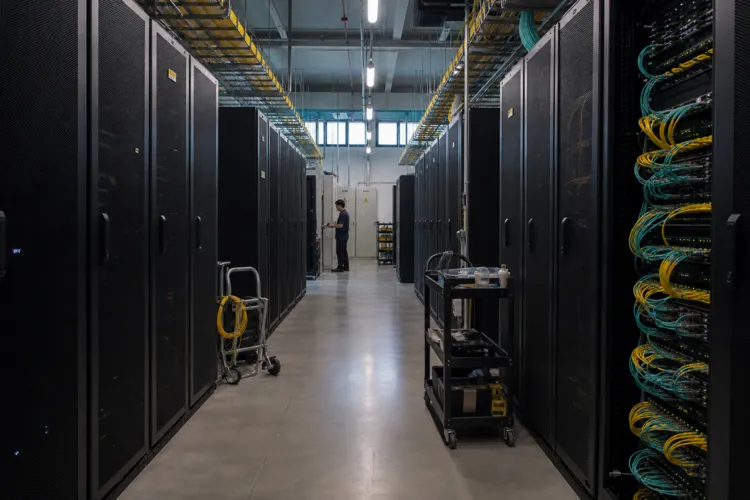
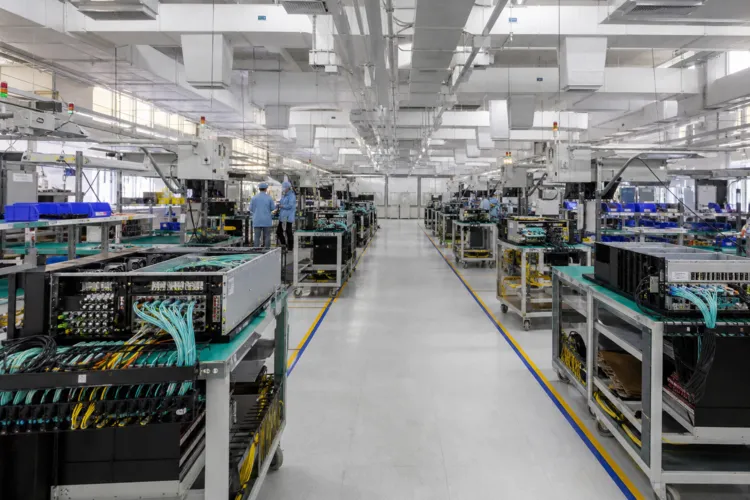
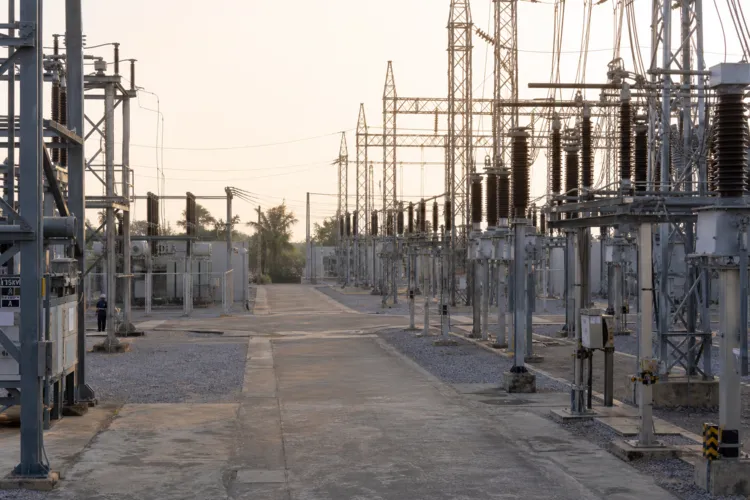
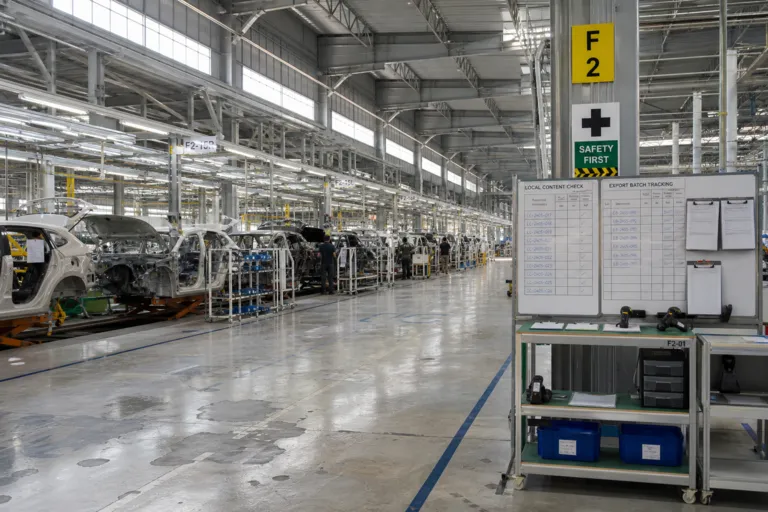
Policy tightening is landing at the same time as a visible wave of factory announcements and ramp-ups. BYD completed its Rayong plant in 16 months, with 150,000 vehicles/year capacity and approximately 10,000 jobs. Changan is building a THB 10 billion Rayong NEV production base, while Neta has a 20,000-unit factory and GAC Aion has a 50,000-unit plant. Marqstats describes Thailand as an “incentives-to-industry” archetype where sales incentives are explicitly tied to local production and supply-chain localisation. That framing matters for Thailand EV export production because the new export credit (1 export vehicle equals 1.5 units toward obligations) makes overseas shipments a practical tool for manufacturers to balance production ramp with softer near-term domestic absorption.
The rule changes also reach into how localisation is measured and how incentives are paid. Imported battery cells can continue to count toward local content until 30 June 2026, but beginning 1 January 2026 only 10% of an EV’s factory price can come from imported cells, reduced from 15%. Authorities also tightened enforcement by linking money to performance: subsidy disbursements from the Excise Department will be delayed if production targets are not met. Deadlines were adjusted as well, with extended registration windows described as a way to support year-end sales and ease administrative bottlenecks. Alongside these controls, investment scale is substantial, with cumulative investments reported at 140 billion THB across 32 EV 3.0 and 11 EV 3.5 manufacturers, and another estimate saying commitments surpassed THB 137 billion.
Market indicators show why manufacturers may increasingly look outward. BEV sales were almost 90,000 units in the first ten months of 2025, accounting for more than 18% of total vehicle sales in Thailand in that period. Another dataset states BEV registrations in 2025 rose approximately 53% year-on-year to around 147,500 units, while a policy note reports that between January and September 2025, EV registrations surged 59% compared to the same period in 2024. Yet domestic demand is described as weakening due to high household debt, tighter lending, and rising energy costs linked to Middle East geopolitical disruptions. In that environment, export-linked compliance and new plants become a route to keep lines running while meeting obligations.
How is EV 3.5 pushing Thailand toward an EV export base?
What are the EV 3.5 local production ratios for 2026 and 2027?
Which factory capacities are being built or expanded in Thailand?
What battery localisation limits apply under the updated rules?
What indicators show the market momentum that set up today’s policy shift?