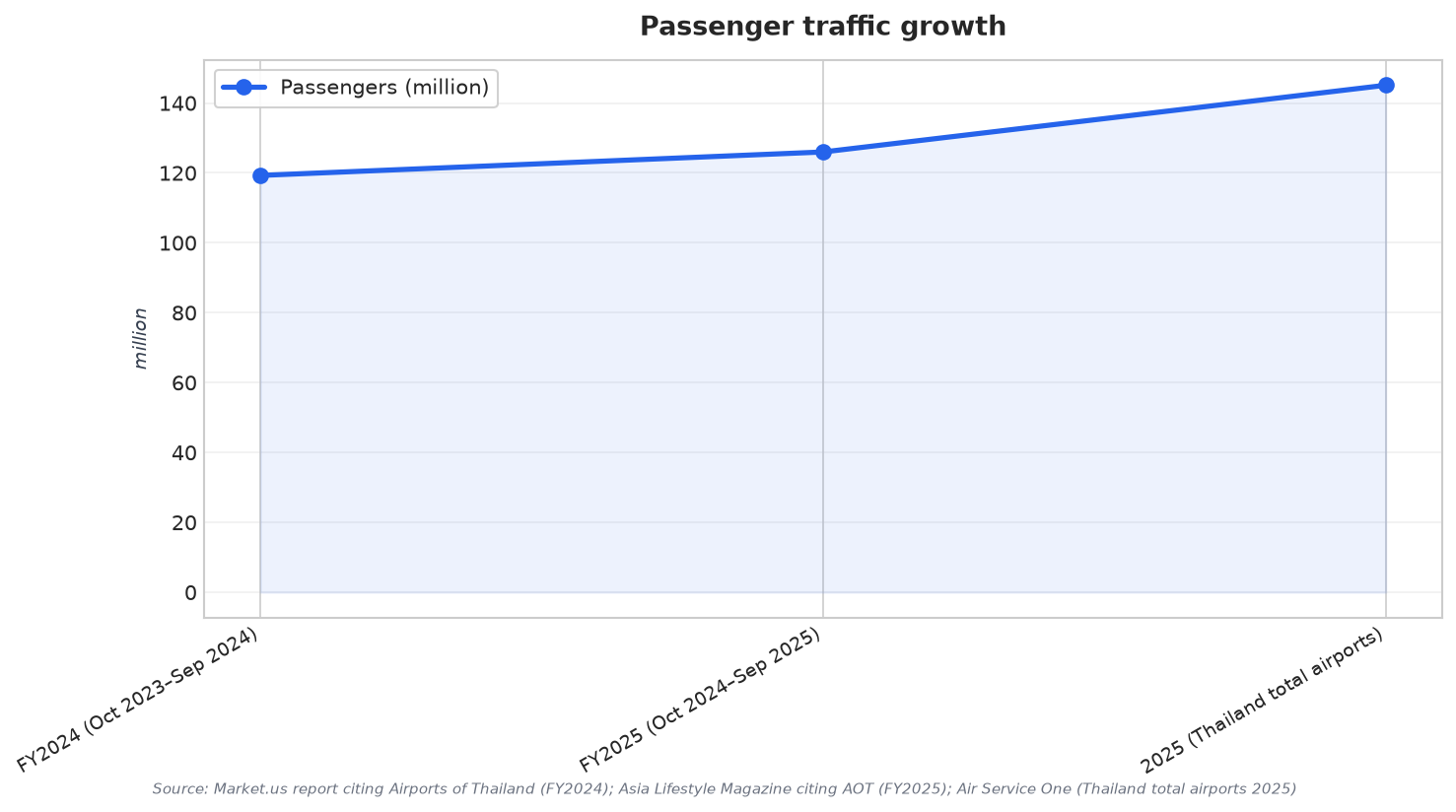
Thailand’s aviation system is being pushed by a tourism-led rebound that is now visible in multiple official and industry-reported passenger tallies. Airports of Thailand (AOT) handled 119.29 million passengers in FY2024 (Oct 2023–Sep 2024), up 19.22% year-on-year, according to an industry report cited in a Thailand tourism market overview. AOT then reported 126 million passengers across its six major airports in FY2025 (Oct 2024–Sep 2025), an 11% year-on-year increase. Separately, a sector-wide snapshot put total travellers handled by Thailand’s airports at 145.1 million in 2025, up from 140.6 million a year earlier, while still below a pre-pandemic peak of 161.8 million.
Those rising volumes help explain why Thailand airport expansion has become a practical necessity rather than a long-term ambition. AOT’s FY2025 figures also show why planners are balancing growth with volatility. In Q4 FY2025, AOT recorded 28.75 million passengers, down 1% year-on-year. The mix shifted, too: international passengers fell 5% year-on-year while domestic passengers rose 5%. Financial performance reflected that uneven demand pattern. AOT’s aeronautical revenue for FY2025 was 68.59 billion baht, up 1.12% from the prior year, even as total passengers increased 11%, pointing to competitive pricing and shifting passenger mix.
Bangkok’s Capacity Relief Meets a More Distributed Tourism Map
Capacity additions are being framed as relief for Bangkok’s constrained system while preserving the role of key hubs. One major project is Don Mueang Airport’s Terminal 3, which is designed to handle up to 50 million passengers per year once complete and is expected to open in the 2030s. Beyond Bangkok, the map of demand is also spreading. Thailand’s secondary airports are increasingly important to a tourism-driven model, and fast-growing airports such as Samui and Krabi have exceeded pre-pandemic passenger levels, according to sector reporting. That diversification reduces reliance on Bangkok-centric flows and aligns with route strategies that aim to send more visitors directly to provincial destinations.
Airline scheduling and network planning are also adapting to congestion and seasonal surges. One report described coordinated route expansion intended to bypass Suvarnabhumi Airport congestion by funnelling international tourists into the provinces, timed to a projection of 36.7 million tourists in 2026 and described as aligned with the Tourism Authority of Thailand’s goal for the same year. Near-term peak travel illustrates the operational pressure. AOT projected that over 4.11 million passengers would travel through its six main airports during the Lunar New Year period from 13 to 22 February, with Chinese routes expected to account for over 679,000 travellers across the network.
Commercial airport activity is strengthening alongside passenger throughput, reinforcing why expansion plans are tied to both capacity and spending. Thailand’s travel retail market was valued at USD 3.28 billion in 2025 and was estimated at USD 3.62 billion in 2026, with a forecast to reach USD 5.84 billion by 2031, according to Mordor Intelligence. Airports held a 65.42% share of travel retail distribution in 2025, and that channel is projected to post the highest CAGR at 9.18%. As airports and airlines work through fluctuating quarterly demand, these figures underline the strategic logic: adding capacity is not only about moving people, but also about protecting the wider ecosystem built around aviation-led tourism flows.
What passenger growth is pushing Thailand’s airport expansion plans?
How did AOT’s FY2025 Q4 performance differ from the full year?
Which project is cited as a major capacity relief step in Bangkok?
How big is the Lunar New Year travel surge expected to be across AOT airports?
What do the travel retail figures suggest about airports’ role in tourism recovery?