
The Thailand auto finance market is being pulled in two directions at once. Financial institutions have “significantly tightened” lending criteria, contributing to high rejection rates for hire-purchase loans, even as the country’s vehicle market posts sharp gains driven by EV deliveries. January 2026 domestic automotive market sales surged 53.77% year-on-year, and another report attributed a 54% January rebound mainly to a surge in deliveries of EVs bought before the EV3.0 incentive expired at the end of 2025 and was replaced by EV3.5 with lower incentives. The rebound comes after two years of sharp declines, when highly indebted consumers and small businesses struggled to access financing after banks tightened lending rules.
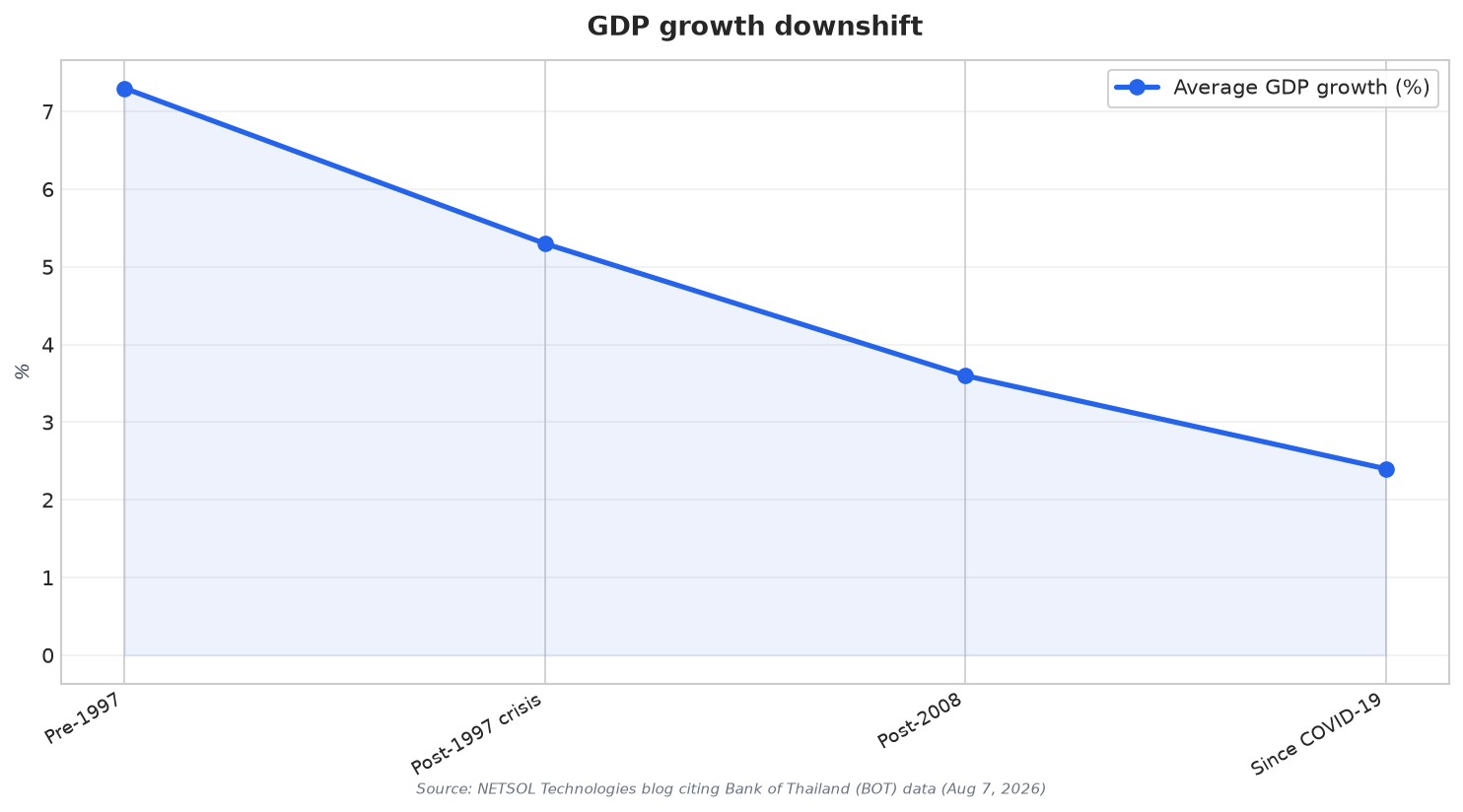
Macro conditions help explain why underwriting has turned conservative. Bank of Thailand data cited in an industry briefing shows growth averaging 7.3% before 1997, 5.3% after Tom Yum Kung, 3.6% after 2008, and 2.4% since COVID-19. The Bank of Thailand’s Monetary Policy Committee forecast projects 1.8% growth for 2026 and 2.0% for 2027. High leverage remains a constraint: household debt peaked at 94.6% of GDP in 2021 and eased to 86.7% by end 2025, still above the 80% threshold referenced by the Bank for International Settlements. In this backdrop, lenders are recalibrating approval standards, down payments, and affordability checks rather than chasing volume.
Tighter Credit Meets a Rapid Shift in Vehicle Mix
Credit tightening is also changing what sells, and therefore what gets financed. A 2026 market review notes pickup sales remain depressed by tightened auto lending, a key issue because pickups have high local content. Another industry briefing using Federation of Thai Industries and Automotive Industry Club data shows the mix shift clearly: pickups, once 43% of sales share between 2010 and 2022, fell to 23% by 2025, while passenger cars climbed to 65%, lifted by EVs and hybrids. It also said electric vehicles became the majority of new car registrations for the first time. For lenders, that mix matters because EV pricing, residual values, and borrower profiles can differ from legacy segments such as heavy-duty pickups.
Production and sales trends add another layer of pressure to loan books and dealer pipelines. 2025 full-year vehicle production was 1,455,569 units, down 0.9%, and first-half production in 2026 was 717,212 units, down 1.04%. Exports have been a drag, while domestic sales were reported up 14.6% in one 2026 update. In lending, the signals are mixed by segment. One briefing said auto hire purchase was the only consumer-credit segment still contracting, while another report cited Tris Rating expecting auto hire-purchase lending to remain flat in the second half of 2025 due to cautious practices, weak purchasing power, a glut of used cars, and limited truck demand. Tris also said used-car non-bank financial institutions still face challenges with elevated and volatile NPL ratios.
Used vehicles are increasingly central to the credit story, partly because financing frictions are pushing buyers down-market. Mordor Intelligence valued Thailand’s used car market at USD 5.51 billion in 2025 and estimated growth from USD 5.86 billion in 2026 to USD 8.27 billion by 2031, at a 7.13% CAGR. Its analysis links elevated household debt and significantly high auto-loan rejection rates with more repossessions and a shift from new cars toward competitively priced pre-owned options. It also reported that offline transactions accounted for 83.37% of bookings in 2025 and that unorganized vendors held a 67.71% share that year. For finance providers, this means tighter underwriting is colliding with demand that is migrating toward older inventory, different channels, and a broader spectrum of credit risk.
Why are lenders tightening in Thailand’s auto finance sector even as sales rebound?
What drove the strong jump in vehicle sales in January 2026?
How is tightened credit affecting pickups versus passenger cars?
What does the data say about Thailand’s used car market direction?
What are expectations for Thailand auto finance market activity in 2025-2026?