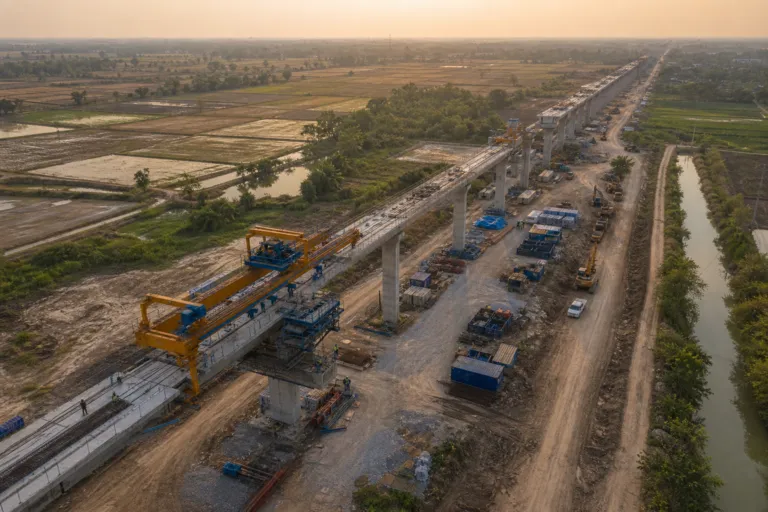
Thailand is building its first high-speed railway on the northeastern corridor, starting with the Bangkok–Nakhon Ratchasima section of the Bangkok–Nong Khai high-speed railway. This initial phase is 253 kilometres and began construction in 2017. Progress has been uneven. The State Railway of Thailand reported 51.74% progress, while another project status update put completion at 52.4% as of March 2026. Government communications have framed this as the country’s first high-speed line and a step toward linking northward to Laos, which already has a high-speed line to Kunming in southern China.
The Bangkok–Nakhon Ratchasima build has a stated total investment value of 179.41 billion baht, and it is structured as 14 construction contracts and one train system contract. Key stations listed for the route include Krung Thep Aphiwat, Don Mueang, Ayutthaya, Saraburi, Pak Chong, and Nakhon Ratchasima. Planning references also describe a maximum operational speed of 250 km/h. Together, these elements show a project moving from plans into a defined, contract-based delivery model, even as delays have pushed the expected start of operations to 2030 in current timelines.
Phase 2 to Nong Khai and the China-ASEAN Rail Link Logic
Thailand’s second phase extends the same corridor from Nakhon Ratchasima to Nong Khai. It was approved by the Thai Cabinet in February 2025 and has passed an environmental impact assessment, according to reporting on government and parliamentary updates. The approved segment spans 357 kilometres and is priced at approximately 341 billion baht, with operations expected to commence in 2031. With a future connection at the northern border, Thai statements have emphasized that the corridor is intended to connect to neighbouring Laos, supporting a broader through-rail concept toward China.
Project documents also place the corridor within the Kunming–Singapore railway central line vision. Thailand and China signed a memorandum of understanding in November 2014 to establish a joint committee for the Thai portion of a transnational railway running from Kunming, China, to the Gulf of Thailand. In November 2015, the parties agreed to divide tasks, and a formal construction agreement was signed in 2016. Under that framework, China conducts feasibility studies and design and undertakes tunnel, bridge, and track work, while Thailand handles impact studies, land expropriation, general civil engineering and power supply, and supplies construction materials.
Operational responsibilities are also mapped out in stages. China is set to operate and maintain the system for the first three years of operation, with shared responsibility from the third to seventh years, and Thailand taking sole responsibility afterward with China advising and providing training for operations and maintenance. The corridor is described as dual standard-gauge tracks. While alternative narratives have suggested earlier opening years for Bangkok–Nakhon Ratchasima, official targets cited in 2026 reporting emphasized completing the first phase by 2030, which aligns with the wider timetable for advancing Thailand’s connection into the China-ASEAN rail link via Laos.
What is the first operational segment in Thailand’s high-speed rail plans?
How far along is construction on the Bangkok–Nakhon Ratchasima phase?
How much does phase 1 cost and how is it contracted?
When were key agreements signed for the Thai–China cooperation behind the Thailand high-speed rail project?
What is phase 2 and what has been approved so far?