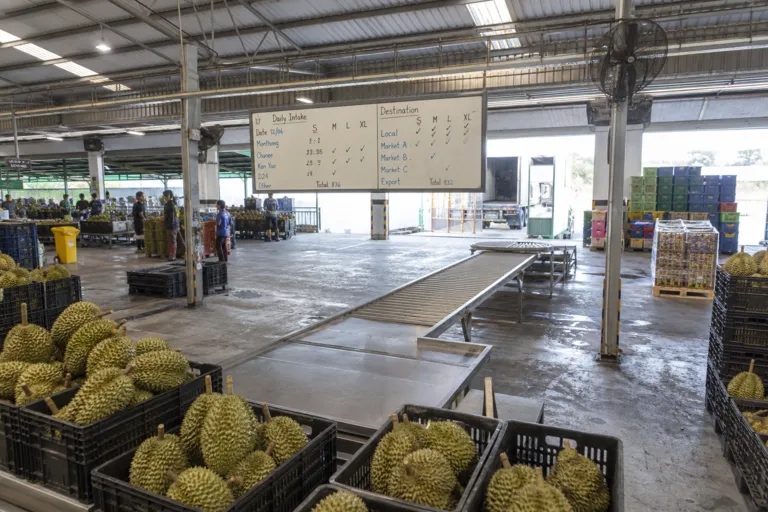
China’s appetite for durian keeps setting new highs, and that is the prize Thailand’s exporters are chasing. Customs data cited by the South China Morning Post shows China imported a record 1.56 billion kilograms of durian in 2024, up 9.4% year on year, with import value up 4.1% to US$6.99 billion. In that same 2024 picture, Thailand still mattered most, even though imports from Thailand declined 12% overall for a total value of US$4 billion. The pace of growth also cooled versus the prior surge: the report noted a 66% growth rate in 2023 after Vietnam entered the market in earnest.
By 2026, the battle was no longer only about growth. It was about managing a glut as exporters tried to offload fruit during the main harvest season. In the first half of 2026, China’s durian imports rose 47% year on year, reaching 1.07 million tonnes, up from 708,000 tonnes in the first half of 2025, according to official customs figures cited by SCMP and also reported by Bangkok Post and Malay Mail. Advisers and analysts quoted by SCMP said production in Southeast Asia has been rising faster than demand during peak season, creating downward pressure on prices. Lim Chin Khee, adviser to Malaysia’s Durian Academy, attributed easing wholesale prices in China to increased supply from several origins, higher stock levels, and more cautious consumer spending.
China’s Import Surge Puts Thailand’s Lead Under New Pressure
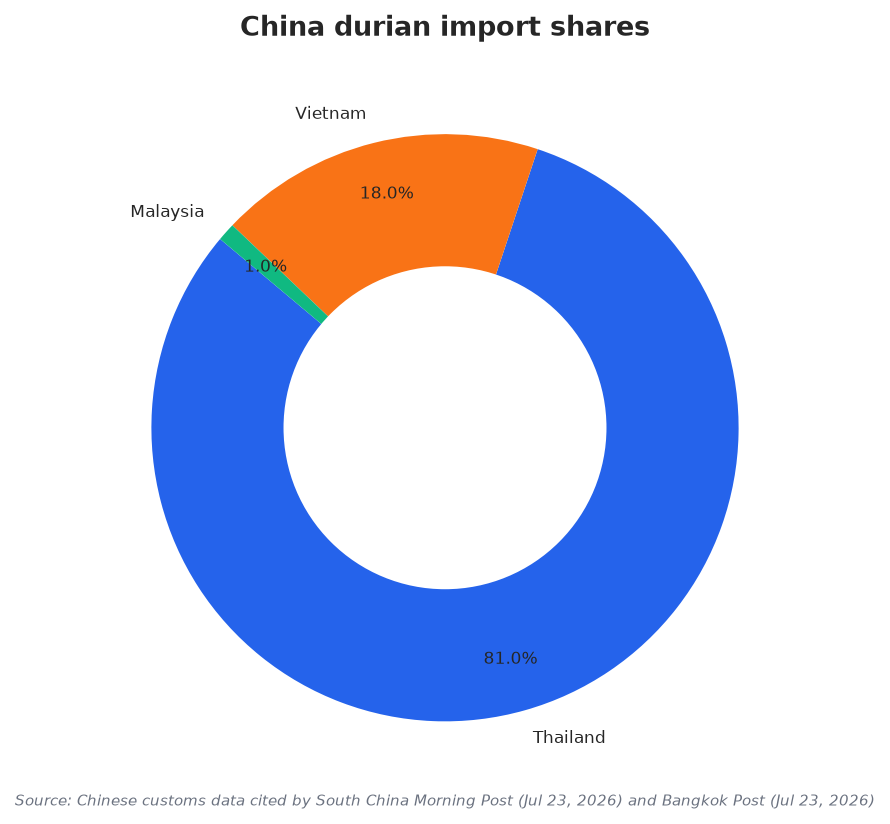
Even with heavier competition, Thailand maintained a dominant share of China’s import market in early 2026. Chinese customs data cited across SCMP, Bangkok Post, and Malay Mail shows Thailand exported nearly US$3.79 billion worth of durians to China in the first six months of 2026, representing 81% of the market. Vietnam ranked second with US$846 million, or 18%. The same reporting noted Thai shipments were US$2.56 billion in the first half of 2025, also nearly 81% of the total. Analysts quoted by SCMP said Thailand’s advantage comes from established logistics and quality-control systems that support strong consumer preference in China.
Still, the competitive map is widening, especially as Malaysia ramps up and Vietnam keeps scaling. In the first half of 2026, Malaysia shipped US$30.26 million to China, up 342% compared with the same period last year, according to customs data cited by Malay Mail and SCMP. SCMP also reported that Malaysia’s rise is linked to trees planted six to 10 years ago reaching maturity. Vietnam, approved to export fresh durians to China in 2022, has expanded quickly but has faced occasional quality issues, according to industry analysts cited by SCMP and Bangkok Post. At the same time, China’s General Administration of Customs has tightened checks after detecting excessive levels of the chemical dye Basic Yellow 2, with Thailand and Vietnam required to provide test reports and random samples inspected at all border crossings from January 10, per SCMP citing Thai media outlet Bangkok Insight.
These shifts frame the next phase for the Thailand durian export industry: defend share in a market where volumes are growing, but prices can fall when supply outpaces demand. Exporters are also operating in a trade environment shaped by logistics improvements and policy moves. SCMP reported that expansion of China-Laos Railway services and Chinese e-commerce has elevated Southeast Asia’s durian exports to China, described as the world’s biggest market with 90% of all durians consumed. On the Malaysian side, agricultural officials in Kuala Lumpur asked China’s GAC to open a land-based shipping route to shorten delivery times, and Malaysia’s prime minister pledged to raise falling prices with China’s premier during a Beijing visit, according to Bernama as cited by Malay Mail. For Thailand, the message is clear: leadership remains, but the margin for error is shrinking.
How big was China’s durian import market in 2024?
What share did Thailand hold in China’s durian imports in the first half of 2026?
Why are durian prices under pressure even as China’s imports rise?
How is Malaysia’s durian export growth changing the competitive landscape?
What are the key compliance issues shaping the Thailand durian export industry in China?