Thailand is increasingly positioned as a practical destination for companies using a China+1 approach. JLL reports industrial estate absorption surged to over 1,170 hectares in 2024, nearly triple the 2019 figure. That property signal matches an investment shift. Based on Bank of Thailand data analyzed by JLL, annual average manufacturing FDI netflows rose from USD 3.9 billion (2017–2019 average) to USD 5.1 billion (2022–2024 average), a 29% increase. In 2024, China accounted for 44% of total manufacturing FDI, adding USD 917 million annually, showing how relocation and diversification decisions are reshaping Thailand’s industrial pipeline.
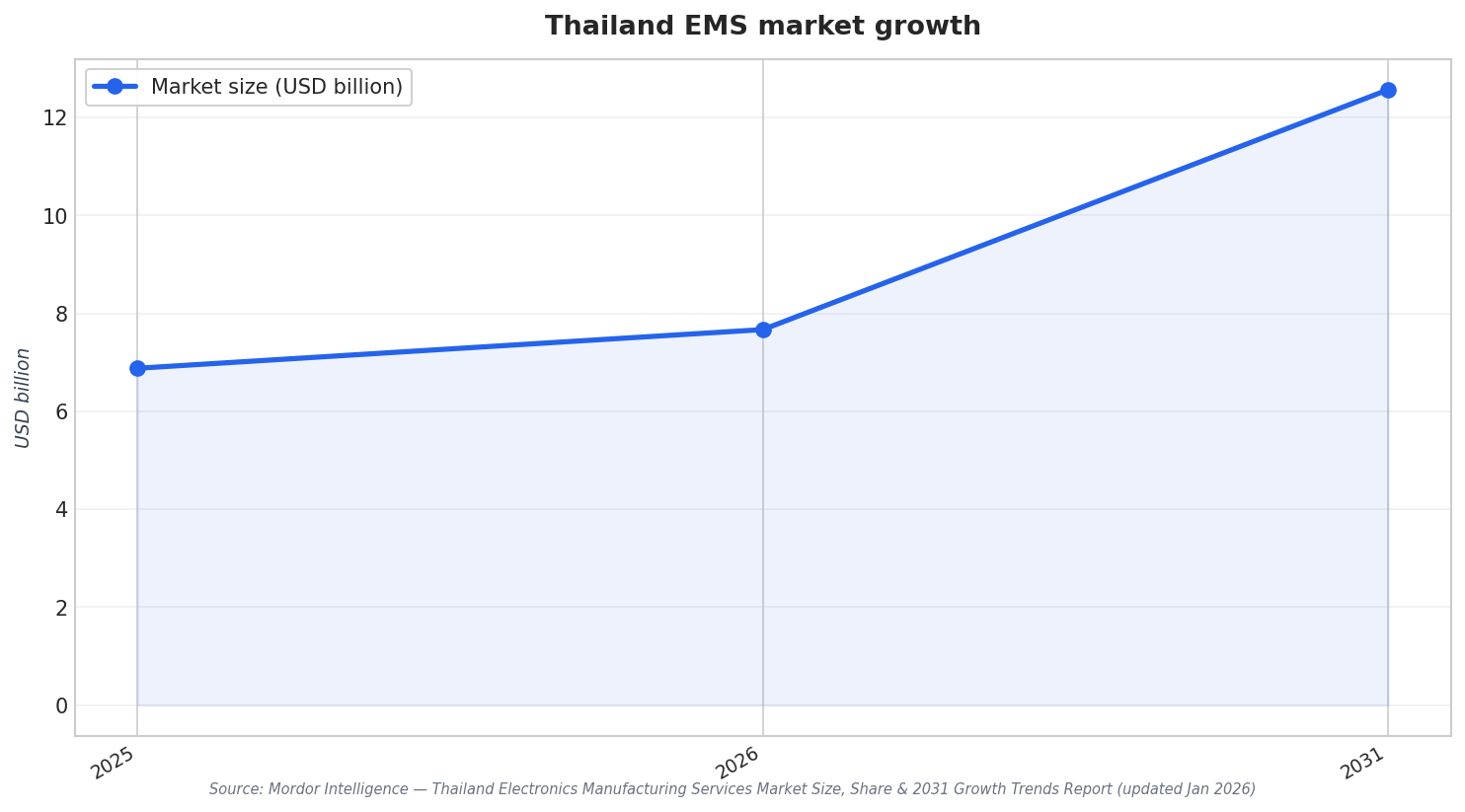
Within that momentum, electronics is a clear beneficiary. JLL finds computer and electronics manufacturing led sector gains with 68% growth compared with pre-pandemic averages, with investment linked to Singapore, the Netherlands, Taiwan, the US, and China. The same analysis shows electrical equipment growth of 70%, attracting USD 859 million annually from Singapore, Japan, China, and Hong Kong. In parallel, Mordor Intelligence estimates Thailand’s electronics manufacturing services market at USD 7.67 billion in 2026, up from USD 6.88 billion in 2025, and projects it to reach USD 12.57 billion by 2031 at a 10.38% CAGR (2026–2031). The report ties the move up the value chain to areas such as EV electronics, 5G module assembly, and medical devices.
Why The Shift Is Pulling Thailand Toward Higher-Value Electronics Work
The mix of services and processes in Thailand’s EMS base shows where buyers are placing orders. Mordor Intelligence reports printed circuit board assembly led with 41.57% share in 2025. Contract manufacturing represented 63.48% of the market in 2025, while hybrid and turnkey structures are projected to advance at a 10.93% CAGR through 2031. On the factory floor, surface-mount technology held 53.73% share in 2025, while advanced packaging is forecast to grow at an 11.07% CAGR to 2031. The same outlook notes a fragmented but “technologically uneven” field, where capabilities such as system-in-package and co-packaged optics can help secure long-term programs as customers seek agile sourcing during tight component supply.
EV-related demand is also tightening the link between automotive production and electronics output. Mordor Intelligence notes BYD began series production at its Rayong plant in July 2024 with an annual goal of 150,000 vehicles, creating pull-through demand for locally sourced printed circuit assemblies and power modules. In semiconductors, Mordor Intelligence sizes Thailand’s semiconductor market at USD 8.46 billion in 2025 and projects USD 11.79 billion by 2030 (6.90% CAGR). It also states Thailand targets 600,000 EVs per year by 2026 under EV 3.0 and EV 3.5 policies. These dynamics help explain why automotive applications in Thailand’s EMS market are poised to register a 12.17% CAGR through 2031, even as consumer electronics held a 36.89% share in 2025.
Thailand’s broader manufacturing base provides context for why China+1 investors can scale. Iconic Research says manufacturing accounts for approximately 25% of Thailand’s GDP and employs close to 10% of the workforce, with industrial estates concentrated in the Central and Eastern regions. The same source states Thailand’s main industries by export value include electronics and electrical equipment, motor vehicles and automotive parts, and processed foods, together comprising the majority of annual merchandise export revenue of over USD 280 billion. DHL adds that in January–May 2025, 426 foreign entities were approved to operate businesses under the Foreign Business Act 1999. Taken together, these indicators point to a supply chain that is already deep, and now being pulled toward higher-value work as diversification accelerates.
What signals show Thailand is benefiting from the China+1 shift?
How large is the electronics manufacturing services market in Thailand?
Which electronics services and processes lead in Thailand today?
How is EV production influencing electronics and semiconductor demand in Thailand?
What is changing in Thailand electronics manufacturing as buyers diversify away from mainland China?