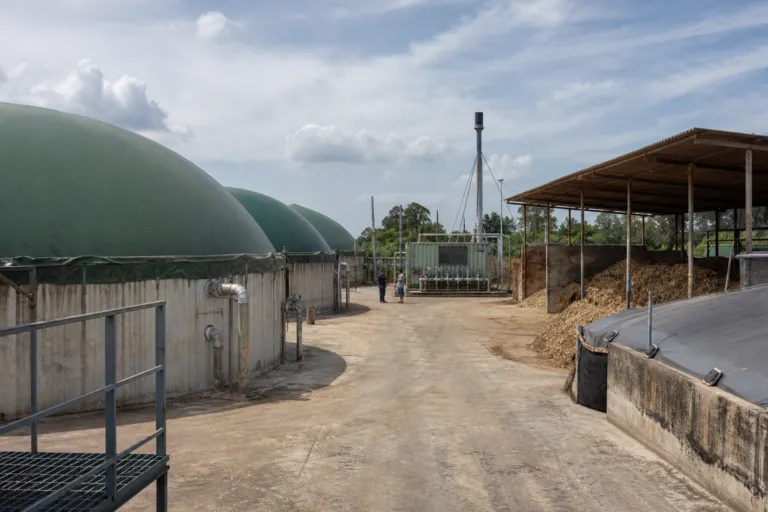
Thailand’s push to improve waste handling is creating clearer space for biogas projects that turn organic materials into useful energy. A Thailand waste management market report values the national market at USD 18.28 billion in 2023 and projects it will reach USD 34.83 billion by 2030, at a CAGR of 8.60% from 2024 to 2030. That same market definition includes waste-to-energy plants as a core component, alongside collection, processing, recycling, and disposal. In parallel, global biogas market commentary links growth to rising energy demand, environmental concerns, and government support for renewable energy adoption, with anaerobic digestion positioned as a technology that supports both energy generation and efficient organic waste management.
Feedstock availability is central to how Thailand can scale anaerobic digestion. Biogas is produced from the anaerobic digestion of organic materials such as agricultural waste, animal manure, municipal solid waste, sewage sludge, and food waste. For Thailand, this matters because rising municipal solid waste volumes are associated with accelerating urbanization and tourism pressure in places such as Bangkok, Pattaya, and Phuket. Policy pressure is also rising on the materials side. Thailand has enforced a national roadmap to ban single-use plastics and reduce plastic waste by 100% by 2027. While plastics are not a biogas feedstock, the roadmap helps drive investment into sorting and higher-quality waste processing systems that can also improve the capture and routing of organic fractions into treatment pathways such as anaerobic digestion.
BOI Investment Momentum and Clean Energy Project Readiness
Investment activity provides a useful signal for how quickly clean energy and circular economy projects can be financed and built. In the first half of 2026, Thailand’s foreign and domestic investment applications surged 37% year-on-year to $43.6 billion across 1,299 projects, according to a BOI-referenced update. Foreign direct investment applications increased 80% year-on-year to $40.5 billion across 877 projects. While this surge was led by digital infrastructure, agriculture and food processing still secured $1.82 billion across 131 projects. For biogas developers, that matters because large agricultural operations and food-processing sites are common sources of organic residues, and investment momentum in these sectors can support project origination, contracting for waste streams, and the build-out of on-site or cluster-based energy recovery solutions.
Thailand’s biofuels landscape also places biogas alongside other renewable options, which can help normalize policy support and private investment interest. A Thailand renewable biofuels market breakdown segments the market into biodiesel, bioethanol, biogas, biomass pellets, waste-to-biofuel, and other emerging fuels. It identifies Bangkok, Chiang Mai, and Nakhon Ratchasima as key production and distribution hubs, supported by infrastructure, strategic locations, and proximity to agricultural resources. In practice, that hub structure can help biogas projects connect to equipment suppliers, engineering capacity, and end users, while keeping feedstock logistics practical. It also aligns with the broader global trend in which biogas market expansion is associated with incentives, subsidies, and supportive laws that encourage waste-to-energy and circular economy practices.
Regional and international comparisons underline that Thailand is not alone in building systems around organic waste. A biogas plant market report describes Southeast Asian countries, including Thailand and Indonesia, as emerging markets due to agricultural-based economies and supportive government policies for renewable energy development. Globally, Europe is described as the leading region in the biogas plant market with projected growth of approximately 3% annually from 2024 to 2029, while the United States is noted as having over 2,200 biogas facilities. Outside Thailand, examples such as Gujarat operationalizing 193 biogas facilities and planning to add 60 more show how government-linked programs can accelerate buildout using organic waste like agricultural residues and cow feces. For the Thailand biogas industry, the takeaway is practical: scaling depends on reliable feedstock capture, bankable project structures, and policy frameworks that reward clean energy and better waste outcomes.
What is driving growth opportunities for biogas in Thailand?
Which waste streams can be used to produce biogas?
How do BOI investment trends relate to clean energy projects such as biogas?
Which Thai locations are identified as biofuel production and distribution hubs?
How is the Thailand biogas industry positioned compared with other regions?