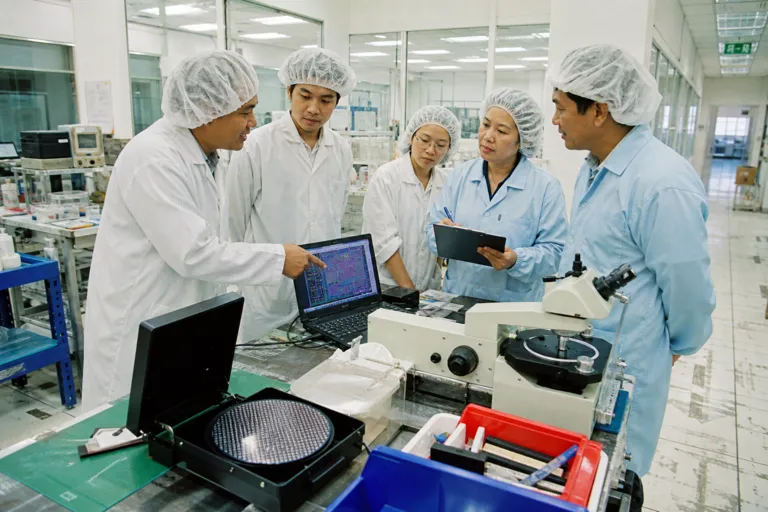
Thailand is moving decisively in 2025 to elevate its role in the global semiconductor value chain. A national push spans strategy design, workforce development, incentives in the Eastern Economic Corridor (EEC), and targeted investment attraction. SEMI reports that the Thailand Board of Investment (BOI) signalled early in the year that a semiconductor sector strategic plan would be drafted within 90 days to guide policy, incentives, and ecosystem build-out. The direction is clear. Thailand wants to move from primarily downstream electronics and legacy back-end work toward higher-value advanced packaging, power electronics (Si/SiC), and selective front-end capacity.
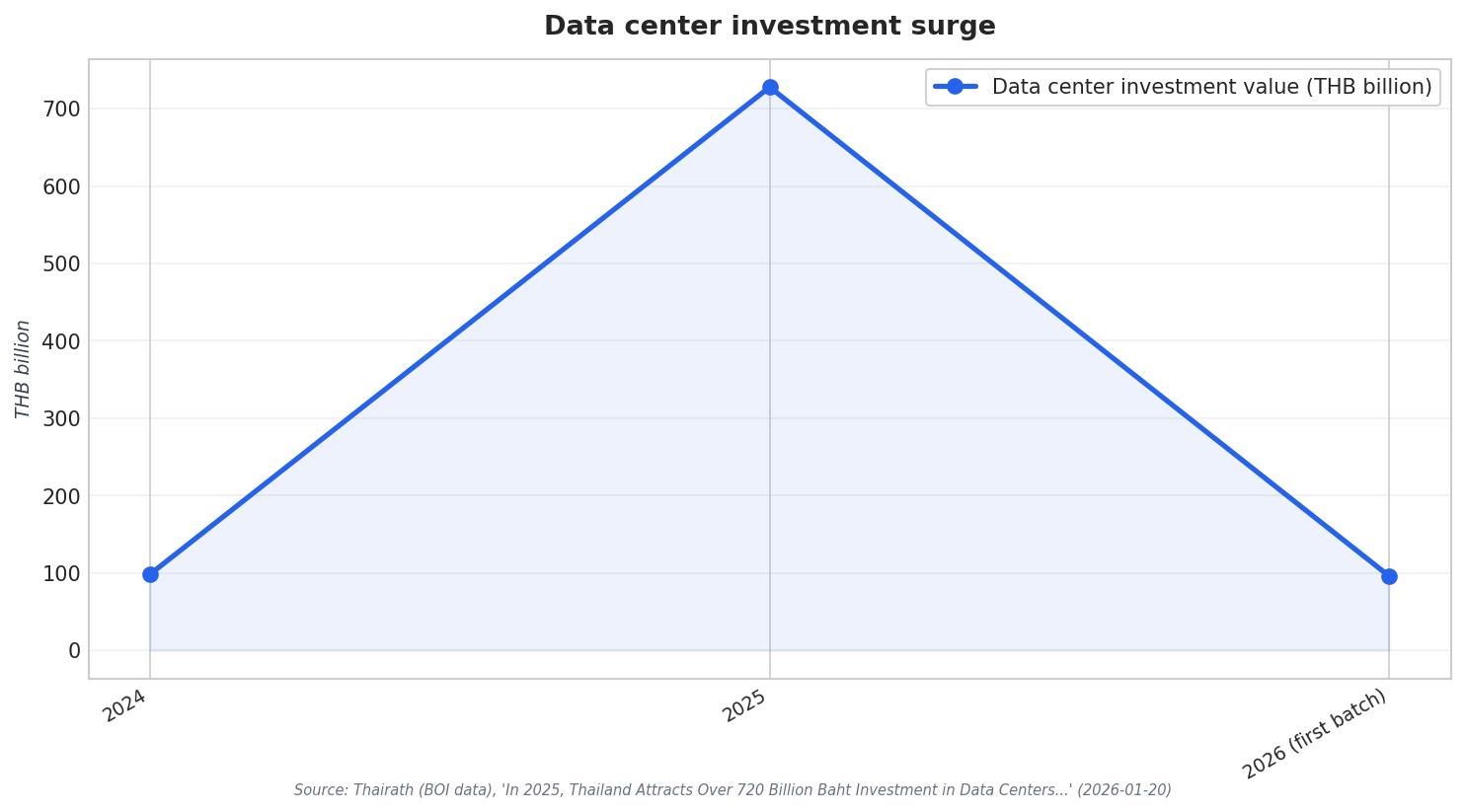
Demand-side momentum is strengthening the case for more local chip-related investment. SEMI notes that in January, the BOI announced a THB126.8 billion (USD3.76 billion) TikTok data-hosting project. It was described as a flagship within a wave of approvals that includes hyperscale data centres from global players, which can accelerate demand for power electronics and advanced modules adjacent to semiconductor production. SEMI also reports that authorities approved USD2.7 billion in data centre and cloud projects in March. Separate BOI data cited by ThaiRath shows 36 applications for data center investment promotion in 2025 totaling 728 billion baht, compared with 98.539 billion baht in the previous year, with projects spread across Rayong, Chonburi, Pathum Thani, and Samut Prakan.
BOI Incentives and the Roadmap Shift the Focus Upstream
Thailand’s policy narrative is now explicitly upstream. Nation Thailand reports that the draft “National Semiconductor Roadmap 2050” is a 25-year strategy intended to transform Thailand from a contract assembler into a technology owner under “Made-in-Thailand Chips.” The plan initially focuses on strengthening assembly and testing (OSAT) and IC design, while setting a long-term goal of developing upstream wafer fabrication. It recommends focusing on five key chip groups—Power, Sensor, Photonics, Analogue, and Discrete—to support Thai industries such as automotive, electronics, and AI. The same reporting highlights incentives including long-term support funding and low-interest loans to attract targeted projects.
Market indicators and supply-chain initiatives are adding practical pathways for that ambition. Mordor Intelligence estimates Thailand’s semiconductor market size at USD 8.46 billion in 2025, projected to reach USD 11.79 billion by 2030 at a 6.90% CAGR. It also states that integrated circuits led with a 52% share in 2024, while automotive represented 26% of the market size that year. The same source says Thailand targets 600,000 EVs per year by 2026 under EV 3.0 and EV 3.5 policies, and reports that the Hana Microelectronics–PTT joint venture is building the country’s first silicon-carbide wafer facility valued at THB 11.5 billion. This connects EV demand to power-semiconductor capability and reinforces why the Thailand semiconductor industry is being positioned around power devices and adjacent upstream steps.
Execution will depend on talent, energy readiness, and investor confidence. Nation Thailand reports a 2-billion-baht workforce development programme to produce 100,000 high-skilled workers through more than 1,000 certified upskilling courses in AI, digital technology, and semiconductor engineering, while using LTR and Smart Visa schemes to attract international experts for knowledge transfer. On the investment-promotion front, Nation Thailand reports that a high-level Thai delegation visited the US to meet firms including Phononic, GlobalFoundries, and Teradyne, inviting them to expand or establish upstream chip manufacturing in Thailand and to cooperate on developing Thai personnel and entrepreneurs. The same report notes the US accounts for more than half of global chip market revenue and that BOI joined SEMI in March, aligning Thailand’s outreach with global networks and standards.
What is Thailand trying to change in its semiconductor value chain position?
Which incentives are highlighted for attracting targeted chip projects?
How large is the data center investment wave tied to BOI applications in 2025?
What concrete upstream step is already underway for power semiconductors?
What workforce plan supports the Thailand semiconductor industry push?