Thailand’s auto industry is recovering unevenly, and one-ton pickups are the clearest laggard. AAA Weekly reported that Thailand’s automobile sales recovered in 2025 to 621,000 units, up 8.5% year-on-year, with momentum linked to government BEV subsidies and excise tax incentives for HEVs. In contrast, the one-ton pickup segment continued to decline, with the same report pointing to persistent loan tightening. LHB Business Research also described one-ton pickups contracting for a third consecutive year, weighed down by fragile purchasing power among farmers and small business operators and persistently tight lending standards among financial institutions.
The strain shows up in 2026 domestic figures even when overall activity improves. Nation Thailand reported vehicle sales of 48,242 units in February 2026, down 2.17% from a year earlier, and linked weak demand to tighter lending, low economic growth, purchase delays amid political uncertainty, and inflationary pressure from energy prices. In the same month, pickup sales fell 1.41% to 12,998 units, even as the report noted electric pickups rose 168.57% from a low base. MarkLines also tied pickup and ICE passenger vehicle declines to tighter lending conditions amid sluggish economic growth and weak purchasing power, despite a broader sales lift linked to accelerated EV deliveries under incentive schemes.
Production Holds Up, but Exports and Pickups Carry the Load
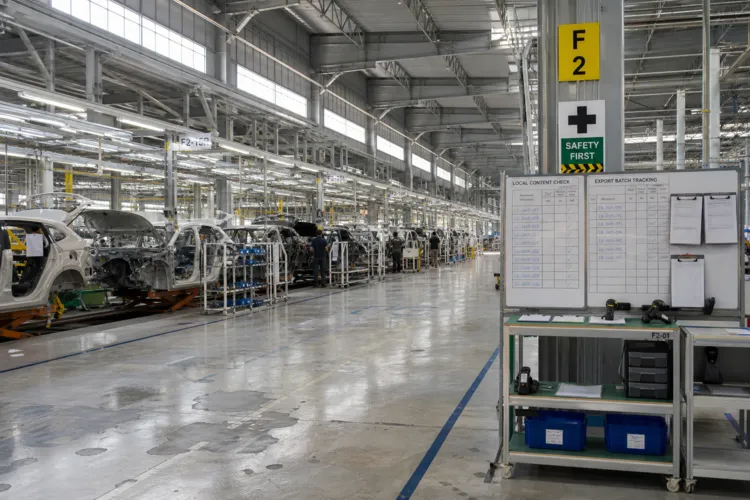
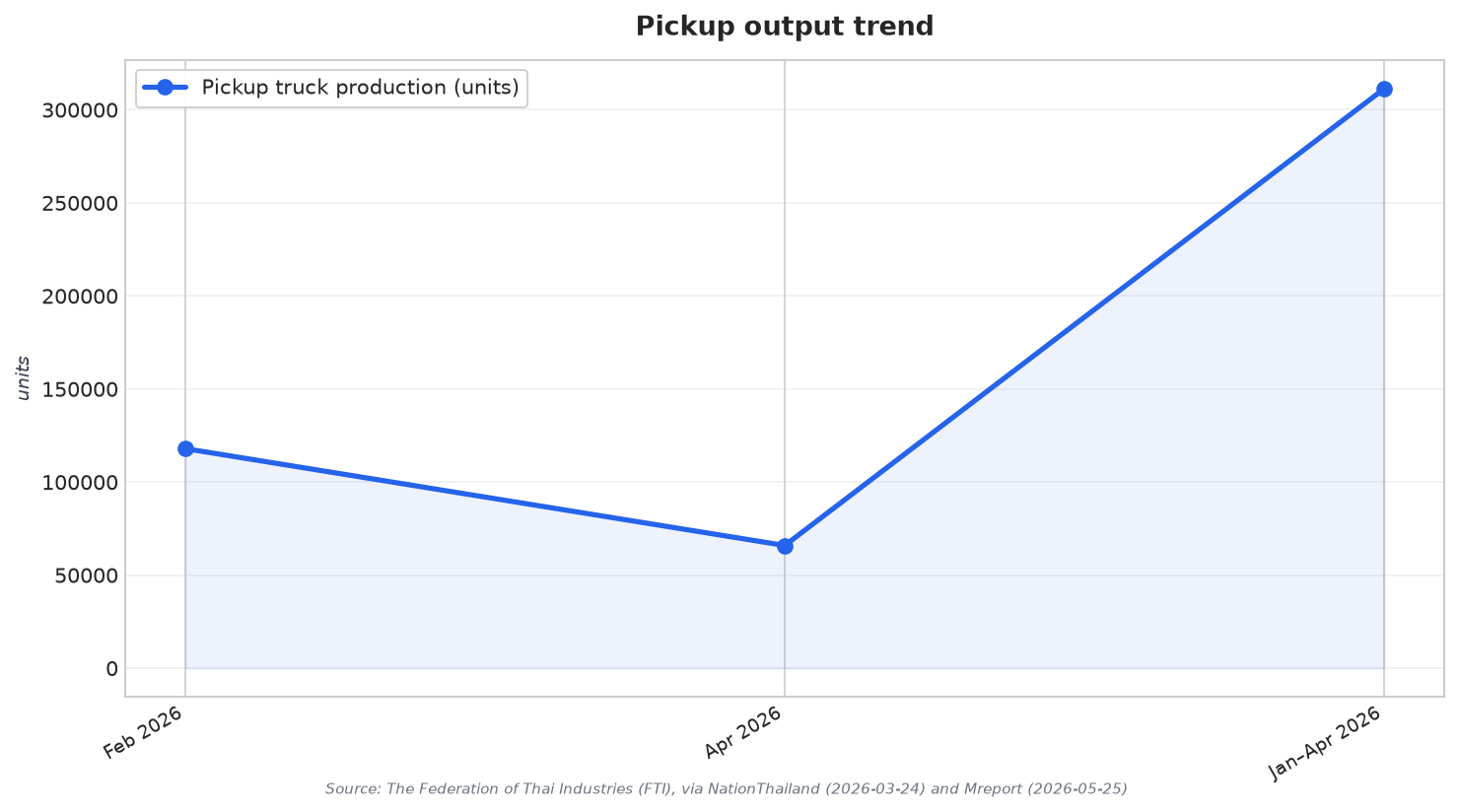
While demand is soft, production data still underscores how central one-ton pickups are to Thailand’s manufacturing base. The Federation of Thai Industries (FTI) said total vehicle production reached 103,794 units in April 2026, down 22.20% from March and 0.44% year-on-year, reflecting weaker domestic demand and export uncertainty. Yet one-ton pickup truck production remained the backbone, totaling 65,933 units in April and 311,290 units in January–April 2026, or 65.74% of total vehicle output. In February 2026, Nation Thailand similarly noted that one-ton pickups accounted for more than 66% of total output, reinforcing how production strength can coexist with weak financing-driven demand.
Export dependence adds another layer of risk. In April 2026, vehicles produced for export totaled 67,262 units, or 64.80% of total production, and January–April export-oriented production reached 316,605 units, or 66.86%, according to the FTI report. Nation Thailand put a value on exports too, saying the total value of automotive exports stood at 78.155 billion baht, down 5.90%, while noting that pickup trucks represented 63.39% of shipments to the region. The same FTI update warned that geopolitical risks in the Middle East, including conflict and the closure of the Strait of Hormuz, have affected pickup exports and could jeopardize export production targets if the situation persists for more than three months.
The soft new-truck cycle is also reshaping the used market, which matters because it can become a pressure valve when lenders tighten on new loans. Mordor Intelligence said pickup sales have seen a substantial decline, flooding the used market with trucks available to rural operators at more accessible prices, and it specifically referenced a 41.6% sales collapse in October 2024 that added supply for rural buyers. The same source said the Bank of Thailand’s Used Vehicle Price Index has shown a notable rebound, hinting at tighter supply once new-car production sees a modest recovery. Together, these signals suggest the Thailand pickup truck market is still searching for a floor, with financing conditions and rural purchasing power setting the pace more than factory capacity.
What is weighing on Thailand’s one-ton pickup demand the most?
How large is pickup production within Thailand’s vehicle output in 2026?
Are pickup sales improving in early 2026?
Why does export risk matter for pickups built in Thailand?
What is happening in the Thailand pickup truck market as buyers shift to used vehicles?