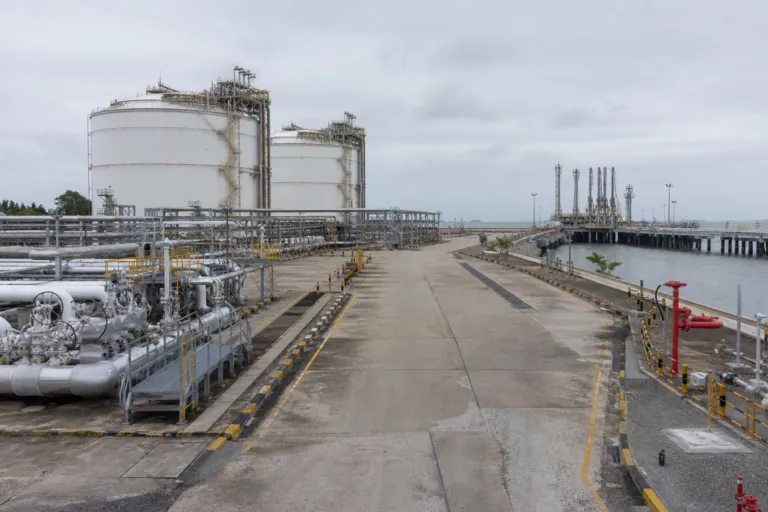
Thailand’s electricity system has increasingly been built around natural gas and imported LNG, a change driven by both legacy decisions and present-day resource constraints. After the discovery of natural gas in the Gulf of Thailand in 1973, the Erawan field became a cornerstone of domestic supply, with estimated recoverable reserves of 1.5 trillion cubic feet. PTT invested in a 425-km subsea pipeline connecting Erawan to Rayong Province, and production began in 1981, enabling gas-fired power generation at Bang Pakong. By the 1990s, Erawan output exceeded 700 million cubic feet (19.8 million cubic metres) per day at its peak. Over time, however, domestic supply has faced depletion pressures, while a portion of “wet gas” has also been directed toward gas separation and petrochemical uses, tightening availability for power.
As domestic fields aged, Thailand began importing gas in the early 2000s, first via pipeline from Malaysia, and then via LNG starting in 2011 when the country’s first LNG terminal began receiving vessels from Qatar. In both value and volume terms, Qatar accounted for almost all of Thailand’s gas imports as recently as 2017, before supplier diversity increased in the 2020s with Malaysia regaining share and Australia and the US becoming important LNG suppliers. The long-run shift in power generation is clear: natural gas accounted for less than half of the national power-generation mix in 1990, but by 2026 it had climbed to almost two-thirds. Over the last 10 years, Thailand’s natural gas imports rose with a 4.7% CAGR from 2015 to 2024, underscoring a structural pivot toward external supply.
Import Exposure Forces a New Definition of Energy Security
Energy security planning is now being reshaped by how quickly imported LNG is becoming central to Thailand’s gas balance. The share of imported LNG in Thailand’s gas mix is expected to climb to 60% by 2035 from around 40% in 2024. Infrastructure expansion is part of the response, including development of a third LNG terminal with an initial capacity of 5 mmtpa and a planned expansion to 10.8 mmtpa in the future. But higher dependence brings strategic risks. Thailand’s LNG trade with the US grew sharply between 2021 and 2024, with a CAGR of 121% in values, highlighting how shifts in supply relationships can accelerate. Analysts also warn that larger import dependence can expose the country to supply disruptions driven by geopolitical manoeuvring around energy supply chains.
Affordability risk is equally central to the Thailand LNG import market story, because global LNG can become expensive or scarce during shocks. The 2022 global energy crisis showed how quickly conditions can tighten: Asian spot LNG prices averaged $34 per MMBtu in 2022, more than double the annual average in 2021, and Asian LNG demand fell from 270 million tonnes in 2021 to 250 mt in 2022. Thailand’s vulnerability is amplified by shipping-route concentration. Krungsri Research estimates Thailand imports approximately 2.2 million tonnes of LNG annually through the Strait of Hormuz, equal to 24% of total LNG imports. That exposure matters for electricity tariffs and industrial competitiveness, because higher LNG prices can feed into broader costs across the economy.
Thailand’s energy security strategy is also being reframed beyond fuel procurement, because reliability is threatened by climate hazards alongside import volatility. The International Energy Agency’s Southeast Asia Energy Outlook 2026 flags infrastructure exposure, noting Thai power plants face extreme river flood risks with a hazard index score of 9.8 out of 10. At the same time, intensifying heatwaves are described as making space cooling a massive driver of electricity demand, raising the stakes for stable generation inputs. Policy discussions therefore highlight trade-offs across energy security, affordability, and sustainability. Continued expansion of gas-fired power generation alongside greater LNG reliance can deepen carbon lock-in, while import dependence can increase disruption risk and price pressure. Against this backdrop, Thailand’s strategy is evolving toward resilience: diversifying supply sources, expanding import infrastructure, and accounting for climate and geopolitical shocks in planning.
What is changing in Thailand’s LNG import dependence over the next decade?
How is Thailand expanding LNG infrastructure to manage supply risk?
Why does price volatility matter for Thailand’s energy security strategy?
How exposed is Thailand to LNG shipping-route disruption?
What does the Thailand LNG import market signal about broader energy security risks?