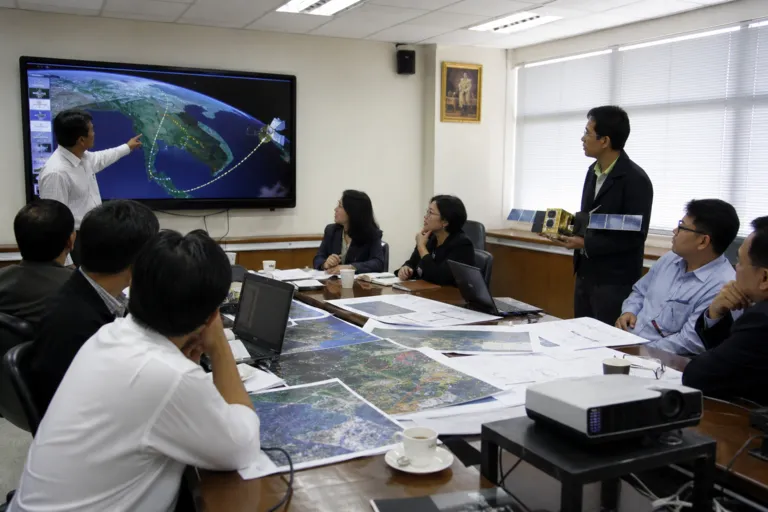
Thailand’s ambitions in space are becoming more structured and more visible. The Geo-Informatics and Space Technology Development Agency (GISTDA) is positioned as a primary implementation body for satellite development, data applications, and drafting regulations within Thailand’s space governance model. That model centralizes policy through a National Space Policy Committee chaired by the Prime Minister or a designated Deputy Prime Minister, with the Cabinet as the final approval authority for major initiatives. This framework signals that satellite and geospatial capabilities are being treated as part of national strategy, not a standalone technical program.
On the satellite side, GISTDA’s roadmap includes both operational assets and planned builds. GISTDA owns the THEOS (Thaichote) satellite, launched on 1 October 2008, and it has continued to pursue newer Earth observation capabilities with THEOS-2 and related missions. Wikipedia’s summary of GISTDA notes that Airbus was selected in June 2018 to build THEOS-2 as a replacement observation satellite, and it also describes the launch of a THEOS-2A small satellite on 12 January 2025 on PSLV-C62 from Satish Dhawan Space Centre in India. At a separate public-facing forum, Thai PBS World reported that GISTDA exhibited models of more than eight Thai satellites, including THEOS-family resource survey satellites currently in operation and additional Thai-developed satellites scheduled for launch in the coming years.
Spaceport Planning Adds Infrastructure Weight to the Roadmap
Beyond satellites themselves, GISTDA is also exploring the infrastructure that could support a broader space economy. The Nation reported that GISTDA is conducting a feasibility study for establishing a spaceport in Thailand in collaboration with KPMG Phoomchai Business Advisory Ltd, with a seminar on “Thailand’s Future Opportunities for Spaceport Development” held on October 15 at iConsiam. The study is described as comprehensive, covering economic aspects, business strategy, environmental and social impacts, and a nationwide survey of potential sites to evaluate a suitable location. The objective, as framed in the report, is to lay groundwork for long-term space infrastructure investment aligned with policy guidelines from the Office of the National Economic and Social Development Council (NESDC).
These national efforts sit inside a regional and global shift toward more countries building capabilities in orbit. Channel NewsAsia reported that nearly 80 countries now maintain official space programmes or agencies spanning activities such as satellite operations, Earth observation, regulatory development, and international cooperation. It also cited a 2025 PwC report estimating global space economy revenues of US$570 billion in 2023, with expectations of US$2 trillion by 2040. Thailand’s approach, as described across sources, emphasizes practical uses of orbital data—Thai PBS World highlighted flood monitoring and natural resource surveying—while governance bodies coordinate priorities and approvals at Cabinet and National Space Policy Committee levels.
Partnership-building is also part of how the Thailand space and satellite industry is being positioned for growth. An AInvest report stated that GISTDA signed a 2024 Memorandum of Understanding with Singapore’s Office for Space Technology & Industry (OSTIn) to advance Earth observation applications. Separately, the same report referenced US$1.96B in 5G and data center investments in the context of accelerating Earth observation and digital infrastructure, which helps frame how downstream connectivity and compute can support satellite data use cases. Taken together with the spaceport feasibility work and the visible pipeline of satellite models and launches, GISTDA’s roadmap reads less like a single project and more like a coordinated push across technology, policy, and enabling infrastructure.
What is GISTDA’s role in Thailand’s space governance structure?
What did GISTDA’s spaceport feasibility study cover?
Which GISTDA satellites and launches are cited in the sources?
How does the Thailand space and satellite industry connect to regional and global trends?
What partnerships are mentioned that support Thailand’s Earth observation goals?