

Growth in Thailand’s snack sector is increasingly coming from product reformulation, portfolio reshaping, and channel expansion rather than pure volume gains. StrategyHelix Market Research projects Thailand’s snacks market to expand from USD 4.0 billion in 2025 to USD 5.0 billion by 2030, implying a 4.57% CAGR. In the current cycle, the demand story is split: shoppers want snacks that feel healthier and lighter, but they also continue to trade up for premium cues such as better ingredients and an elevated quality image. This combination keeps value growth moving even as consumers become more cautious, pushing brands to innovate with formats, flavors, and packaging that better match changing daily routines.
Health-led demand is becoming more visible in the kinds of products winning attention. StrategyHelix highlights growing interest in baked formats, multigrain products, lower-fat and lower-sodium options, and snacks with clearer functional positioning. Mordor Intelligence connects this evolution to lifestyle changes and increasing health awareness that favor convenient, functional, and nutritious snacks, especially in portable, on-the-go formats. Urbanization and busier schedules are part of the backdrop, while fitness-oriented consumption is a specific tailwind for certain categories. In this context, the Thailand snack food industry is leaning into cleaner labels, lower sugar, higher protein, and nutrient-fortified positioning to compete for both everyday and premium use occasions.
Snack Bars and Better-for-You Ingredients Move Into the Spotlight
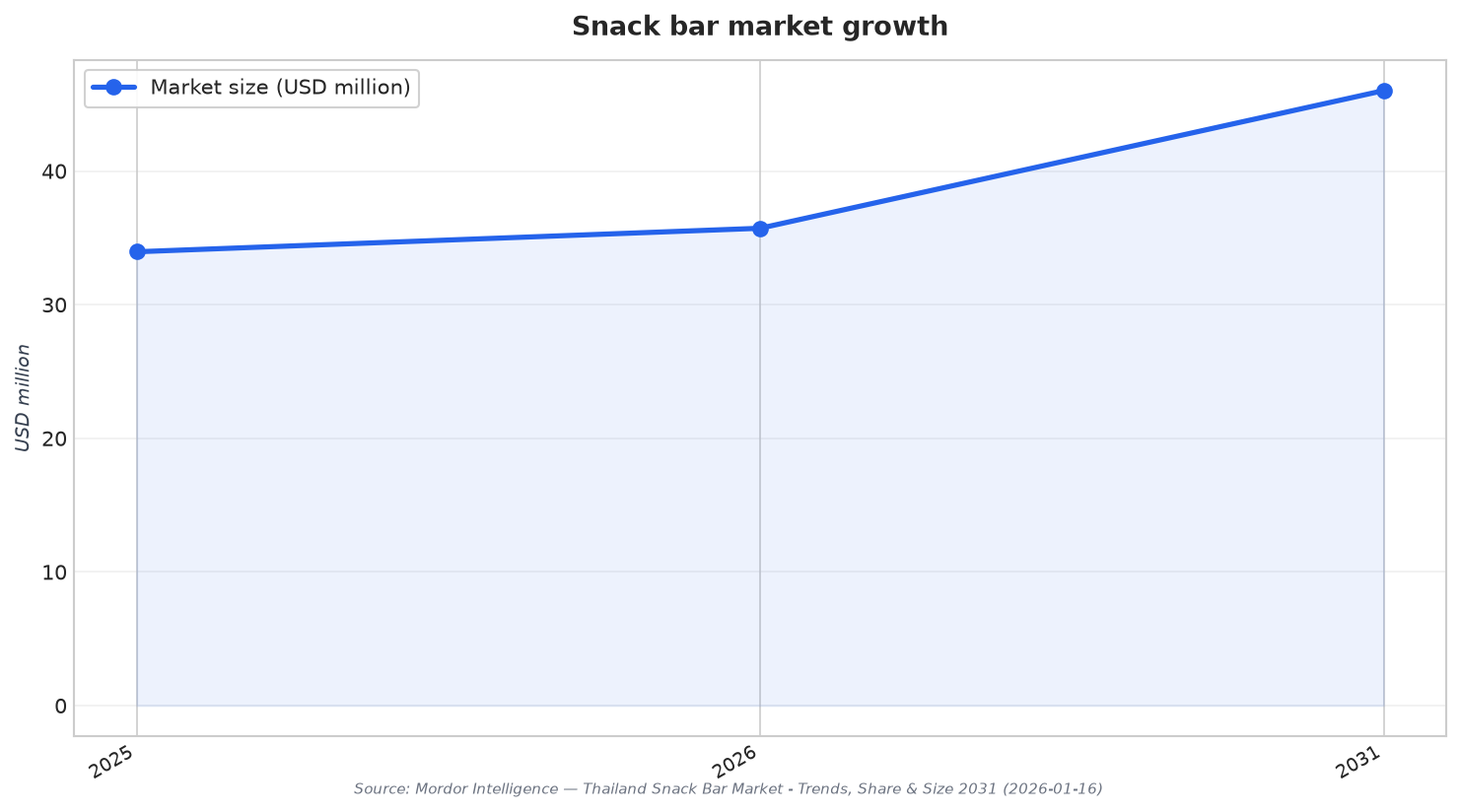
The snack bar category shows how the wider market shift translates into measurable segmentation gains. Mordor Intelligence values Thailand’s snack bar market at USD 33.96 million in 2025 and estimates growth from USD 35.72 million in 2026 to USD 46.02 million by 2031, a 5.19% CAGR for 2026–2031. In 2025, cereal bars led with 48.10% market share. Nut-based bars held 36.15% share by ingredient base, while granola and oat formulations are forecast to grow at a 6.05% CAGR to 2031. Mass-tier SKUs represented 75.90% of revenue in 2025, but premium offerings are projected to grow at a 5.46% CAGR, signaling room for both affordability and trading up.
Demand signals also tie into sports and wellness behaviors, which influence how consumers pick “functional” snacks. Mordor Intelligence cites Thailand’s Ministry of Tourism and Sports, which reported that Thailand’s sports industry generated approximately 437 billion Thai Baht (USD 12.66 billion) in total output value in 2023. That activity supports snack occasions linked to workouts and active lifestyles, helping categories like protein bars scale; protein bars are forecast to expand at a 5.28% CAGR through 2031. On the savory side, a Southeast Asia-focused Mordor Intelligence report notes Thailand’s Ministry of Public Health promoted sodium reduction strategies aiming to reduce sodium consumption by 30% by 2025, reinforcing reformulation momentum around reduced sodium and oil.
Distribution and regional positioning are shaping where incremental growth comes from next. Mordor Intelligence reports supermarkets and hypermarkets accounted for 46.00% of snack bar value in 2025, while online retail is expected to be the fastest-growing channel with a 6.88% CAGR through 2031. StrategyHelix similarly describes e-commerce as a smaller share today but expanding actively, aided by live commerce, reviews, and rapid-delivery services. Beyond Thailand’s borders, industry commentary points to opportunities to expand snack exports across ASEAN and into global markets, leveraging Thailand’s manufacturing base. That export ambition sits alongside domestic pressures—cost increases, competition, and nutrition scrutiny—that keep innovation and reformulation central to sustaining growth.
What is the growth outlook for Thailand’s snacks market through 2030?
How fast is Thailand’s snack bar market expected to grow?
Which snack bar types and ingredients lead in Thailand?
What is driving the shift toward healthier snack formats in Thailand?
How is the Thailand snack food industry changing its route to consumers?