Thailand’s dairy market is described as one of Southeast Asia’s more dynamic food sectors, shaped by rising domestic consumption and investment in production. Demand for milk, yoghurt, cheese, and other dairy products has expanded as urbanisation, higher incomes, and changing dietary preferences push consumers toward protein-rich and value-added foods. In 2025, Thailand’s milk market is valued at US$2.94 billion, with projected annual growth of 7.39% through 2030, based on Statista data collated in a Thailand dairy market overview. The same source estimates per capita revenue at US$41.01 and average consumption at 23.1 kilograms per person, with market volume expected to reach 2.14 billion kilograms by 2030.
At the broader basket level, Thailand’s dairy products and eggs market is valued at US$8.56 billion in 2025 and projected to grow 5.55% annually through 2030, also using Statista data collated in the same market overview. That dataset estimates per capita revenue at US$119.48, average consumption at 47.6 kilograms per person, and a market volume forecast of 4.11 billion kilograms by 2030. The sector blends domestic producers with international brands, and Thailand’s position is often framed as both a consumer and processing hub linked to regional trade flows. Even so, the same overview notes imports remain significant for specialised items such as premium cheeses and milk powders, where domestic supply cannot meet all demand segments.
School Milk Builds Demand, Stabilizes Supply Networks
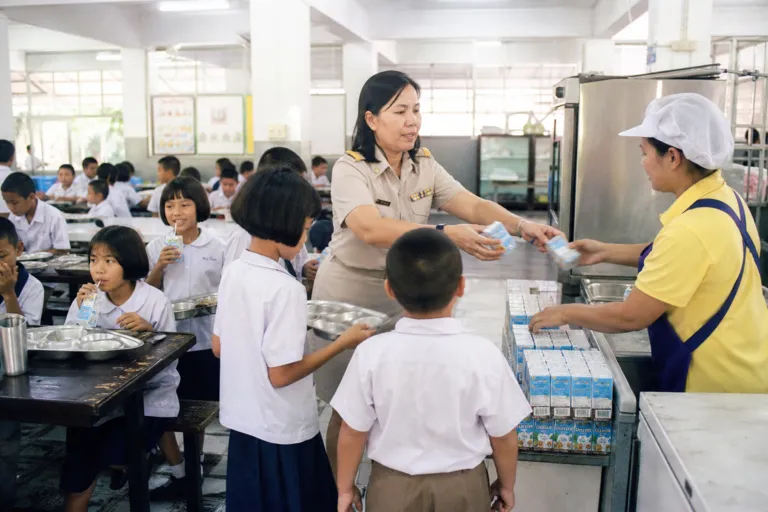
The Thai School Milk Programme is a direct policy lever that connects farm supply to everyday consumption. Established nationwide in 1992, it provides free milk to preschool and primary school students and distributes approximately 200 millilitres of milk per child on school days. It is jointly administered by the Ministry of Agriculture and Cooperatives and the Ministry of Education, with an annual government budget of around 14 billion baht. As of 2024, it was estimated to benefit approximately 3.9 million children. Only pasteurized or UHT milk is permitted, and since 2004 all processors must obtain HACCP certification, reinforcing safety requirements alongside scale.
Historically, the program was introduced after a 1985 pilot project that was designed to absorb surplus milk from Thai dairy farmers. The program has been credited with significant increases in production and consumption: annual milk production rose from approximately 290 million litres in the early 1990s to more than 1.1 billion litres by 2003, while per capita milk consumption increased from about 2 litres in 1984 to over 23 litres in 2002. The scheme also created competition for supply quotas, which led to administrative and quality concerns between 2009 and 2018, including reports of spoiled milk and inefficient distribution. In 2019, reforms were introduced to improve transparency and re-establish clear quota zones for suppliers.
Outside schools, convenience and long shelf life are pushing more consumers toward UHT formats, aligning with broader market commentary about processed dairy demand in Thailand. A global UHT milk report anticipates the UHT milk market expanding from $61.8 billion in 2024 to $107.2 billion by 2034, at a CAGR of approximately 5.7%, driven by convenience and urbanization; this is global context rather than a Thailand-specific figure. In parallel, a dairy products market report notes that rising incomes, urbanization, and Western dietary trends have boosted dairy consumption in Indonesia and Thailand, making them high-growth dairy product markets. Together, these forces help explain why the Thailand dairy industry is expanding through both institutional demand formation and evolving everyday buying habits.
How does Thailand’s School Milk Programme support dairy demand?
How many children does the School Milk Programme reach?
What is the government budget for the School Milk Programme?
What do recent sources say about Thailand’s milk market size and growth outlook?
What factors are shaping the Thailand dairy industry right now?