Thailand’s cement sector sits at the intersection of infrastructure demand and rising pressure to cut emissions. Independent research cited by ThaiPR.NET describes the industry as contributing about 7–8% of Thailand’s GDP, while also navigating structural adjustment from subdued demand and oversupply. Domestic cement consumption is projected to contract by around 5.5% year-on-year in 2025 to approximately 34.7Mt, even as installed capacity is estimated at around 75Mt/yr and 2025 output is forecast at about 40.1Mt, down 2.8% year-on-year. In this environment, decarbonisation is not just a climate story; it is also a competitiveness and resilience story as producers decide where to deploy capital and which technologies to prioritise.
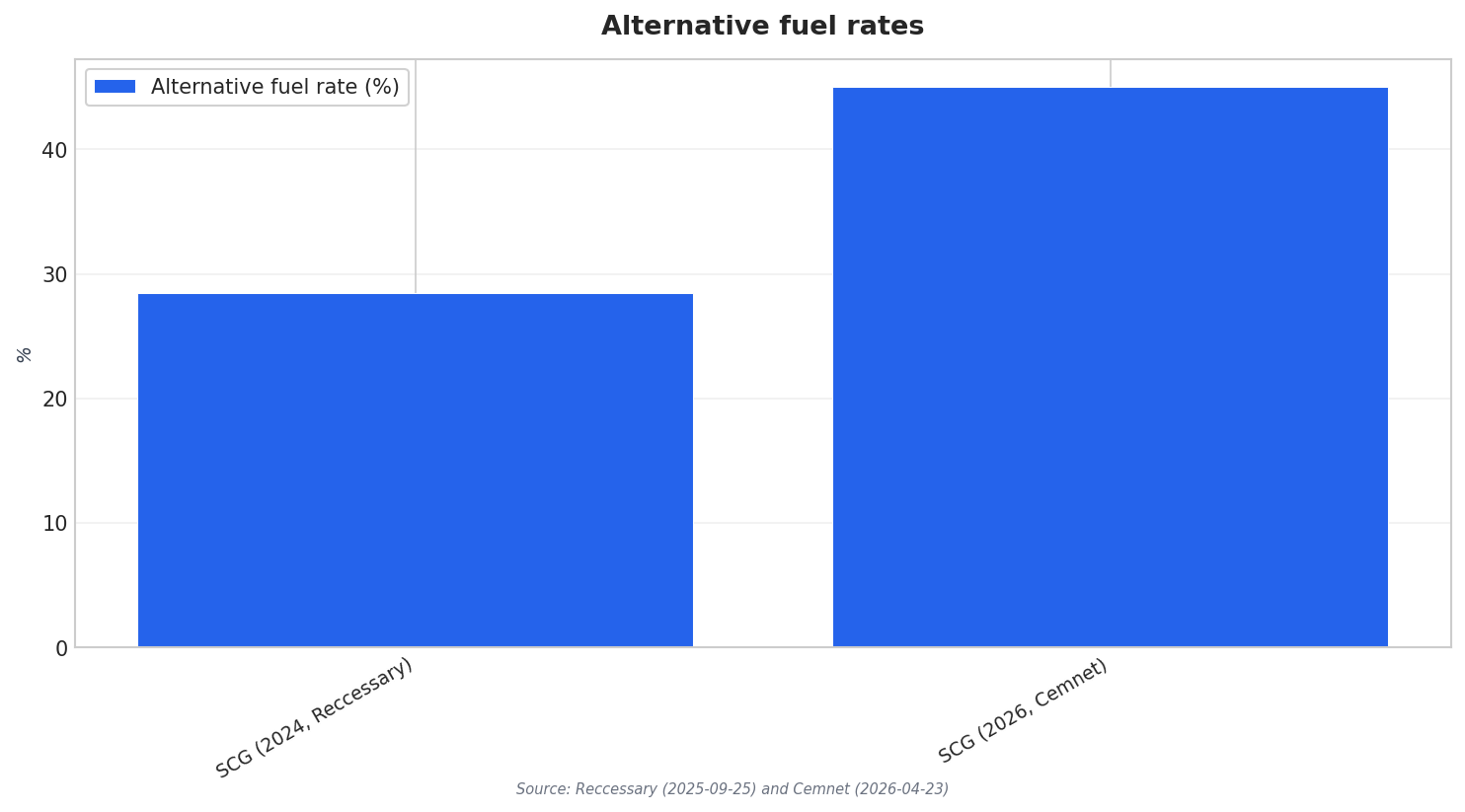
Two companies dominate the narrative. Reccessary reports that Thailand’s two leading cement producers, Siam Cement Group (SCG) and Siam City Cement Public Company (SCCC), are tackling decarbonisation from different angles. SCG is expanding into renewable energy, while SCCC is focused on reducing its clinker ratio and increasing the share of alternative fuels. SCG’s fuel switching includes substituting coal with biomass and refuse-derived fuel (RDF), and it also promotes energy crops such as bamboo and Napier grass. Reccessary notes SCG’s alternative-fuel use was about 28.5% in 2024, framing it as relatively modest even as the company has been recognised as a highlight project in the Saraburi Province Low-Carbon City Sandbox initiative.
Alternative Fuels Now, Carbon Capture Later
Other reporting shows how quickly operational strategies can evolve. CemNet says SCG Cement aims for a 10–30% reduction in CO2 emissions compared with traditional OPC by shifting toward low-carbon cement, with a strong focus on alternative fuels and energy resilience. In that account, SCG has achieved an alternative fuel rate of 45% by increasing agricultural waste and biomass use and applying technologies including external combustion chambers and dedicated alternative-fuel burners. CemNet also points to energy efficiency at SCG’s Ta Luang plant, citing a 17.5MW solar plant alongside a waste heat recovery system. It adds that SCG operates Southeast Asia’s first industrial heat battery at its Saraburi plant, supplying 2.3MWth of continuous steam by combining grid power with a nearby floating-solar farm.
Siam City Cement (INSEE) is taking a more materials-led near-term route. CemNet describes clinker reduction, energy efficiency, and alternative fuels as its closest levers today, with carbon capture positioned as a later-stage solution. The same source notes the company’s regional footprint of 15.63Mta. Regionally, the direction of travel is reinforced by Global Cement’s analysis of decarbonisation roadmaps in Asia, which highlights the Thai Cement Manufacturers Association (TCMA) and its Thailand 2050 Net Zero Cement & Concrete Roadmap published in late 2024. That article says alternative fuels are expected to cut CO2 emissions by 15.4Mt by 2035, with emphasis on biomass, RDF, and industrial waste.
Carbon capture is emerging as a longer-horizon enabler, but the emphasis in Thai corporate messaging remains on getting early steps right. Bangkok Post quotes SCG stating it is crucial to “get it right from the start” rather than relying on carbon capture as a last resort, while positioning Saraburi as a test bed for clean energy, low-carbon cement, and large-scale renewables. At the national level, THAILAND.GO.TH reports that the Department of Mineral Fuels under the Ministry of Energy is the project owner for assessing CO2 storage potential in geological formations in the Upper Gulf of Thailand. Planned work includes seismic surveys covering about 1,000 square kilometers expected to begin in Q3 2026, plus exploratory drilling and laboratory analysis anticipated to start in 2027. Together, these moves show how Thailand cement industry decarbonization is being built from operational fuel switching and efficiency now, with carbon storage capabilities being prepared in parallel.
What is driving different decarbonisation strategies between SCG and Siam City Cement?
What alternative-fuel rates have been reported for SCG?
How does Thailand’s cement market context shape decarbonisation priorities?
What does Thailand’s government say it will do next on carbon storage assessment?
What does Thailand cement industry decarbonization look like in practice for the biggest players?