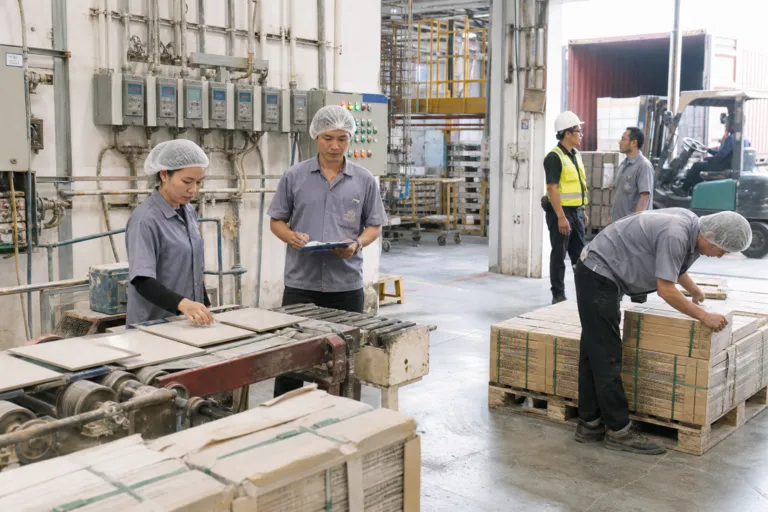
Thailand’s ceramic tile exporters are heading into 2026 with tightening margins and rising policy uncertainty. Domestic demand has been growing, but external headwinds are stacking up. In 2025, Thailand’s ceramic tiles market was valued at USD 1.42 billion, and Mordor Intelligence estimates it will grow from USD 1.47 billion in 2026 to USD 1.75 billion by 2031, at a 3.57% CAGR for 2026–2031. That growth is linked to infrastructure spending under the Eastern Economic Corridor (EEC), a housing rebound, and tourism-led hospitality construction. Yet exporters must operate in a global market where pricing and compliance standards are shifting fast.
Trade signals show a mixed picture. IndexBox reports that Thailand saw a 23% surge in ceramic tile imports, reaching $28M in January 2024, which it describes as a peak for that month. At the same time, Thailand’s own overseas shipments have been weakening: in 2025, export volumes decreased for the third consecutive year after two years of growth, and IndexBox describes the longer trend as a noticeable contraction. Destination concentration also matters for risk planning. By volume, Myanmar was the main export destination, with Lao People’s Democratic Republic second and Cambodia third, according to IndexBox’s 2026 market report for Thailand.
CBAM Adds a New Compliance Layer as Scope Could Extend to Ceramics
For exporters selling into Europe, policy risk is becoming more immediate. The EU’s Carbon Border Adjustment Mechanism (CBAM) enters its definitive phase on January 1, 2026, The Nation reports. The current CBAM product categories are iron and steel, aluminium, cement, fertilisers, electricity, and hydrogen, but the EU is also expected to widen the scope over time to additional product groups such as glass and ceramics. That expectation matters for tile makers because it implies future reporting and potential carbon-cost pass-through. The EU has also introduced Regulation (EU) 2025/2083 as a CBAM “simplification” package, including a 50-tonne-per-year mass threshold exemption for some CBAM goods, though electricity and hydrogen are not covered by that exemption.
Thailand-wide exposure estimates underline why companies are watching CBAM closely. Kasikorn Research Center estimates CBAM could affect 3.8% of Thailand’s exports to the EU in 2026, worth about 28 billion baht, as the policy begins aligning with the EU Emissions Trading System (EU ETS), according to The Nation. It also cited an indicative carbon price range of 60–90 euros per tonne for CBAM certificates, with certificate costs linked to embedded emissions. While those figures are not tile-specific, they signal what could happen if ceramics are added to the covered list: EU importers may factor expected CBAM costs into purchasing decisions and supplier selection, raising the bar for emissions data readiness across exporting sectors.
Against that backdrop, competitiveness will increasingly hinge on product mix and the ability to defend pricing at home and abroad. In Thailand’s domestic market, porcelain held a 41.40% share in 2025, while floor installations represented 58.50% of market size, according to Mordor Intelligence. Residential demand also dominated with a 70.20% share in 2025. But import competition persists, and Mordor Intelligence notes ongoing import pressure from China and Vietnam, even as stricter customs scrutiny and rising environmental standards may help quality-focused manufacturers. For the Thailand ceramic tile industry, 2026 looks like a year where export resilience depends on compliance readiness, destination strategy, and maintaining value positioning while imports remain strong.
When does the EU CBAM enter its definitive phase, and why does it matter to exporters?
Could ceramics be included under CBAM later on?
What headline trade signal shows stronger import pressure into Thailand?
Which export destination leads Thailand’s ceramic tile shipments by volume?
What is the near-term growth outlook for Thailand’s ceramic tile industry in 2026?