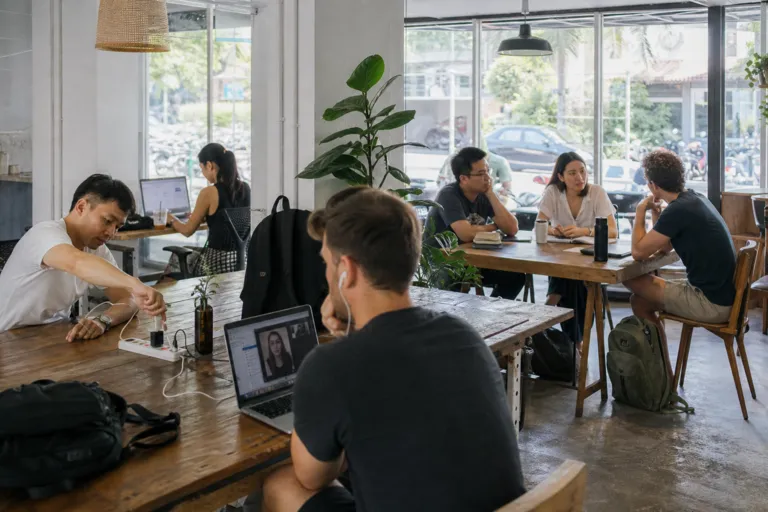
Thailand’s coworking and managed workspace industry is scaling up fast, and the growth story increasingly reaches outside Bangkok’s traditional core. A 2024–2030 market report valued the country’s coworking sector at USD 106.7 million in 2023 and forecasts USD 550.8 million by 2030, implying a 26.2% CAGR from 2024 to 2030. The same report links demand to startups and small enterprises that want flexibility in lease terms and space needs, plus the network effects of shared environments. It also points to remote work culture in Thailand as a driver, as more professionals seek productive alternatives to traditional office settings.
Bangkok remains the largest magnet, partly because it is positioned as a startup hub. Bangkok ranked 74th globally in StartupBlink’s 2023 report, and the market analysis describes coworking spaces as playing a pivotal role in supporting entrepreneurial activity there. But pressure in the conventional office market is also part of the backdrop for flexible solutions. Cushman & Wakefield estimates Bangkok had about 8.93 million square meters of office space, with roughly half (4.97 million square meters) in the CBD, and another 654,000 square meters under construction scheduled to launch between 2025 and 2027. That concentration and pipeline influence how tenants think about optionality, timing, and shorter commitments.
Flexible Work Is Pushing Demand Into New Districts and Cities
Hybrid work expectations are a direct tailwind for flex formats, and not only in the CBD. Ken Research estimates 65% of companies will adopt flexible work arrangements in future, a shift that it says will drive demand for adaptable office spaces and short-term leases. In parallel, Cushman & Wakefield’s outlook for 2025 highlights how the supply cycle is changing: only two new office buildings were completed in the past year, adding about 101,000 square meters, which it notes is about an 84% decline versus the prior year’s 12 buildings and around 615,000 square meters. Even so, earlier deliveries, particularly in CBD locations, still need time to be absorbed, keeping competition intense and making flexible options more attractive to some occupiers.
As companies and individuals prioritize mobility, coworking supply is also appearing more visibly beyond central Bangkok. A 2026 overview of coworking and remote-work infrastructure reports that, in addition to Bangkok, Chiang Mai, and Phuket, coworking exists in Pattaya, Hua Hin, Koh Samui, and some provincial capitals, though coverage outside major hubs is described as uneven. It notes that many smaller locations are independent, single-site operators with limited capacity and variable service standards. The same source also highlights that some newly built condominium and serviced apartment developments across Bangkok and other cities have added residents-only coworking lounges or business centers, which can broaden access to semi-private work settings even when they are not full-service coworking operations.
For operators and landlords, the opportunity is to match flexible products to a more distributed pattern of demand while addressing enterprise expectations. The remote-work infrastructure source says many Bangkok providers can accommodate corporate needs through private office suites, custom network configurations, or enterprise packages, typically via direct negotiation and sometimes longer contract terms. At the same time, the Thailand coworking space market analysis flags cybersecurity as a challenge to broader acceptance, particularly for firms that must manage sensitive work. As flexible offices expand beyond the CBD into additional districts and cities, consistent standards, security practices, and clear service levels will be critical to sustaining growth.
How large is Thailand’s coworking market expected to become by 2030?
What office supply signals are shaping flexible office demand in Bangkok?
Which Thai cities are seeing coworking supply beyond Bangkok?
What is one key risk that can slow adoption in the Thailand coworking space market?