
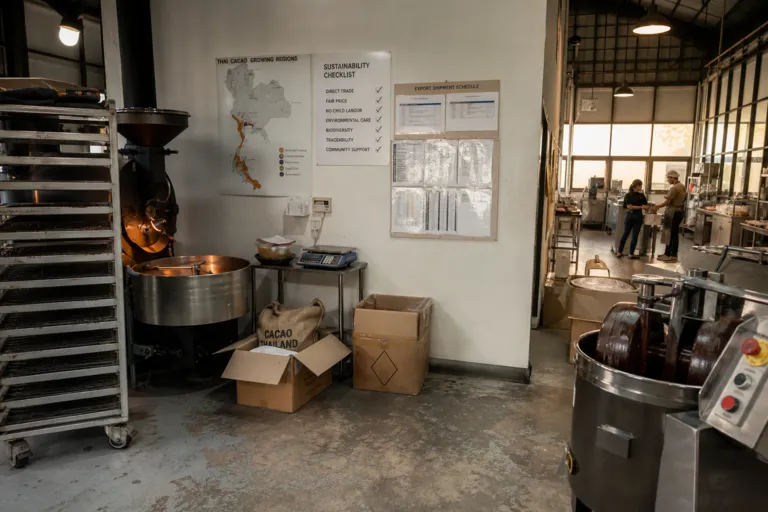
Thailand’s cocoa and chocolate sector is building a premium story at a time when global cocoa bean price volatility is pushing risk down the supply chain. In 2025, Thailand exported cocoa and cocoa preparations worth USD 131.3 million, up 27.4% from the previous year, and exports in Q1 2026 reached USD 32.5 million. The same direction shows up in a separate account that puts exports of cocoa and chocolate products at about USD 131 million “last year,” alongside claims of over 40% export growth in a single year to Japan and China. For many Thai brands, export momentum is becoming a strategy to reduce reliance on domestic volume growth while aiming for higher-value buyers abroad.
On the supply side, Thailand produced more than 3,100 tonnes of raw cocoa beans in 2025, nearly 40% more than a year earlier, according to comments attributed to the Trade Policy and Strategy Office (TPSO). That expansion matters because local cocoa is the foundation for traceable, origin-led products. In Chiang Mai, a professor at Maejo University developed the I.M.1 varietal, described as a cross between Peruvian criollo and a Filipino forastero strain, and the Thailand Cocoa Center helped propagate it onto dozens of farms across the north. These kinds of origin narratives can support higher pricing power in craft segments, where small-batch positioning, local identity, and traceability are part of the sales pitch.
Awards, Sustainability, and Specialty Inputs Support Premium Positioning
Recognition from competitions is also helping Thai chocolate signal quality to overseas buyers. PARADAi Chocolate’s Phuket Dark 70% was named best plain-origin dark chocolate bar at the 2026 Asia-Pacific Bean-to-Bar competition. Taluang Cocoa and TinTin Chocolate won gold at the 2025 Cacao of Excellence Awards, and the Academy of Chocolate in London gave silver to Thai-origin dark chocolate at its 2025 awards. Sustainability-linked trade filings are cited as another under-tracked tailwind: Thailand shipped 5.4 million kilos of sustainably certified cocoa in 2023, a 30% year-on-year rise. The same source notes ISO 14001’s 25% waste-reduction target and links it to about a 7% reduction in processing costs for certified factories, reinforcing the business case for “green” compliance in premium channels.
At the same time, Thailand remains exposed to global price swings through its ingredient pipeline. In cocoa powder (not sweetened), one market analysis estimates the country is structurally import-dependent, with 75–85% of supply sourced from overseas origins including Indonesia, Malaysia, Côte d’Ivoire, and Ghana. It also estimates that industrial B2B buyers account for 60–70% of demand, meaning cost shocks can ripple quickly into confectionery, bakery, and beverage manufacturing. The same analysis links global cocoa bean price volatility to landed cost uncertainty for Thai importers, squeezing margins and forcing frequent contract renegotiations. This is why exporters are emphasizing premium, specialty differentiation while import-heavy manufacturers navigate commodity-linked risk.
Looking ahead, demand signals point to growth but with a clear premium tilt. One forecast says Thailand’s cocoa powder market volume could expand by 30–50% from 2026 to 2035, implying a 4–6% CAGR, and it notes that premium and specialty cocoa powder grades can command price premiums of 20–35% over standard natural cocoa powder. In the wider sweets space, a separate report puts Thailand’s confectionery market at USD 820.9 million in 2025, projecting USD 1,133.1 million by 2034 at a 3.50% CAGR, while highlighting the role of premium craft chocolate exports. This combination—export-led craft momentum plus imported-input vulnerability—frames how the Thailand cocoa and chocolate industry is targeting premium export niches while building resilience against volatile global cocoa costs.
How fast are Thailand’s cocoa and cocoa preparation exports growing?
How much raw cocoa did Thailand produce recently?
Why does global cocoa price volatility matter for Thai manufacturers?
What evidence suggests Thai craft chocolate is gaining international recognition?
What is shaping the Thailand cocoa and chocolate industry’s premium export strategy?