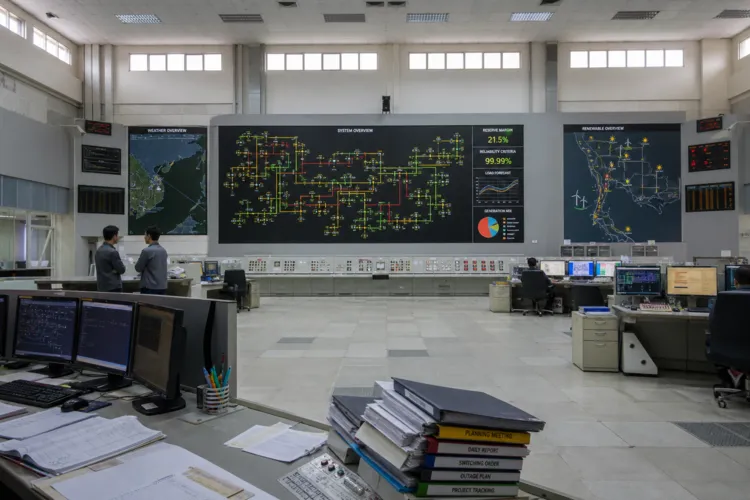

Thailand’s push for an advanced, more flexible grid is becoming more urgent as two forces grow at the same time: rising renewable integration and the rapid build-out of power-hungry data centers. As of April 2025, Thailand’s total installed power generating capacity was approximately 52 GW, produced by EGAT, IPPs, SPPs, VSPPs, and imports, with renewable capacity around 20% of the total installed base. The U.S. Commercial Guide notes Thailand is implementing pilot projects for an advanced grid system designed to manage the increased volatility associated with more renewables, while the private sector explores BESS deployments to enhance stability and efficiency.
At the same time, the data center pipeline is putting pressure on transmission, distribution, and reliability standards. Mordor Intelligence values the Thailand data center market at USD 1.89 billion in 2025 and estimates growth from USD 2.22 billion in 2026 to USD 4.9 billion by 2031, at a CAGR of 17.21% for 2026–2031. In power terms, the same source projects the market to expand from 0.77 thousand MW in 2025 to 2.93 thousand MW by 2030 (30.60% CAGR, 2025–2030). Bangkok held a 70.25% share in 2025, signaling a concentrated load profile that can strain existing networks and increase the value of monitoring, automation, and redundancy.
Direct Renewable Procurement Becomes a Grid-Modernization Catalyst
Policy design is also evolving to match these new loads. On June 25, 2024, the National Energy Policy Council approved a pilot framework that allows eligible data centers to buy renewable power directly from producers through the national grid, with a cap of 2,000 MW. The Energy Regulatory Commission released draft regulations in October 2025, with final rules expected by late 2025 or early 2026; as of March 2026, no fully executed post-commissioning contracts had been confirmed. Under the framework, eligible data centers must have BOI promotion, commit to 100% renewable energy, and meet a minimum IT base load of 50 MW per building, alongside a ten-year electricity plan and backup supply contracts with EGAT, MEA, or PEA.
These changes land amid a surge in project approvals and capital commitments that translate into power-infrastructure needs. Green Energy Thailand reports that in the first half of 2025, Thailand approved 28 data center and cloud projects valued at THB 521.2 billion (about USD 16.1 billion), and total digital investment pledges for 2025 reached USD 23.5 billion. Separately, The Nation reports that in 2025 alone the BOI approved 36 data center projects worth approximately THB 728 billion, plus seven projects valued at over THB 96 billion approved in January the following year. The same report cites EGAT’s planned THB 31 billion investment roadmap to upgrade transmission capacity across the EEC to address infrastructure built for conventional industrial loads.
For the Thailand smart grid market, these demand signals show up in data-center power systems and grid-side flexibility investments. Mordor Intelligence estimates the Thailand data center power market at USD 502.93 million in 2026, rising from USD 456.71 million in 2025, with projections of USD 814.35 million by 2031 (10.12% CAGR for 2026–2031). The report also highlights how major hyperscale commitments raise requirements for resilient electrical infrastructure and monitoring. In parallel, Thailand’s broader power-market analysis points to modernization outlays of THB 90 billion for pumped-storage dams and high-voltage corridors, and notes that smart meter penetration remains below 10%, underscoring why digital grid investments are central to absorbing new renewable and data center loads.
What is driving upgrades in Thailand’s smart grid and power network?
How big is Thailand’s data center growth, according to Mordor Intelligence?
What is the 2,000 MW direct renewable PPA pilot for data centers?
What do the sources say about investment momentum tied to data centers in Thailand?
How is the Thailand smart grid market connected to data center power needs?