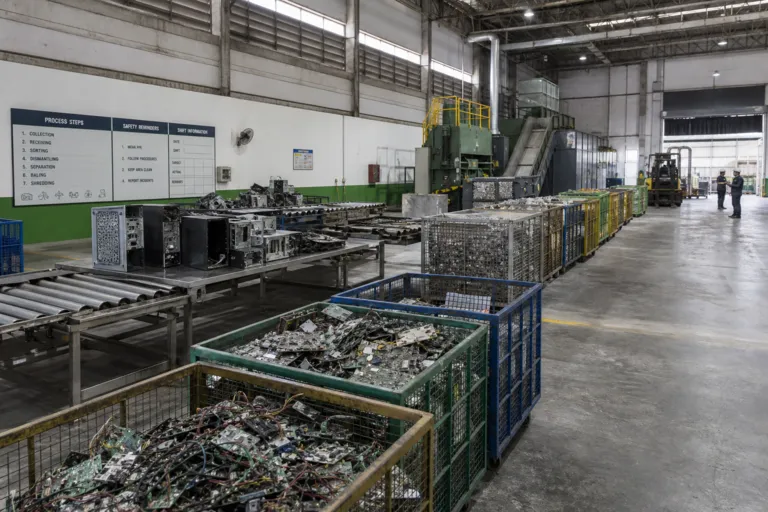
Thailand’s move toward a more formal electronics-recycling system is being shaped by two forces that pull in the same direction: tougher import controls and stronger demand for recovered materials. Thailand’s Ministry of Natural Resources and Environment has introduced policies to control and ban the import of waste, including electronic waste, plastic waste, and municipal waste, citing environmental and public-health protection. The enforcement push also includes follow-up legal action, including prosecution, even as shipments continue to arrive. These policy signals matter because they encourage more processing to happen inside the country, and they raise the bar for how electronics waste must be handled.
Urban pressure is a major backdrop for the shift. One market source describes Thailand’s waste management market at USD 18.28 billion in 2023, with a projection to reach USD 34.83 billion by 2030 at an 8.60% CAGR (2024–2030). Separately, Thailand’s waste management and recycling tech market was valued at USD 2.5 billion, tied to urbanization and government initiatives. The same source cites World Bank figures that Thailand’s urban population is projected to reach 50 million in the future, up from 48 million in 2020, alongside waste generation estimated at 27 million tons annually, with urban areas responsible for approximately 60% of total waste. Together, these conditions intensify the need for organized collection, segregation, and specialized downstream recycling pathways.
Import Bans and Urban Mining Economics Push Formalization
The economics of “urban mining” are straightforward in principle: discarded electronics can be treated as a feedstock for valuable materials. Thailand-focused enforcement reporting notes that common forms of e-waste include cellphones, IT equipment, batteries, consumer electronics, and printed circuit boards. It also states these items contain precious metals such as gold, copper, silver, and rare earth minerals that can be extracted for reuse. At the same time, hazardous substances containing mercury, lead, and cadmium are frequently disposed of in landfills, creating an incentive for safer, more controlled processing. As Thailand’s import controls expand across waste categories—including a plastic-waste import ban in January 2025—the direction of travel is clear: less reliance on incoming waste streams and more emphasis on compliant handling and recovery.
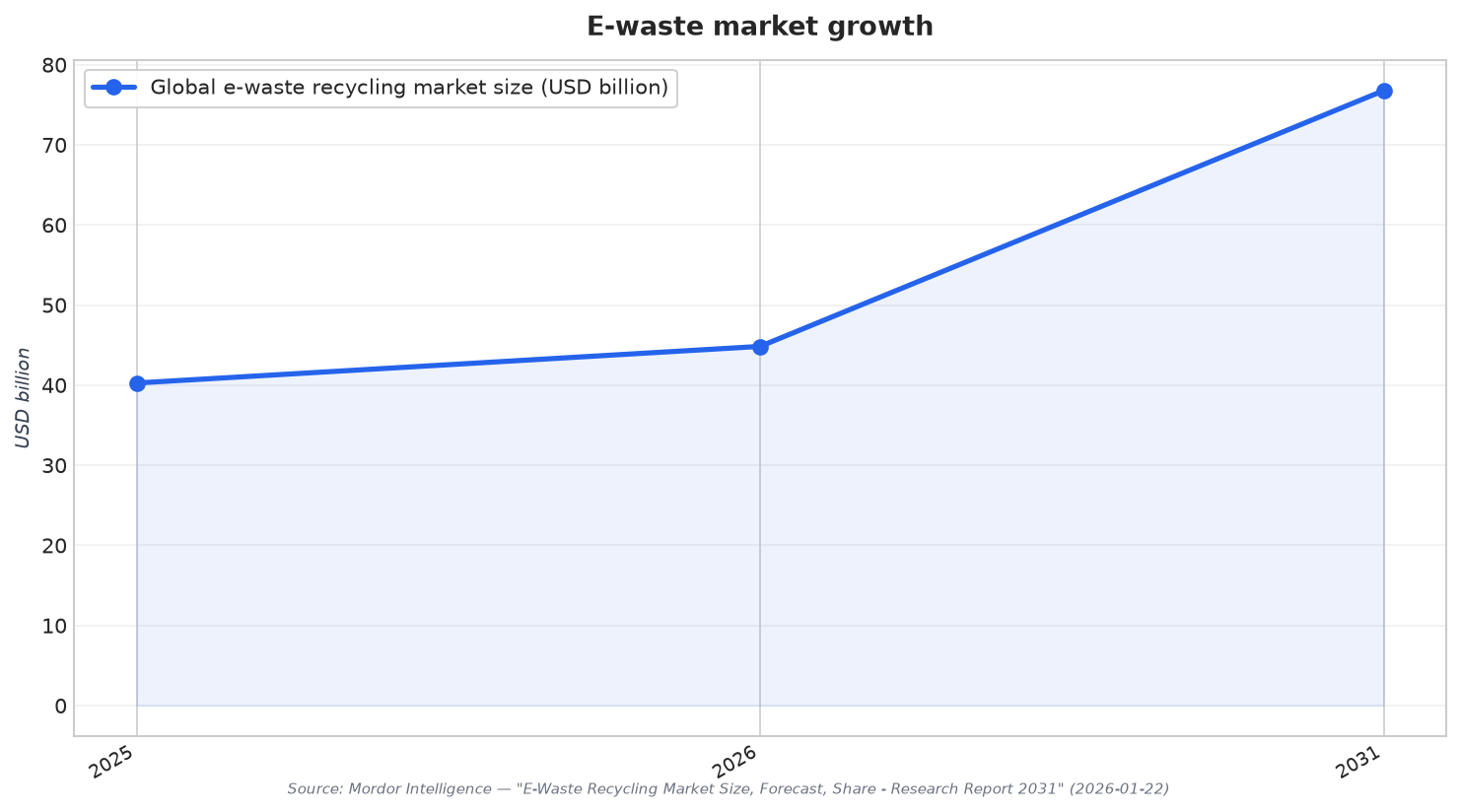
Global market signals reinforce why more formal capacity is attractive, even if Thailand-specific e-waste volumes are not disclosed in the available sources. Mordor Intelligence estimates the global e-waste recycling market at USD 44.84 billion in 2026, with projections of USD 76.77 billion by 2031, reflecting an 11.34% CAGR (2026–2031). The same report states that Extended Producer Responsibility (EPR) schemes in the European Union, India, and South Korea steered roughly 2.1 million t of e-waste into certified plants during 2024. It also reports that, by geography, Asia-Pacific held 46.25% revenue share in 2025. For Thailand’s e-waste recycling industry, these numbers do not describe local performance, but they do illustrate how regulation and certification can create formal revenue streams for processors.
Policy-led localization also implies investment in compliant processing and equipment. A global recycling-equipment analysis notes that stringent e-waste export bans and “right-to-repair” legislation can localize processing, and that enforcement of e-waste take-back laws helps create a formal sector that relies on capital-intensive, certified equipment to operate safely while capturing material value. In Thailand, government planning and modernization efforts further support the direction of change. One market report references the government’s Smart City Masterplan and efforts under the Bio-Circular-Green (BCG) economy model as reinforcing urban infrastructure upgrades and encouraging private-sector participation in collection, recycling, and treatment. The practical implication is a clearer runway for formal operators as compliance expectations rise and urban mining demand grows.
What is driving formalization in Thailand’s e-waste recycling industry?
What kinds of materials can be recovered from e-waste mentioned in the sources?
What risks are associated with improper e-waste disposal in the sources?
What do the sources say about Thailand’s overall waste-management market growth?
How do global trends provide context for Thailand’s shift toward certified e-waste processing?