
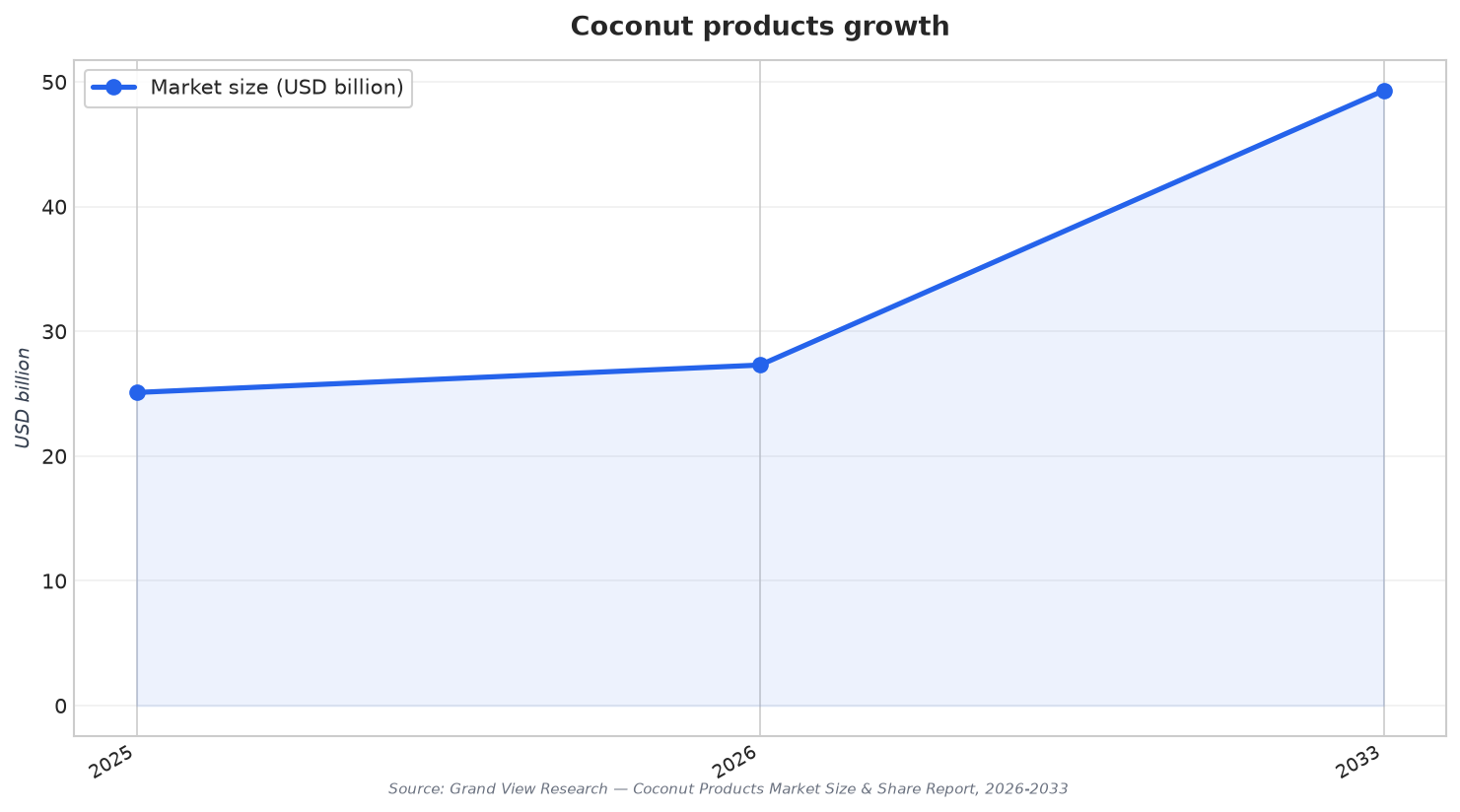
Global appetite for coconut-based beverages and ingredients is strengthening, and exporters are positioning to capture that pull. The global coconut products market was valued at USD 25.1 billion in 2025 and is projected to rise from USD 27.3 billion in 2026 to USD 49.3 billion by 2033, at a CAGR of 8.8%. Asia Pacific held the largest revenue share at over 30.0% in 2025, reflecting the region’s central role in supply and processing. Momentum is also visible at the brand level: in October 2025, Vita Coco reported a major net sales increase in the third quarter, driven by 42% growth in Vita Coco Coconut Water. These signals create a supportive backdrop for export-focused players shipping higher-value coconut formats beyond raw commodities.
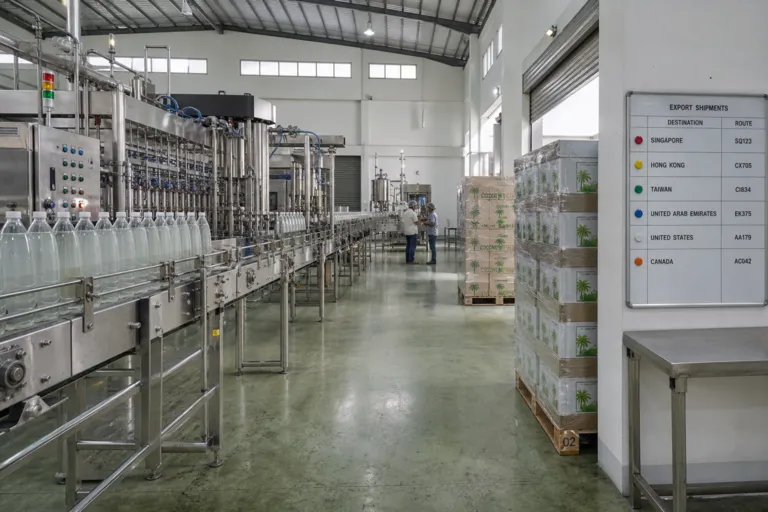
For Thailand, export scale in packaged coconut water stands out in the broader coconut drink trade. One report states Thailand exported over 650 million liters of packaged coconut water, with domestic consumption at 420 million liters (both in 2023). Another dataset frames Thailand’s coconut water segment with USD 0.95 billion size, a 29.23% share, and a projected 7.2% CAGR, supported by 350 million liters of packaged output and 40% export distribution in 2024. Read together, these figures highlight two realities. First, Thailand has developed strong packaging and export pathways. Second, demand is not just local; it is shaped by international buyers seeking convenient, shelf-ready formats across retail and foodservice channels.
Why Plant-Based and “Clean” Ingredient Demand Lifts Export Value
Exporters are also benefiting from how coconut has expanded into plant-based formulation needs. Across the category, coconut milk, cream, oil, water, and flour are described as preferred components with broad applications in recipes, making them attractive to food manufacturers. A key demand driver is consumer scrutiny of additives. A 2023 Plant-Based Foods Association report found that 68% of consumers aged 35–44 said excessive additives and additive ingredients are among the major issues in the global food supply. This preference reinforces the shift toward natural and plant-based ingredients and supports the idea that value will increasingly move toward higher-margin processed coconut products rather than raw commodities. In February 2026, major manufacturers also expanded production capacities for coconut-based beverages, oils, and snack products to meet rising demand for dairy alternatives and natural food ingredients.
Coconut water specifically remains a headline growth channel that can anchor broader ingredient exports. One forecast shows the coconut water market growing from USD 3.97 billion in 2026 to USD 5.24 billion by 2031 at a 5.68% CAGR, tied to plant-based and clean-label hydration. Another report sizes the coconut water market at USD 3.25 billion with a forecast 6.8% CAGR. On the consumption side, coconut water represented 52% of coconut drink market volume in 2023, within a year when over 4.8 billion liters of coconut drinks were consumed worldwide. Asia-Pacific is also described as consuming more than 1.9 billion liters of coconut drinks in 2023, and the United States is cited as leading global coconut drink consumption with over 980 million liters in 2023. These demand pools provide context for export strategies centered on availability, packaging quality, and consistent supply.
Thailand’s competitive story sits inside a concentrated global supply map and a value-led export dynamic. In 2024, Indonesia, the Philippines, and India accounted for 71% of global coconut consumption and 73% of global production, illustrating how supply is clustered in Asia-Pacific. At the same time, Thailand is described as the world’s preeminent exporter by value, capturing nearly half of global export market value, while China accounts for over half of all import value. The average export price reached USD 488 per ton in 2024, indicating a price environment that matters for margins and product mix. For the Thailand coconut products export industry, the opportunity is to keep aligning packaged beverages and plant-based ingredients with global demand growth—while managing supply-chain pressures that can affect consistent yields.
How is Thailand’s coconut export position described in global trade by value?
What export volumes show Thailand’s strength in packaged coconut water?
What is the projected growth outlook for coconut products globally?
Why do plant-based ingredient trends matter for the Thailand coconut products export industry?
What do the sources say about coconut water market growth?