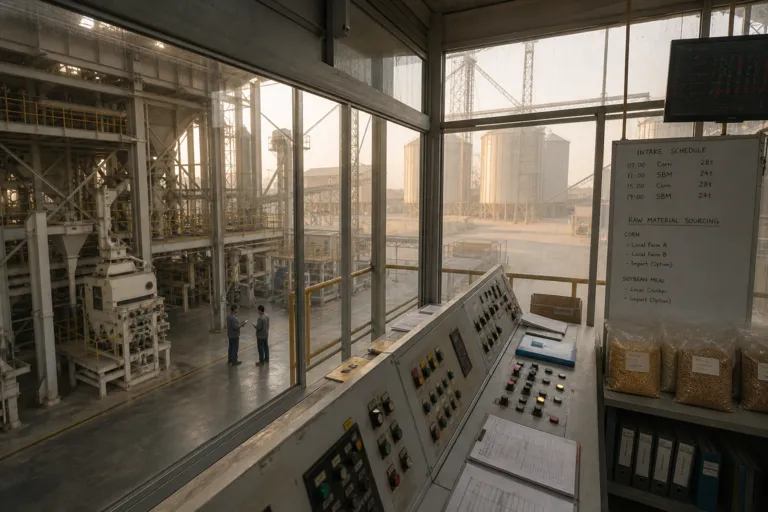
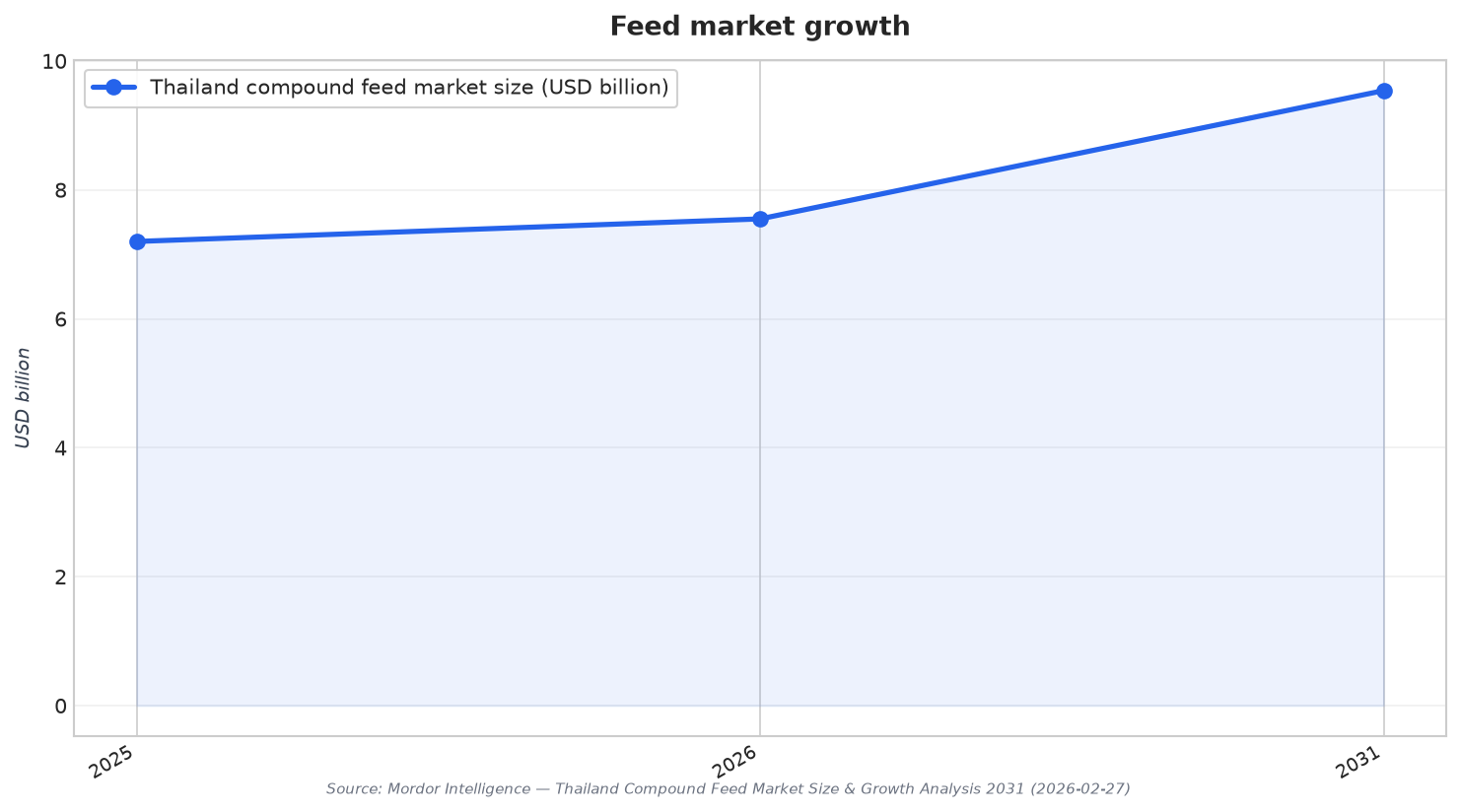
Thailand’s feed sector is entering 2026 with bigger policy-driven levers shaping raw material planning. Mordor Intelligence values Thailand’s compound feed market at USD 7.20 billion in 2025 and estimates growth from USD 7.55 billion in 2026 to USD 9.54 billion by 2031, at a 4.80% CAGR (2026-2031). In that same market snapshot, cereals are the largest ingredient group at 52.0% of market size in 2025, and poultry feed leads animal types with 46.0% share. Those numbers matter because feed costs and ingredient availability are being reworked around import quota access, tariff levels, and compliance conditions that affect what mills can buy, when they can buy it, and at what effective cost.
The clearest 2026 pivot is in feed corn (maize) access under Thailand’s WTO tariff-rate quota. USDA FAS reports that on June 23, 2026, Thailand set a zero percent in-quota tariff rate for feed corn imports for calendar year 2026, with an out-of-quota rate of 73 percent. The quota volume is set at 1 million metric tons (MMT), expanded from a previous 54,700 MT quota referenced in the same USDA update. Bangkok Post also describes the in-quota tariff as reduced from 20% to 0%, while the out-of-quota tariff remains at 73%, together with a fee of 180 baht per tonne. Access to the zero percent in-quota rate is conditioned on a 3:1 domestic corn purchase requirement, meaning importers must buy three units of domestic corn for every one unit imported at the in-quota rate.
What 2026 Quota Mechanics Mean for Feed Formulas and Sourcing
Policy mechanics also change timing and sourcing channels. USDA FAS says Thailand extended the ASEAN Free Trade Area (AFTA) feed corn import window for general importers from 5 months (February 1 to June 30) to 7 months (February 1 to August 31, 2026), at a zero percent preferential tariff. Bangkok Post adds that Thailand requires burn-free certification for all feed corn and wheat imports to curb cross-border air pollution, and expects corn imports from Myanmar to fall to 1.1 million tonnes this year. In parallel, Mordor Intelligence notes that mills are trying to offset volatile corn and soybean prices and are optimizing feed conversion ratios, while pellets hold 49.0% share of feed form in 2025 and crumbles are forecast as the fastest-growing form at a 5.9% CAGR through 2031.
Soybean-linked inputs are also part of the 2026 recalibration, tied to trade terms and export-market sensitivities. NutriNews reports that authorities approved soybean meal imports for 2026-2028 from 11 imports, with a tariff set at 2%. The same report links the move to trade negotiations with Washington and flags concerns that failing to establish controls could jeopardize animal product exports to markets with strict GMO standards, such as the EU and Japan. Bangkok Post quotes the Thai Feed Mill Association (TFMA) saying Thailand has used GMO soybeans in food and feed production for more than 30 years without a negative impact, while also emphasizing that importers need to purchase all available Thai corn before importing under the WTO quota and comply with the 3:1 regulation.
These shifts land in a broader trade and demand backdrop that affects procurement decisions. The U.S. Department of Commerce notes U.S. exports of agricultural and related products to Thailand increased 8% from about $1.32 billion in 2023 to $1.43 billion in 2024, alongside a rebound in Thailand’s livestock sector after an African Swine Fever impact. It also says bulk commodities were 36% of U.S. agricultural exports to Thailand, rising 4% in 2024 due mainly to soybean exports, which surged 49% from 2023. For the Thailand animal feed industry, the practical takeaway is that 2026 quota access, tariffs, and purchase conditions may shape how mills balance domestic corn obligations, imported corn windows, and soybean meal terms—while still meeting traceability and export expectations described by market analysts.
What is Thailand’s 2026 WTO feed corn tariff-rate quota and tariff structure?
What condition must importers meet to access the zero percent in-quota corn tariff?
How did the AFTA feed corn import window change for 2026?
What soybean meal import terms were approved for 2026-2028?
How is the Thailand animal feed industry positioned in the compound feed market outlook?