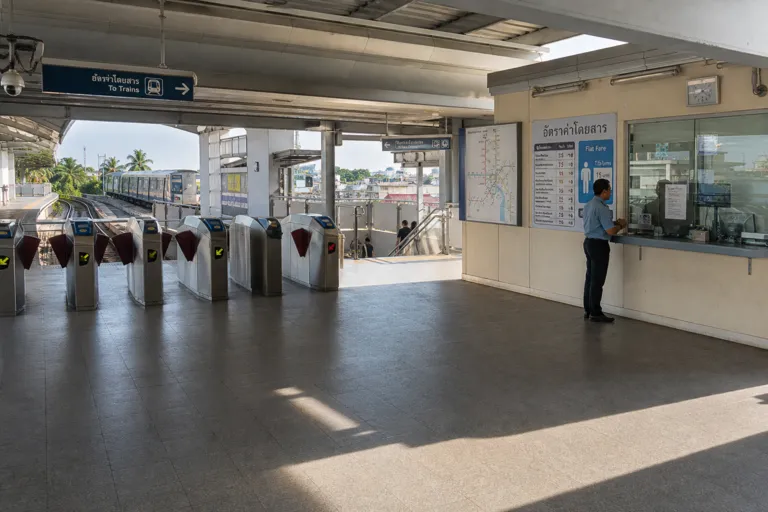
Bangkok’s rail story is shifting from a network-by-network fare discussion to a single-price debate about access, funding, and growth. A 20-baht flat fare has been positioned as cost-of-living relief and as a lever to move commuters from roads to rail. In Greater Bangkok, the policy is set to apply to all electric train services from October 1, 2025, with Thai citizens paying one price per ride across the city’s electric rail lines. Separately, the State Railway of Thailand (SRT) network has a cabinet-approved 20-baht flat fare for all routes, with an accelerated rollout that was expected to launch in April 2026, after initially being planned for May 1.
What changes the economics is not only the price point, but also the scope and the gap it creates versus prior fares. In Greater Bangkok, the unified fare covers 13 electric train lines across more than 279 kilometers and 194 stations, including the Green, Red, Blue, Purple, Yellow, Pink, and Gold lines, plus the Airport Rail Link. Before the flat rate, Bangkok train fares ranged from 15 to 62 baht depending on distance and route. The policy is explicitly limited to Thai nationals, while foreigners continue to pay regular fares under existing regulations, which adds a new operational and political constraint alongside the pricing shift.
Fare Caps Meet Expansion: New Lines, New Revenue Risk
Expansion planning is moving in parallel with fare intervention, and that pairing reshapes how projects can be financed. The Mass Rapid Transit Authority of Thailand (MRTA) has four new metro lines under study and development—Brown, Grey, Silver, and Blue—with milestones stretching from 2026 to 2028. In that framing, the 20-baht flat fare is presented as a tool to reduce financial burdens and boost ridership. MRTA’s approach is described as a PPP Gross Cost model, where private firms handle construction and operations while the government absorbs revenue risks, a structure that can make lower fares more feasible but also shifts financial exposure to the public side.
Policy analysis has warned that system-wide caps can destabilize revenues and make further expansion less affordable, even if lower prices improve affordability for some riders. An ISEAS Perspective piece noted that Bangkok’s mass transit remains underdeveloped compared to urban peers, with as much as a third of Bangkok’s population lacking easy access to mass transit trains. It also highlighted the complexity of Bangkok’s transit administration and the long-running political debate around a 20-baht cap for Thai citizens, planned to begin in October or November 2025, and expanding on a 2023 fare cap for some trains, including a 20-baht cap on the Purple Line that started in October 2023.
How the fare gap gets financed is becoming a central market signal for operators and suppliers tied to the Thailand urban rail transit market. For Bangkok’s electric trains, the government has said it will establish an Integrated Ticketing System Promotion Fund, financed through profits from MRTA and the national budget, to compensate operators such as BTS, MRT, BEM, and SRT. Legal reinforcement is expected through amendments to the MRTA Act and the Integrated Ticketing System Management Act. For the SRT’s 20-baht policy, implementation is described as a six-month trial to track KPIs including ridership, revenue, operational costs, and infrastructure strain, with concerns about peak-hour overcrowding and possible responses such as increasing train frequency and upgrading rolling stock.
What does Bangkok’s 20-baht flat fare cover?
How much were Bangkok electric train fares before the unified 20-baht price?
Who is eligible for the 20-baht flat fare on Bangkok’s electric trains?
How could the Thailand urban rail transit market be affected by a flat-fare cap?
What new metro lines are being studied for Bangkok, and when?