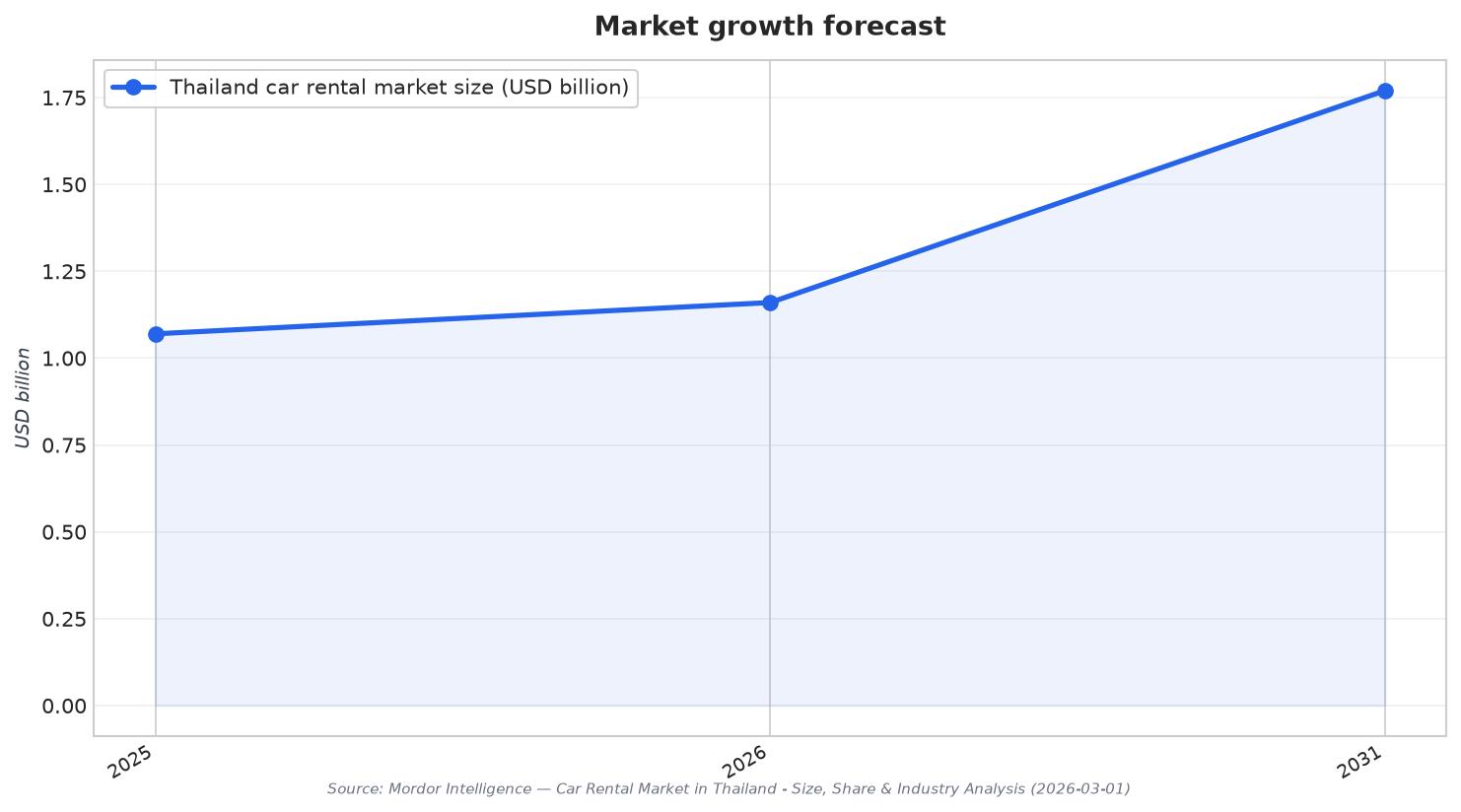
The Thailand car rental and leasing market is on a defined growth path, supported by both leisure mobility and corporate fleet needs. Mordor Intelligence values the Thailand car rental market at USD 1.07 billion in 2025 and estimates growth from USD 1.16 billion in 2026 to USD 1.77 billion by 2031, at a CAGR of 8.76% (2026–2031). Ken Research separately values the Thailand self-drive car rental market at USD 1.22 billion in 2025, while another Ken Research view places the broader car rental and leasing market at about USD 1.16 billion based on five-year historical analysis. Across these perspectives, the direction is consistent: demand is expanding, and operators are repositioning their fleets, channels, and products to capture it.
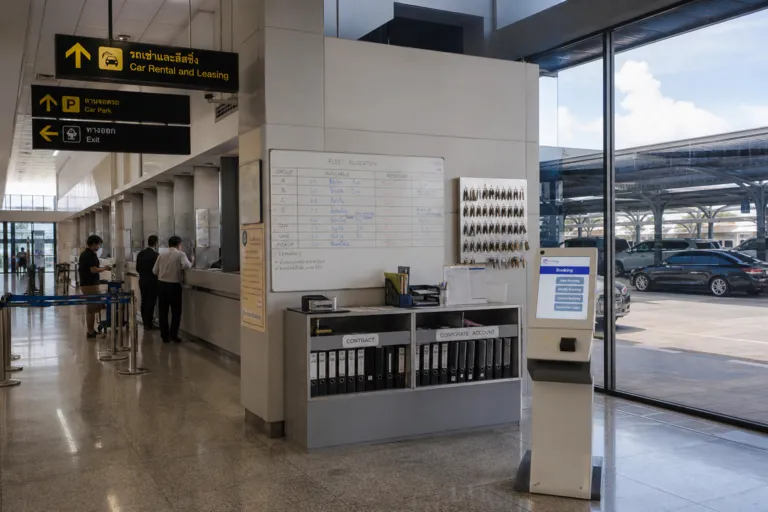
Tourism remains the volume engine, and distribution is increasingly digital. Mordor Intelligence reports that leisure and tourism accounted for 65.47% of Thailand’s car rental market in 2025, while online channels held 63.16% share that year and are projected to advance at a 9.28% CAGR through 2031. Airport counters are still pivotal, commanding 68.31% share in 2025, but downtown and off-airport outlets are growing at a 9.38% CAGR through 2031. MarkWide Research links peak demand concentration to Bangkok Suvarnabhumi Airport expansion and notes that tourists dominate transaction volumes. It also highlights Phuket and Chiang Mai as extended-stay corridors that generate recurring weekly rentals distinct from traditional tourist patterns.
Corporate Fleets, Long-Term Contracts, and Asset-Light Leasing Redefine Competition
Corporate demand is rising fastest, changing fleet utilization and pricing strategies. Mordor Intelligence states commuting and business rentals are the fastest-growing application segment, projected at a 9.43% CAGR to 2031. The same source shows short-term agreements still dominated with a 71.26% share in 2025, yet long-term contracts are projected to expand at a 9.41% CAGR through 2031, signaling deeper adoption of corporate subscriptions and extended-use models. MarkWide Research describes a shift toward asset-light leasing frameworks, where operators outsource fleet ownership to third-party financiers to compress capital requirements, even as this fragments control across stakeholders. In the wider ASEAN context, MarkWide Research adds that subscription-based fleet access is hardening into a core revenue model, reinforcing the pivot toward predictable recurring revenue.
Competitive playbooks show how global brands and strong local operators are responding. MarkWide Research says Thai Rent A Car leverages domestic network density to sustain pricing power in provincial airports, while Hertz anchors its presence through partnerships with Thai hospitality chains, and Chic Car Rent differentiates via localized service protocols. Mordor Intelligence’s global report notes that Enterprise Mobility expanded in Thailand in October 2024 through franchise partner Thai Rent a Car, opening Enterprise Rent-A-Car, National Car Rental, and Alamo branches. At the same time, Mordor Intelligence flags intensifying competition from peer-to-peer platforms and ride-hailing-linked rental schemes that squeeze traditional margins, pushing investment into differentiated service models and platform-led distribution.
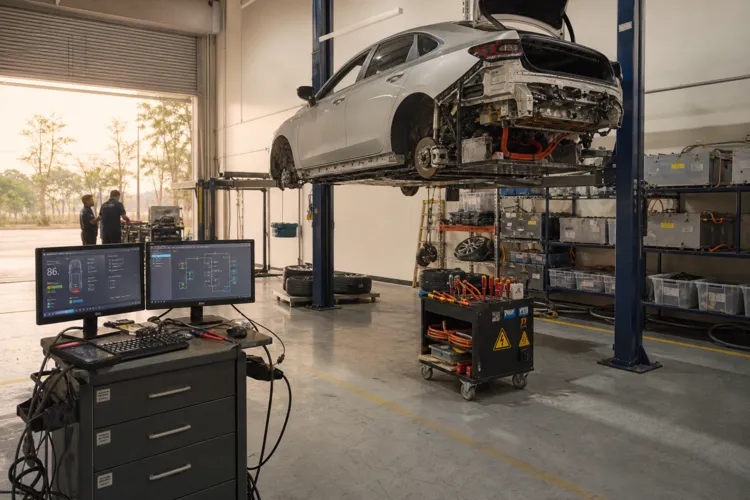
Fleet composition and compliance pressures are becoming a strategic lever, not just a cost line. Mordor Intelligence reports that internal-combustion engine vehicles held 87.15% share in 2025, while BEVs are expanding at a 12.36% CAGR through 2031. It also notes operators are adding BEVs to align with government sustainability incentives. MarkWide Research emphasizes that Thailand’s Department of Land Transport enforces commercial vehicle registration and periodic inspection standards that dictate fleet replacement timelines and maintenance cost structures. These rules, paired with the market’s tilt toward online booking and longer corporate contracts, create a clear imperative: keep fleets newer, deploy them efficiently across airport and city nodes, and design products that fit both tourist peaks and corporate travel calendars.
How big is Thailand’s car rental market, and what growth is forecast?
What share of bookings are made online in Thailand’s rental sector?
Are long-term rentals becoming more important for corporate fleets?
What is changing in fleet composition and electrification?
What are the key forces shaping the Thailand car rental and leasing market today?