Thailand’s pharmaceutical market was valued at USD 9.6 billion in 2025 and is forecast to reach USD 17.2 billion by 2033, with an expected CAGR of 7.6% from 2026 to 2033. Demand is linked to rising healthcare needs and chronic diseases, including diabetes, cardiovascular diseases, and cancer, which in turn lift usage of prescription medicines, biologics, and specialty drugs. In the current molecule mix, conventional drugs (small molecules) were the largest revenue-generating category in 2025, showing how foundational mature products and broad prescribing remain in the country’s medicine demand profile.
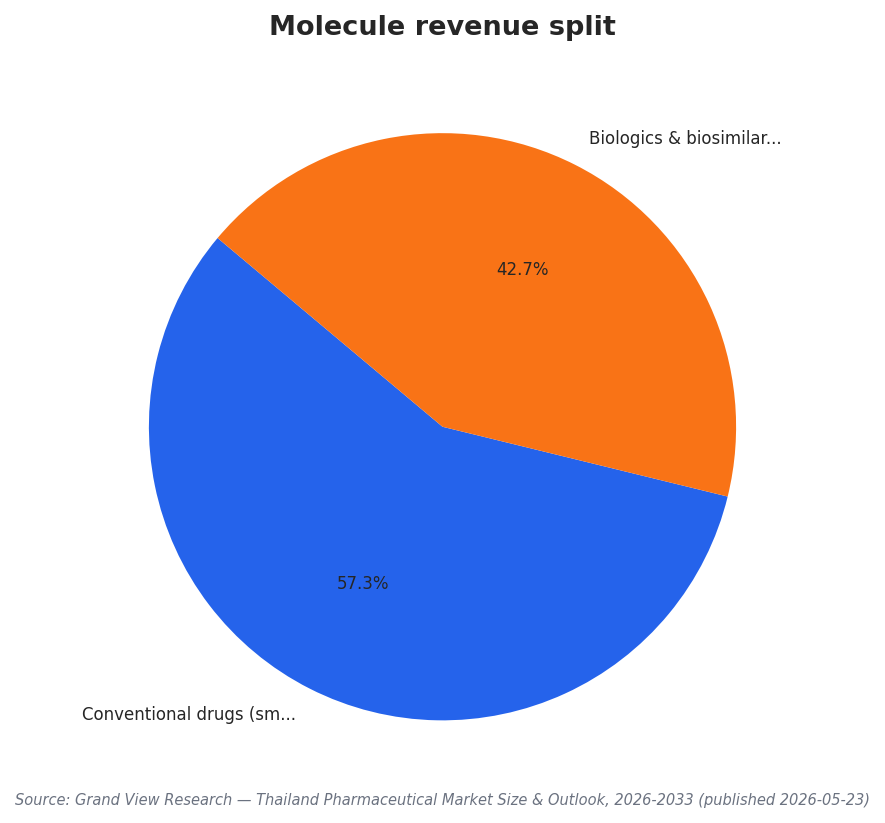
Generics remain central to the domestic production story. One industry overview describes generic drugs as the backbone of Thailand’s domestic pharmaceutical manufacturing, even as multinational firms largely dominate through import and distribution rather than local manufacturing. In the small-molecule segment, conventional drugs held a 57.29% revenue share in 2025, underscoring why price-sensitive and high-volume therapies matter commercially. Thailand also has a defined specialty pocket: the specialty injectable generics market is valued at USD 1.0 billion. That segment includes complex injectables and is being shaped by oncology use in hospitals, alongside growing activity in autoimmune, inflammatory, and infectious diseases, including HIV and hepatitis, as access and treatment protocols expand.
Biologics and Biosimilars: Faster Growth, Higher Stakes
While small molecules lead today, biologics and biosimilars are positioned as the faster-growth opportunity in Thailand’s market outlook. Grand View Research notes that biologics and biosimilars (large molecules) are expected to be the most lucrative molecule segment, registering the fastest growth during the forecast period. On the ground, biologics demand is tied to oncology and specialty care, and the competitive landscape is influenced by multinationals that bring products into the market through distribution. Local capability is also visible through state-linked production. The Government Pharmaceutical Organization (GPO) manufactures essential medicines and vaccines and, through Siam Bioscience, produces biologics for domestic use. Siam Bioscience is described as Thailand’s most advanced biologics manufacturer and a prominent signal of ambitions in biosimilar production.
The push for local production is not only about finished drugs. It also depends on inputs and manufacturing readiness, including pharmaceutical intermediates and excipients. Dedicated Thailand-focused reports frame pharmaceutical intermediates as pharmaceutical-grade chemical substances used as formulation components or process aids in the manufacturing of APIs and finished drug products, under strict pharmacopeial and regulatory standards. Similar Thailand-focused work defines pharmaceutical surfactants as amphiphilic excipients used to enhance solubility, stability, and bioavailability of active ingredients in regulated formulations. These categories matter because they map how supply capability, quality requirements, and workflow stages shape where companies can localize manufacturing and where they may still rely on external supply.
Thailand’s market also sits inside wider Asia Pacific strategies, where companies expand manufacturing and supply chains to reduce costs, speed delivery, and respond to disruption and regulation. Regional deal activity includes Sun Pharmaceutical Industries acquiring a niche dermatology-focused company in Thailand in September 2024 to broaden specialty offerings and reinforce its Southeast Asia presence. In the broader Asia Pacific context, conventional drugs held a dominant share of the regional pharmaceutical market in 2025, while biologics and biosimilars are expected to grow with an expected CAGR of 14.3% in the coming years. For Thailand, the commercial implication is clear: defend scale in generics, while investing in biologics and the manufacturing ecosystem needed to move up the value chain.
How big is Thailand’s pharmaceutical market, and what is the growth outlook?
Which molecule type leads revenue in Thailand today?
What is driving interest in biologics and biosimilars in Thailand?
What role do local and state-affiliated producers play in Thailand?
What is happening in the Thailand pharmaceutical industry around injectable generics?