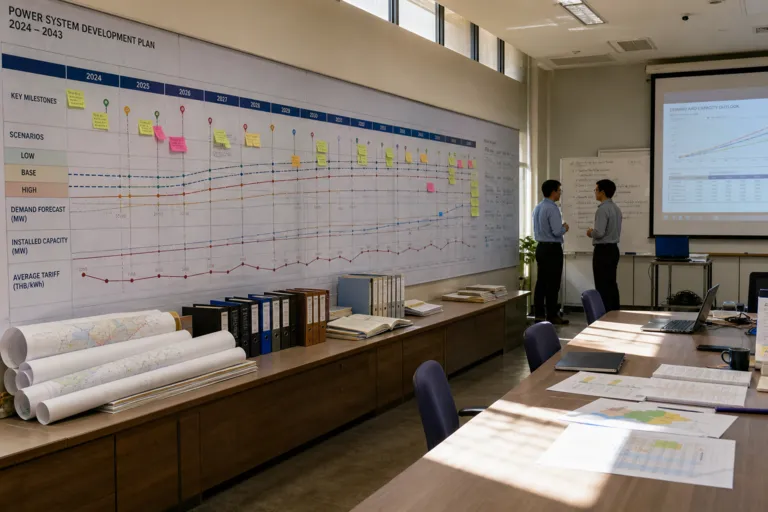
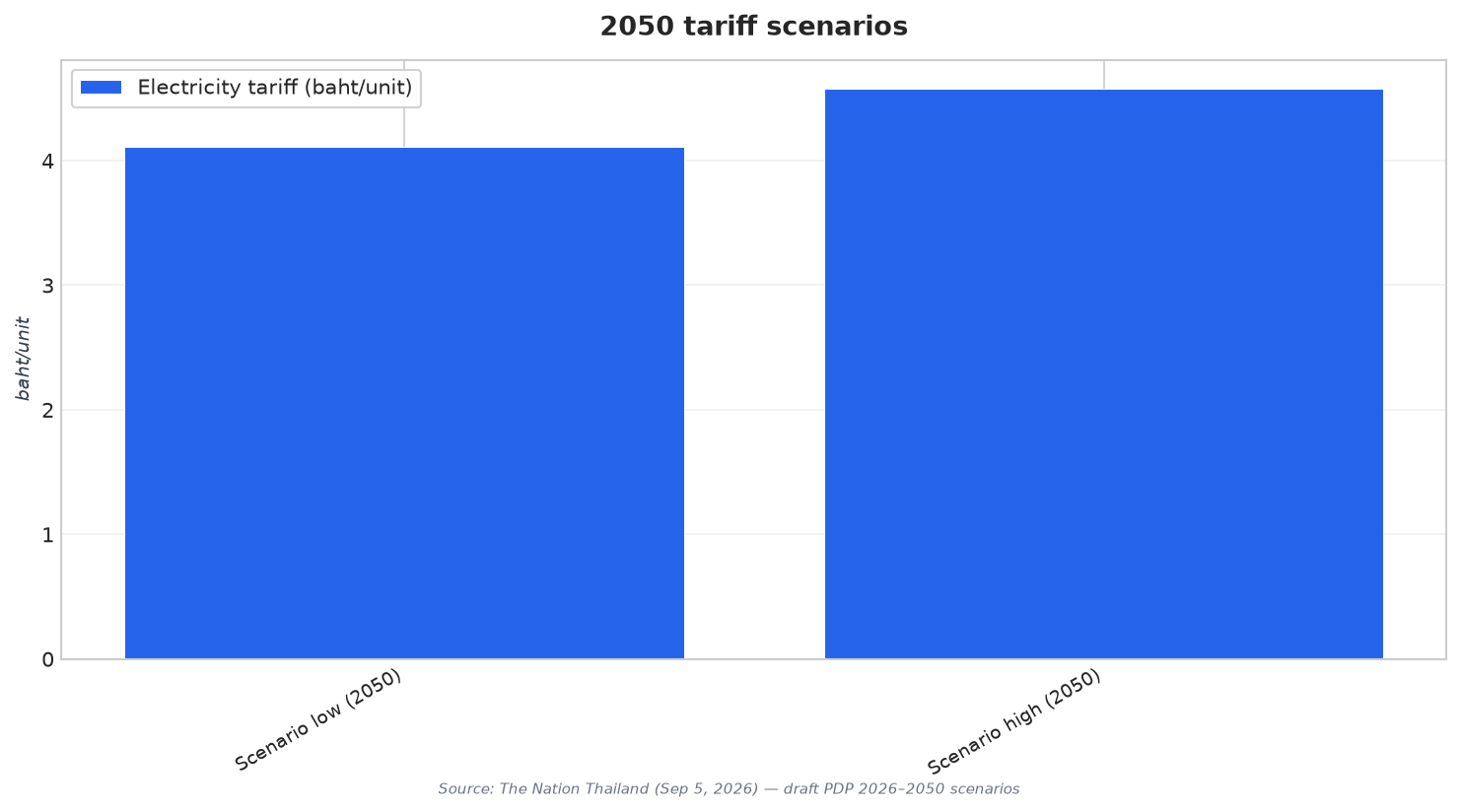
Thailand’s draft Power Development Plan for 2026–2050 (PDP 2026) puts the national debate on electricity prices into sharper focus. The Energy Policy and Planning Office (EPPO) said electricity tariffs in Thailand could reach 4.11–4.58 baht per unit in 2050 under four scenarios, reflecting trade-offs between integrating renewable energy and capturing carbon emissions. Over the longer period of 2027–2050, EPPO projects average retail tariffs of 3.83–3.89 baht per unit, depending on the scenario chosen. Those period-wide averages are lower than the projected end-of-plan rates, which is why the long-run direction still matters for households, industry, and new loads such as data centres.
Near-term tariff signals show why the long-range numbers attract attention. For May–Aug 2026, electricity in Thailand averages 3.95 baht per unit (including the Ft of 0.1623 baht per unit, before 7% VAT), compared with 3.88 baht per unit in Jan–Apr 2026 with an Ft of +0.0972. A separate ERC-linked outlook highlighted how sensitive bills can be to Ft scenarios, with possible tariffs described in a 4.65–6.01 baht per unit range, compared with a cited current rate of 4.18 baht per unit in that discussion. It also pointed to around 98 billion baht of debt owed to EGAT as one factor that can affect future tariffs as repayment resumes.
What PDP 2026 Changes, and Why Scenarios Diverge After 2037
PDP 2026 is structured around four cases that compare different combinations of clean energy, carbon capture, and conventional generation. EPPO notes the lowest-cost baseline would not achieve the 2050 net-zero emissions target, while the other three examine alternative routes towards it. All four cases share the same initial infrastructure programme during the plan’s first 12 years, from 2026 to 2037, before their development paths diverge more clearly after 2037. The proposed additions total 50,900 MW, including both electricity generation and battery storage. The draft also incorporates two cost categories that were not included in previous plans, reinforcing that the tariff pathway is tied to new system requirements rather than fuel prices alone.
Reliability planning is also being reframed in a way that can shape investment and, indirectly, prices. Instead of relying principally on reserve margins, the draft adopts Loss of Load Expectation (LOLE), with a threshold of no more than 1.0 day per year. EPPO has explained LOLE better accounts for changing demand and uncertainty in electricity generation, and it is a planning measure rather than a prediction of a full day of blackouts. At the same time, the plan supports more direct procurement. The National Energy Policy Council (NEPC) approved an expansion of direct power purchase agreements (Direct PPAs) and third-party access (TPA) on July 15, 2026, opening the way for industrial users and data centres to buy green electricity directly from producers.
Clean-power ambition sits alongside price management goals, which is why Thailand’s electricity tariff outlook is being discussed as both an industrial policy and an energy-transition issue. One summary of the energy plan says it commits the nation to at least 60% clean electricity by 2050 and is designed to keep the average tariff across its life at no more than four baht per unit, using a conservative GDP assumption of 2 to 2.5%. That same clean-electricity target is echoed in another PDP 2026 overview, which also notes the plan is expected to be finalised around August to September 2026. EPPO’s public consultation on September 8, 2026 is positioned as the point where stakeholders can test assumptions across all four scenarios before the draft is revised and presented to the NEPC.
What does PDP 2026 project for Thailand’s electricity tariff by 2050?
How does the plan try to balance clean power with affordability?
What reliability metric is PDP 2026 using instead of reserve margins?
What near-term tariff figures were cited for 2026 and the Ft adjustment?
What does the Thailand electricity tariff outlook imply for how businesses buy power?