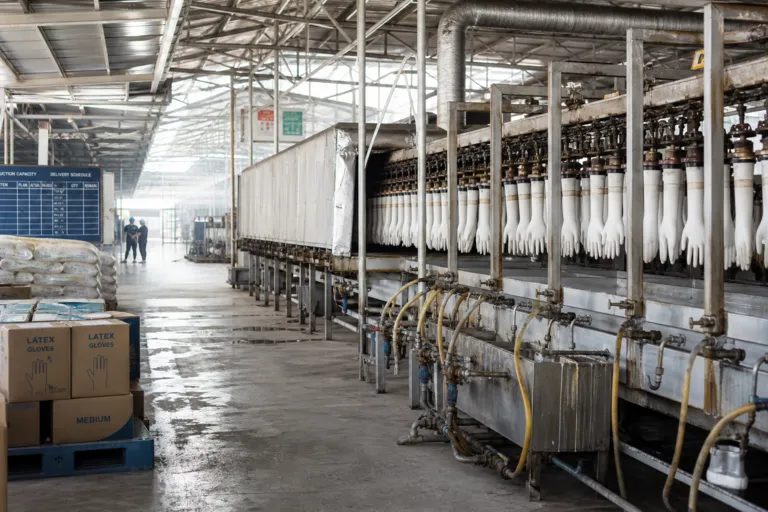
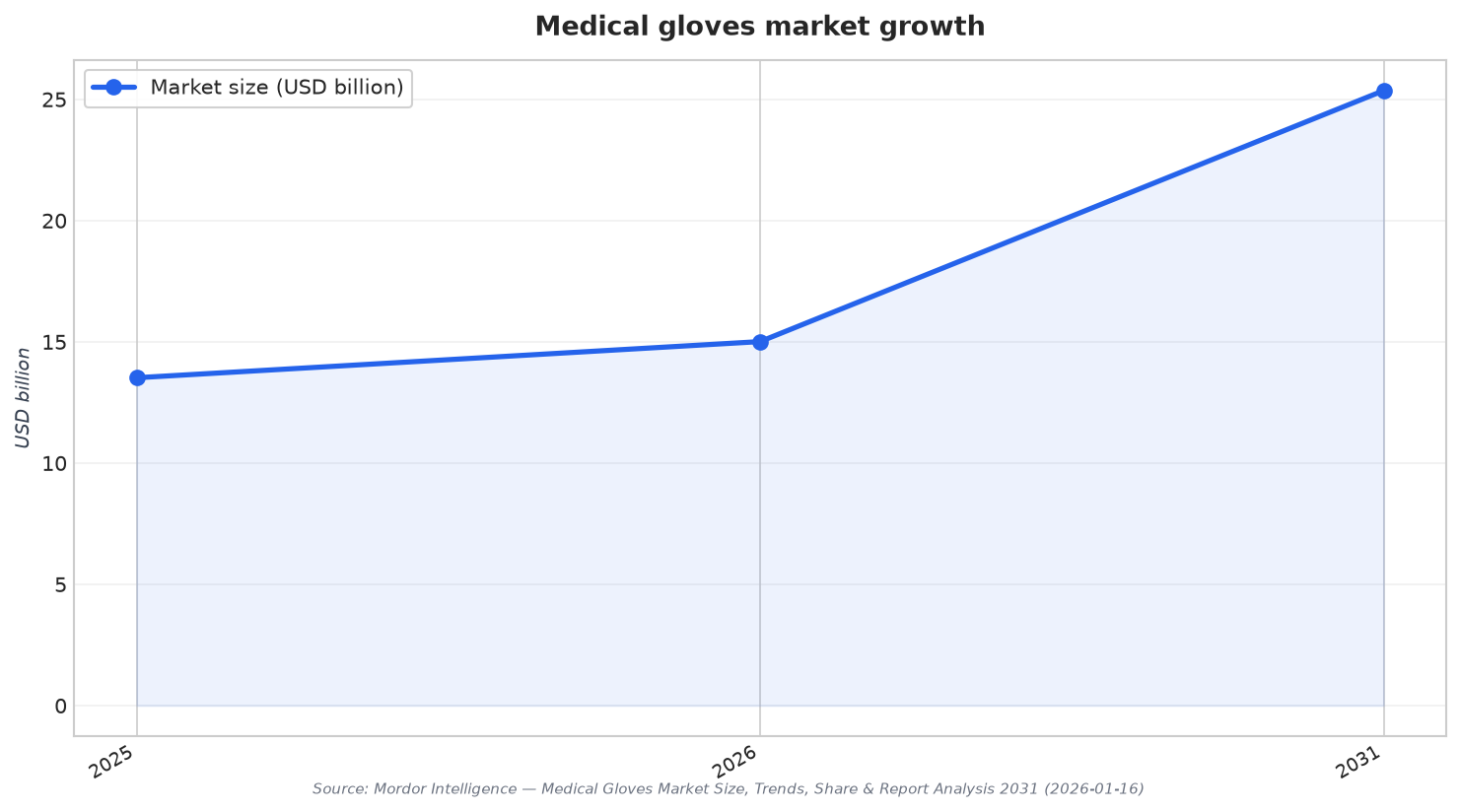
Global demand fundamentals are helping Thailand’s Medical Glove Industry rebound, even as input costs move higher. Mordor Intelligence values the global medical gloves market at USD 13.52 billion in 2025 and estimates it will grow from USD 15.01 billion in 2026 to USD 25.36 billion by 2031, at a CAGR of 11.05% from 2026 to 2031. The same report notes that nearly three-quarters of global output is located in Malaysia and Thailand, linking the demand upswing directly to the region’s producers. It also highlights a shift by procurement teams toward multi-year contracts to lock in volume and pricing, improving visibility for manufacturers while raw-material volatility remains a key consideration.
Within that demand base, product segmentation matters for Thailand-based suppliers planning their mix. In the medical gloves market, examination gloves led with a 62.94% revenue share in 2025, while non-sterile gloves accounted for 71.64% of market share in 2025, according to Mordor Intelligence. By material, nitrile gloves held a 47.82% share in 2025, while neoprene gloves are forecast to grow at a 12.22% CAGR through 2031. End users also shape order stability: hospitals and clinics held a 47.18% share in 2025. These splits help explain why volume-oriented production remains central, while specialty lines can be positioned around faster-growth niches as tenders evolve.
Demand Signals Are Firm, but Supply and Pricing Stay Dynamic
Broader rubber glove market indicators reinforce the same theme: demand is resilient, but supply conditions and pricing power can change quickly. IndustryResearch.biz reports that more than 350 billion disposable gloves are manufactured globally each year and cites a 62% increase in global demand for single-use protective gloves across healthcare and industrial sectors since 2020. The same source flags constraints too, stating that 41% of small and medium producers face raw material supply disruptions and nitrile concentrate shortages affecting production volumes. In surgical gloves, Mordor Intelligence values the market at USD 5.04 billion in 2025 and estimates growth from USD 5.26 billion in 2026 to USD 6.54 billion by 2031 at a 4.44% CAGR, adding another steady-use segment that supports baseline consumption.
Asia-Pacific’s production role provides important context for Thailand’s manufacturers as natural rubber costs rise and buyers compare sourcing options. IndexBox estimates Asia-Pacific accounts for 60–65% of global rubber glove production, with manufacturing concentrated in Malaysia, China, and Thailand, and notes Thailand’s southern provinces are integrated with natural rubber supply. On the consumption side, IndexBox describes mature markets such as Japan, Australia, and South Korea showing per-capita usage over 50 pairs per year, while developing economies such as India, Indonesia, Vietnam, and the Philippines often remain below 10 pairs per year, implying additional headroom. Verified Market Reports also describes Asia-Pacific as the dominant force in rubber gloves, highlighting Malaysia, Thailand, and China as beneficiaries of well-established latex production capabilities and supportive policies for PPE manufacturing.
Competitive strategy is also shifting as buyers add new decision factors and as product formats standardize. Mordor Intelligence notes that environmental, social and governance criteria can account for up to one-fifth of tender scores, effectively making sustainability a prerequisite for high-value bids. In surgical gloves, powder-free variants commanded an 87.65% share of market size in 2025, showing how regulation and user preference can concentrate demand into specific specifications. For Thailand’s producers, the rebound story is therefore not only about higher volumes. It is also about adapting to multi-year contracting, navigating raw-material swings tied to rubber and nitrile inputs, and aligning investment with the product categories and tender requirements that are gaining share globally.
What is driving the rebound in Thailand’s medical glove sector?
How big is the examination glove segment in the global market?
Which materials are leading medical glove demand globally?
What supply-side pressures are affecting glove producers?
How concentrated is rubber glove production in Asia-Pacific?