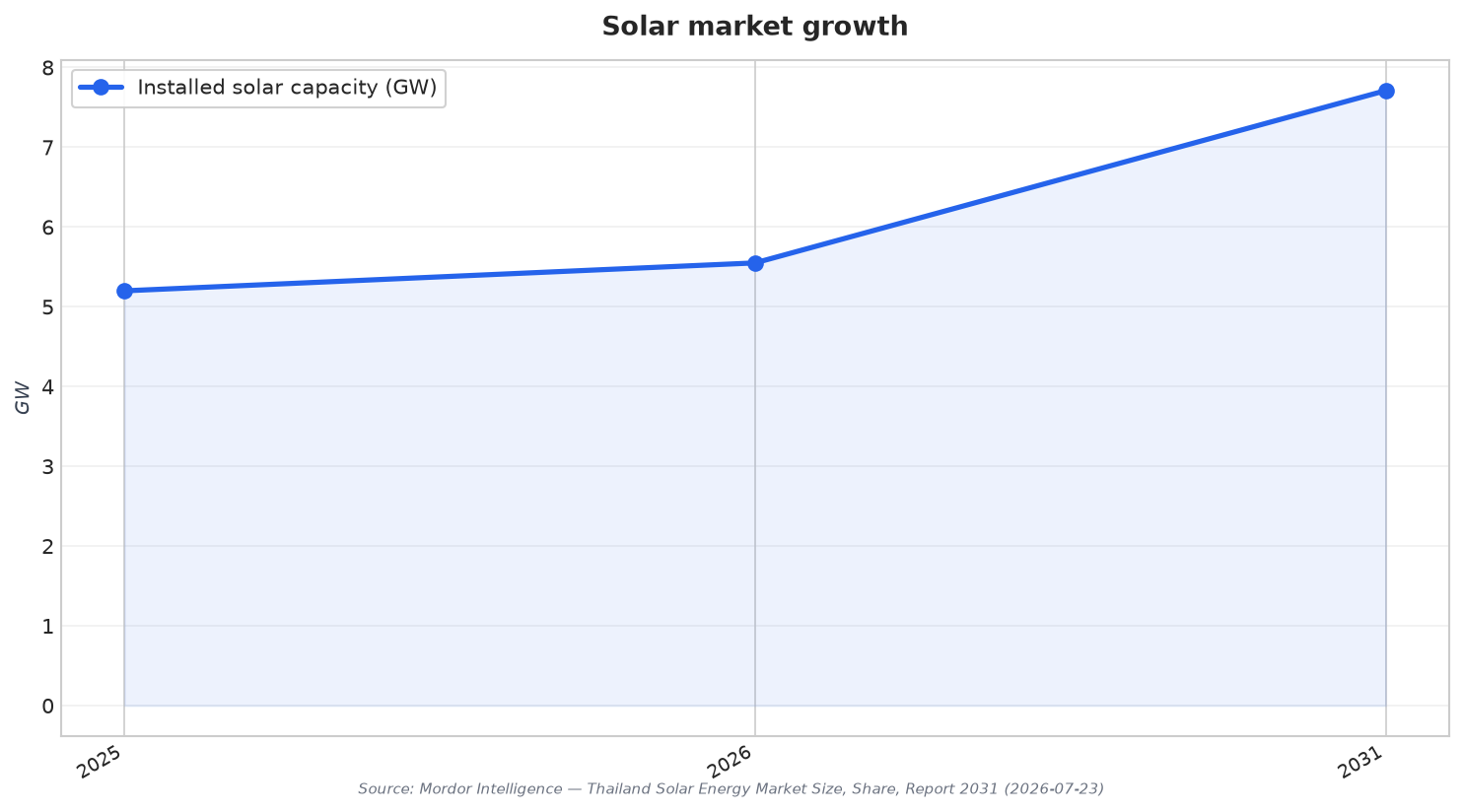
Thailand’s solar pipeline is moving toward water-based deployment as developers work around land limits and grid bottlenecks. Mordor Intelligence forecasts the Thailand solar energy market to grow from 5.20 GW in 2025 to 5.55 GW in 2026, reaching 7.71 GW by 2031, at a 6.78% CAGR over 2026–2031. In 2025, photovoltaic (PV) systems held 100.00% of installed capacity while concentrated solar power remained commercially inactive. On-grid systems also dominated, holding 90.12% share in 2025. This context sets up why hydro-floating hybrids matter: they offer a route to scale PV while tapping established infrastructure.
Cost and tariff dynamics are reinforcing the business case for more solar, including floating projects tied to hydro assets. Retail tariffs were THB 4.15–4.18 per kWh in 2024, while the Electricity Generating Authority of Thailand (EGAT) reported cumulative losses of nearly THB 98 billion, which Mordor Intelligence notes could imply an 8–12% tariff hike by late 2025. At the same time, PV economics improved as module prices fell to USD 0.10–0.12 per watt in 2024, trimming commercial payback periods to five to seven years. A typical 1 MW rooftop installation can pay for itself within seven years, supporting broader demand from commercial buyers and manufacturers seeking to hedge electricity-price volatility.
Hydro-Floating Hybrids: A Direct Path to More Grid-Ready Solar
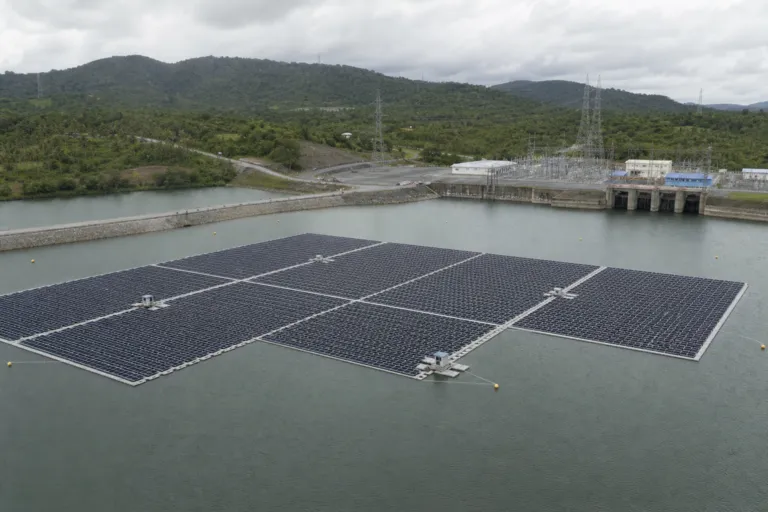
Hydro-floating hybrid projects are emerging as a practical way to add capacity without the same land-acquisition hurdles as ground-mounted solar. Mordor Intelligence describes EGAT’s floating-solar roadmap spanning nine reservoirs totaling more than 2,700 MW, and separately notes floating-solar hybrid projects planned for nine hydroelectric reservoirs adding 2.7 GW of incremental capacity. The IEA-PVPS member page for Thailand cites a draft AEDP 2024 floating solar target hybrid with hydropower plants at 2,789 MWp. A concrete reference point is the Sirindhorn Dam Hydro-floating Solar Hybrid Project, which became operational in 2021 with 58.5 MW installed capacity, illustrating how hybridization can optimize existing hydro infrastructure while expanding solar output.
Technology choices are also adapting to the realities of floating PV. Mordor Intelligence notes bifacial modules are quickly becoming standard in floating-solar tenders, and reports the Ubolratana project registered 5–8% higher output than monofacial arrays. At the cell level, TOPCon is cited at 24–25% conversion efficiency, with developers using multi-year supply contracts to stabilize component pricing. These improvements matter because Thailand also faces integration constraints. Developers report approval times of six to eighteen months due to voltage-stability studies and substation-capacity reviews, and in 2024, curtailment events totaled up to fifty hours in feeders where solar penetration exceeded 18% of daytime demand.
Against that backdrop, the Thailand floating solar market is best understood as part of a broader power-system shift that still depends on gas but is absorbing more PV each year. Mordor Intelligence estimates Thailand installed nearly 3 GW of solar PV capacity in 2024, raising cumulative solar capacity to 11.875 GW. Its Thailand power market work also states installed thermal capacity, dominated by natural-gas plants, accounted for 75.6% of the power market in 2024. Policy and procurement changes are adding momentum on the demand side. A 2,000 MW direct power purchase pilot approved in 2024 opens an alternative procurement path, while Third-Party Access code finalization in 2025 is expected to unlock up to 2 GW of direct PPAs for data centers and export-manufacturing clusters.
What is driving growth in Thailand’s floating solar and hydro-hybrid pipeline?
How does the Thailand floating solar market fit into the country’s broader solar outlook?
What project shows Thailand’s hydro-floating model in operation today?
What grid challenges could slow solar project delivery in Thailand?
What numbers show improving solar economics for Thai buyers and developers?