
Thailand is moving toward fuel standardization around gasohol E20, a gasoline blend with 20% ethanol, as the country heads into 2026. According to Hydrocarbon Processing, Thailand extended subsidies on biofuels by two years until September 24, 2026, aiming to boost the use of E20 among other blends, and policy is moving toward standardizing around E20 while retiring legacy fuel grades. The Department of Energy in 2024 allowed oil companies to market E20 on a voluntary basis, but it did not set a binding timeline for making the 20% blend compulsory, citing the need to ensure domestic ethanol supply and vehicle compatibility. That context matters as the market braces for a year when E20 is expected to become the standard grade.
Producers say supply readiness is not the immediate bottleneck. The Bangkok Post reported that Thailand has ethanol production capacity of 7.2 million liters per day from 28 plants nationwide, with surplus capacity of 50% to 60%, according to the Tapioca Ethanol Association. The same report put Thailand’s ethanol consumption at roughly 3.5 million liters per day, while total gasoline consumption exceeds 30 million liters per day. If E20 is actively promoted as the primary fuel, the Thai Ethanol Manufacturing Association expects ethanol demand to rise to more than 6 million liters per day. Energy officials are also focused on retail pricing, with a caretaker energy minister saying the government wants to widen the price gap to around 5 baht per liter to accelerate adoption.

E20 Momentum Meets an EV Shift
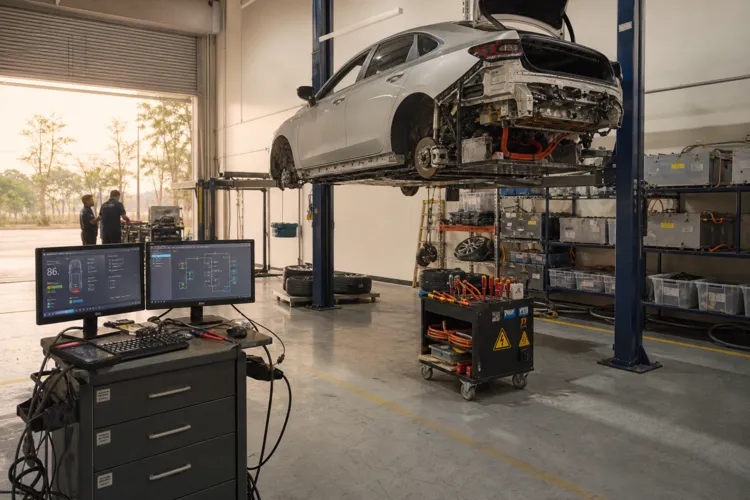
Even as E20 is pushed into the mainstream, the vehicle market is changing fast. RECCESSARY reported that Thailand’s battery electric vehicle (BEV) market is projected to exceed 120,000 units in 2026, citing the Electric Vehicle Association of Thailand (EVAT), with volatile oil prices pushing consumers toward alternatives to gasoline-powered cars. The same report highlighted commercial vehicles—trucks, vans, and pickups—as an emerging growth segment as logistics operators try to reduce exposure to fuel cost volatility. In parallel, Marqstats valued Thailand’s EV market at USD 3.80 Bn in 2025 and projected it to reach USD 9.50 Bn by 2030 at a 20.12% CAGR. This creates a balancing act: E20 can expand quickly inside the combustion fleet, while BEVs chip away at future petrol demand.
Policymakers and industry groups are signaling ambitions that go beyond incremental growth in E20 volumes. Chiang Rai Times reported that energy officials want to push E20 usage beyond 10 million liters per day and described a planned relaunch of gasohol E20 in late 2026 to lift consumption well past that level. It also stated that Thailand currently produces roughly seven million liters of raw ethanol each day. This type of demand target implies not only more blending, but also distribution execution, such as ensuring availability at service stations and aligning automakers around E20-compatible vehicles. For ethanol producers, the near-term opportunity is clear, but it depends on consumer switching behavior and retail price signals.
Longer term, Thailand’s biofuel strategy is being debated in a world where some peers mandate much higher blends. Krungsri Research pointed to Indonesia’s announced mandatory B50 from 1 July 2026 onward, and referenced Brazil’s use of E100, but it warned that Thailand faces constraints that differ from major energy-crop producing countries. The report listed structural issues including insufficient upstream feedstock supply, the enforcement of emission standards, Thai consumers’ growing preference for EVs, and the risk that high-blend fuels could damage engine systems. It suggested an alternative direction: developing advanced biorefining to produce drop-in fuels such as renewable diesel (HVO) or sustainable aviation fuel (SAF), aimed at premium export markets and the global aviation industry. In this transition, the Thailand ethanol industry sits at the center of a policy push for E20 today, and a strategic question about what comes after petrol demand peaks.
What is E20 and why is Thailand pushing it in 2026?
Does Thailand have enough ethanol supply to support higher E20 demand?
How fast is Thailand’s BEV market growing in 2026?
What demand level are officials targeting for E20 consumption?
What is the outlook for the Thailand ethanol industry as EVs expand?