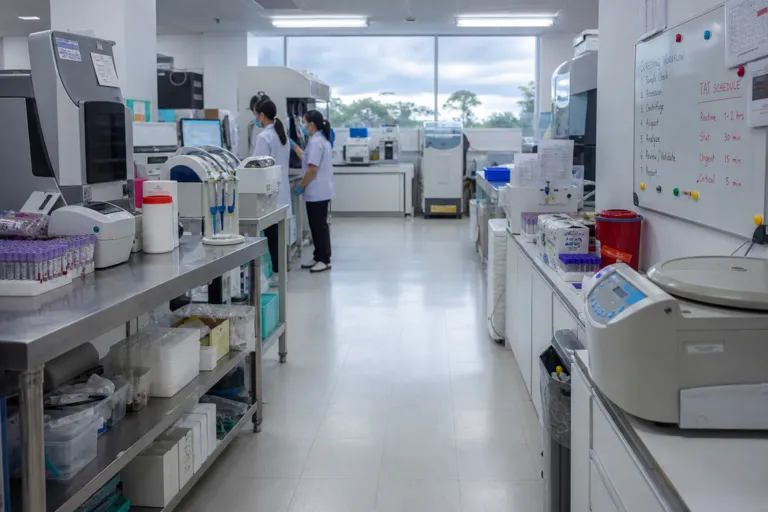
Thailand’s diagnostics and lab services are growing as healthcare demand shifts toward early detection and preventive care. Nexdigm notes that Thailand’s clinical diagnostics market is already generating over USD 500 million, with increasing awareness around regular health check-ups helping lift demand. Ken Research also describes a large recurring-testing base supported by Thailand’s approximately 71.7 million residents in 2024, where routine chemistry, hematology, microbiology, and disease screening are tied to ageing and chronic-care pathways. Across the country, growth drivers include advancements in diagnostic technologies, laboratory automation, and government initiatives aimed at improving healthcare accessibility and quality standards.
Population ageing is a central demand signal for routine monitoring and early disease detection. NextMSC reports that nearly 20% of Thailand’s population is over 60, reinforcing sustained testing needs. Ken Research adds that test volumes are increasingly influenced by ageing and chronic-care pathways, while Nexdigm highlights rising chronic illnesses such as diabetes, cancer, and heart conditions as a factor pushing more accurate and timely testing. These pressures connect directly to the day-to-day workloads of hospital labs and independent facilities, where blood tests, urine tests, and microbiological tests remain foundational for diagnosis and ongoing disease management in clinical practice.
Where Growth Concentrates: Bangkok, Hospitals, and Higher-Complexity Testing
Market activity concentrates where infrastructure, specialists, and patient flows are densest. Nexdigm identifies Bangkok as the dominant city, hosting much of the country’s advanced healthcare infrastructure and state-of-the-art diagnostic technologies. Ken Research similarly points to Bangkok and the Central Region as the principal commercial hub, and notes that Bangkok Dusit Medical Services operated more than 50 hospitals across its network in 2025, enabling centralized procurement, specimen routing, and referral testing. On the demand side, Nexdigm’s segmentation shows hospitals as a dominant end user because they provide comprehensive diagnostic services and increasingly invest in advanced equipment, while clinical laboratory testing is described as having a dominant share due to extensive use across diseases.
Technology mix is also evolving toward higher-complexity assays and faster workflows. Ken Research values Thailand’s clinical laboratory market at USD 1,380 million in 2025 and projects it to reach USD 2,050 million in 2032, representing a 5.82% CAGR, compared with a 5.65% historical CAGR during 2020–2025. Ken Research also identifies molecular and genetic testing as the fastest-growing segment for 2025–2032, while Nexdigm highlights growing adoption of molecular diagnostics, genetic testing, imaging, and laboratory automation. In parallel, IndexBox reports that laboratory test volumes are rising at about 4% per annum and links this to a shift from manual to automated testing platforms that consume higher-value reagents.
The IVD supply chain provides another lens on demand, because reagent usage scales with test complexity and throughput. NextMSC estimates Thailand’s in-vitro diagnostics market at USD 1.03 billion in 2023 and ties ongoing demand to population ageing and preventive-care initiatives. IndexBox describes Thailand as primarily a demand center for IVD reagents and notes the country operates more than 1,000 government hospitals and 350 major private hospitals, supported by regional and community laboratories. IndexBox also reports molecular diagnostics expanding at an 8–10% CAGR, citing expanded cervical cancer screening, hepatitis C elimination initiatives, and HIV viral load monitoring under the national AIDS program. Together, these dynamics shape the Thailand medical laboratory market as labs balance routine volume with a growing share of specialized testing.
What is driving growth in Thailand’s diagnostic labs and medical testing services?
How large is Thailand’s clinical laboratory market, according to Ken Research?
How does an aging population affect demand for lab testing in Thailand?
Which testing areas are expanding fastest in the Thailand medical laboratory market?
Why is Bangkok so important to Thailand’s diagnostics and laboratory ecosystem?