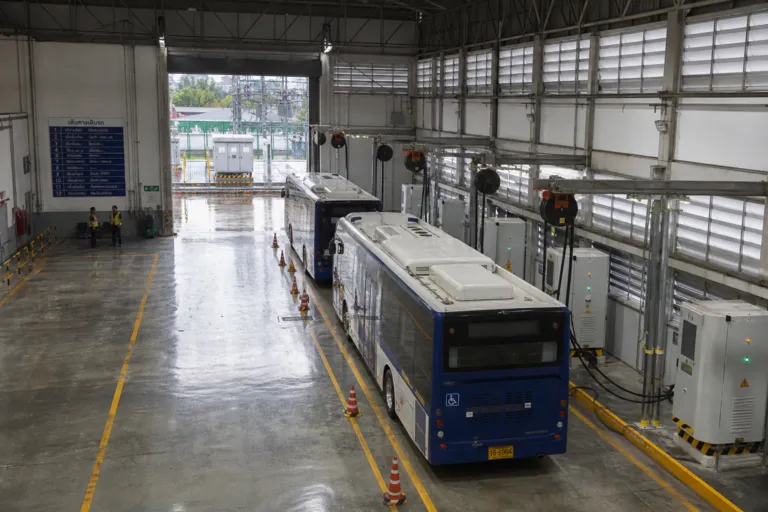
Bangkok is no longer testing electrification at the margins. The Bangkok Mass Transit Authority operates a fleet of 2,350 electric buses across 124 routes, and it plans to replace over 2,000 diesel buses with EVs by 2029. That scale matters for how Thailand’s bus ecosystem develops, because it forces practical decisions on route planning, depot operations, and charging uptime. It also helps explain why the market is often discussed through an urban lens. One Thailand-focused market assessment notes that growth is driven by government support and rising demand for cleaner public transport, with adoption concentrated in urban centers such as Bangkok and Chiang Mai where congestion and air quality concerns are most pressing.
Looking beyond the city operator’s headline fleet, the Thailand electric bus market is also broadening into a systems-and-platform story. Nexdigm segments the market by product type into Battery Electric Buses, Plug-in Hybrid Electric Buses, Fuel Cell Electric Buses, Charging Infrastructure Systems, and Battery Management Systems. It also segments by platform type into Urban Platforms, Intercity Platforms, Electric Bus Depots, Charging Stations, and Integrated Platforms. In that breakdown, battery electric buses lead due to higher efficiency and decreasing battery technology costs, while urban platforms dominate because electric buses are increasingly positioned as a practical response to air pollution and congestion. This framing aligns with Bangkok’s day-to-day needs, where regular schedules and dense ridership can help justify investments in depots and charging stations.
Bangkok’s Momentum Is Pulling Infrastructure and Supply Chains Forward
Bangkok’s electrification push is happening as Thailand’s broader EV market shows early but visible commercial uptake. Department of Land Transport registration data cited in a Thailand EV market report shows that in January–February 2026, commercial EV registrations included 19 buses, alongside 98 pickup trucks/vans and 95 trucks. The same report emphasizes that commercial electrification is infrastructure-limited and expected to expand as fleet depot charging and commercial EV incentives develop. In practice, the bus segment is highly sensitive to depot readiness, grid connections, and operational planning. This is why market narratives in Thailand increasingly connect vehicle procurement to enabling layers like charging stations, depot build-outs, and battery management systems.
Competitive dynamics also reinforce the direction of travel. Nexdigm describes a landscape shaped by both international and local players, with strategic partnerships and joint ventures with local governments and transport authorities helping to expand infrastructure and adoption. It points to the influence of global players such as BYD and Volvo Buses alongside local manufacturers. Regionally, Asia-Pacific research highlights how certification requirements and platform choices shape supply availability, including China’s GB/T 34014 battery certification influencing supplier eligibility across the Asia-Pacific electric bus supply base, while fast charging station infrastructure is described as expanding fastest among charging modalities. For Thailand, these regional pressures function as context rather than local performance metrics, but they still shape vendor strategies, technology roadmaps, and sourcing decisions for fleets.
At a global level, the electric bus sector is being pulled by public transport procurement. One global market report states that public transport authorities accounted for 68.9% of the global electric bus market in 2025. That context helps explain why Bangkok’s fleet actions can influence how suppliers prioritize bids, services, and partnerships in Thailand, even though the global share itself is not Thailand-specific. With Bangkok already operating thousands of electric buses and planning further diesel replacement by 2029, the immediate next phase is execution: keeping vehicles on the road, scaling depots and charging stations, and aligning local partnerships so that electrification becomes routine rather than exceptional.
What is driving the electric bus scale-up in Bangkok?
How is the Thailand electric bus market being segmented by industry researchers?
What do Thailand’s recent commercial EV registrations show about bus adoption?
Which companies are referenced as influential in Thailand’s electric bus competitive landscape?