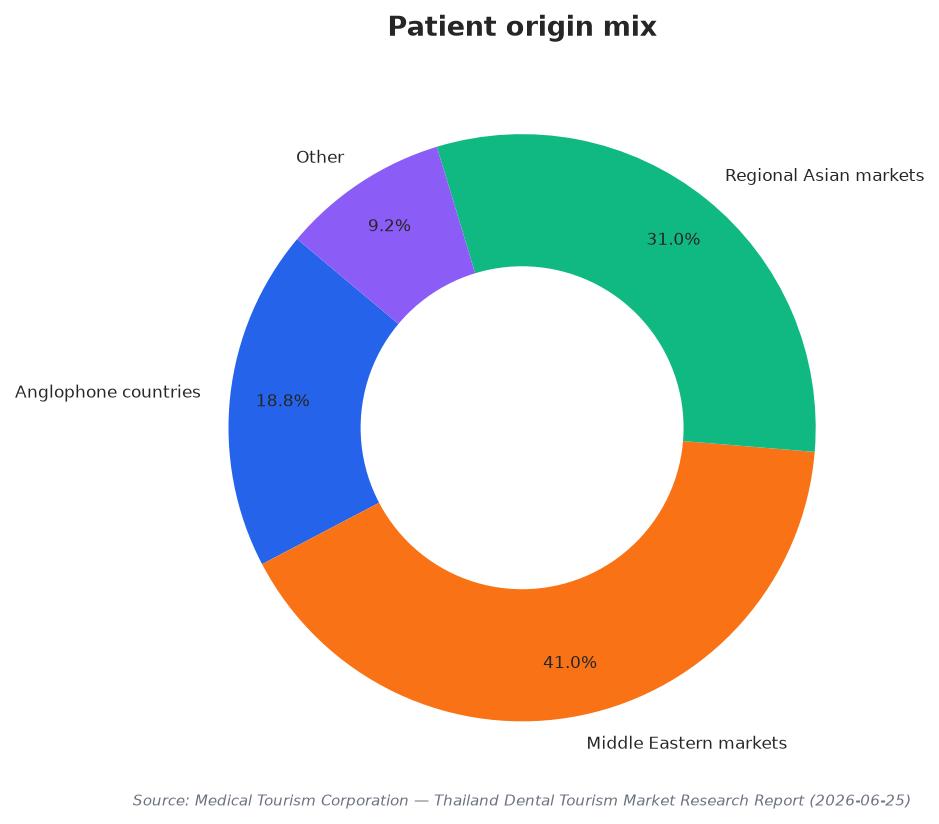
Thailand is widely positioned as Southeast Asia’s leading destination for international dental care. Medical Tourism Corporation estimates the country serves around 972,000 international dental patients annually, equal to about 1.5% of Thailand’s 64+ million total foreign visitors. The same source frames that volume as 12 times Vietnam’s emerging dental sector. Within the estimate, Anglophone markets total about 183,000 patients (18.8%), while Middle Eastern markets account for roughly 350,000–400,000 patients (36–41%) and regional Asian markets contribute about 250,000–300,000 patients (26–31%). This mix matters because it shapes which services grow fastest and how clinics package care for different travel patterns.
In the Thailand dental tourism market, the money follows procedures that are expensive at home and predictable to schedule abroad. Grand View Research reports dental implants were the largest revenue-generating service in 2025, with a 44.93% revenue share. It also describes dental cosmetics as the most lucrative segment and the fastest-growing during the forecast period. Travel And Tour World similarly characterizes implants as the largest revenue segment and says “smile makeovers,” including porcelain veneers and laser whitening, are the fastest-growing category. Both sources emphasize that while routine cleanings exist, the market is increasingly dominated by higher-acuity elective treatments that are worth building a trip around.
Why Implants and Cosmetic Dentistry Keep Winning
Pricing remains a structural driver for inbound demand, especially for implants. Medical Tourism Corporation reports implant procedures cost about $900–1,500 in Thailand versus $3,500–6,500 in the United States, $2,600–3,900 in Australia, and $2,500–4,400 in the UK. It states this can translate to 60–75% savings, even including international airfare and accommodation. For All-on-4 full-arch reconstruction, it cites $10,000–15,000 in Thailand versus $25,000–50,000 in the United States, implying savings of $15,000–35,000 per patient. Travel And Tour World also points to a roughly 60% cost gap for a crown or implant in Thailand compared with the West, reinforcing why these procedures justify travel.
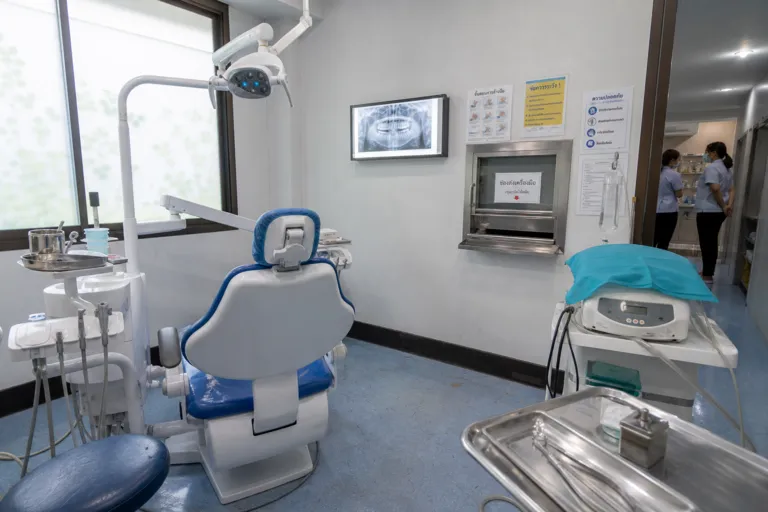
Capacity and service design help convert interest into bookings. Medical Tourism Corporation cites 50+ JCI-accredited hospitals with dental departments and 2,180+ dental clinics across six major cities, creating provider density and a quality-assurance backbone. It also notes major hospital groups—including Bumrungrad International, Bangkok Hospital Group, and Vejthani—operate dental tourism departments that bundle logistics such as flight coordination, interpreter services, and post-procedure follow-up. Connectivity is part of the same conversion funnel: the report highlights daily direct flights from Sydney, Melbourne, Brisbane, and Perth to Bangkok and Phuket (7–10 hours), plus multiple daily London–Bangkok services (12 hours) via British Airways and Thai Airways.
Economic impact estimates underscore why stakeholders are tracking this segment closely. Medical Tourism Corporation estimates Thailand’s dental tourism generates $4.2–5.0 billion in annual dental tourism revenue, with total economic impact including multiplier effects reaching $8.4–9.0 billion. It adds that this activity supports about 140,000–165,000 direct and indirect jobs and yields around $650–850 million in annual government tax revenue. Not every source uses the same market framing: Travel And Tour World references a “Thailand Dental Services Market” sized at $1.7 billion and describes a tenfold increase in U.S. demand, while an MMR Statistics preview attributes implant market momentum to dental tourism inflows, rising cosmetic dentistry demand, and expanding private clinic networks, without publishing the locked values.
How big is Thailand’s inbound dental patient volume each year?
Which services lead revenue in Thailand’s dental tourism demand?
How much can patients save on implants by traveling to Thailand?
What infrastructure supports international patients in Thailand?
What is driving the Thailand dental tourism market toward implants and cosmetic work?