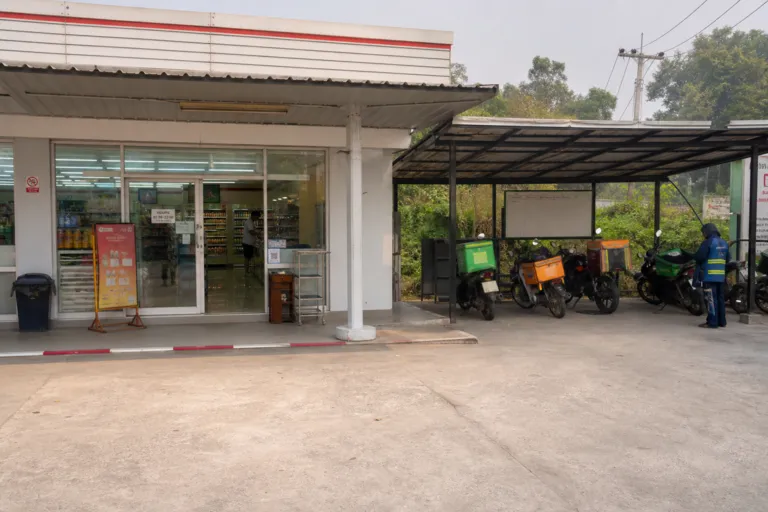
Thailand’s convenience retail is shifting from a Bangkok-centered growth play to a wider provincial expansion story. In the broader Thailand retail market, convenience stores held 38.78% of retail market share in 2025, and Mordor Intelligence forecasts the convenience store segment to grow at a 10.15% CAGR from 2026 to 2031. This reach is developing alongside a retail landscape where traditional mom-and-pop outlets still accounted for 44.10% of the Thailand retail market share in 2025, highlighting why modern chains see headroom in up-country markets. The direction is reinforced by the report’s view that modern trade chains are extending footprints into rural provinces using mobile wallets and data-driven category management.
Digital payments are one practical lever to unlock provincial growth. Mordor Intelligence cites that PromptPay usage topped 52.7 million accounts, based on the Bank of Thailand, helping steer consumers toward “friction-free” shopping journeys. That matters when convenience outlets double as neighborhood service hubs, supporting repeat trips and replenishment baskets. Operators are also building omnichannel capabilities that blur store and delivery boundaries, while quick-commerce fulfillment networks proliferate and raise expectations for localized inventory and faster delivery propositions. These trends strengthen the case for store density beyond central business districts, particularly where consumers increasingly prioritize speed and predictable availability over long trips to larger formats.
Quick-Commerce Pressure Is Reshaping Convenience-Led Expansion
Thailand’s quick commerce market adds another growth engine that can reinforce provincial store rollout. Mordor Intelligence values the Thailand quick commerce market at USD 0.66 billion in 2026 and forecasts it to reach USD 1.12 billion by 2031, at an 11.25% CAGR. Service speed has become a defining standard: the 11–30 minute window accounted for 56.25% of the Thailand quick commerce market in 2025. Category performance also aligns with convenience missions, with Grocery and Staples holding a 53.48% share in 2025. For operators, these figures suggest that expanding store hubs and localized fulfillment can support the everyday-basket economics needed to win outside Bangkok as well as in tier-2 cities.
Provincial growth is also shaped by policy, logistics investment, and competition rules. MarkWide Research notes that Thailand’s Ministry of Commerce enforces the Trade Competition Act to prevent monopolistic consolidation among retail conglomerates, which can push operators toward efficiency gains rather than acquisition-led scale. The same source highlights BOI digital infrastructure incentives, including tax privileges for warehouse automation and e-commerce platform investments, as a catalyst accelerating fulfillment expansion into second-tier provinces. Operational partnerships also underline the logistics focus: Data Insights Market cites that in August 2020, Tesco Lotus partnered with DHL Supply Chain Thailand to manage warehouse operations in Surat Thani, a concrete example of supply chain investment linked to provincial capability.
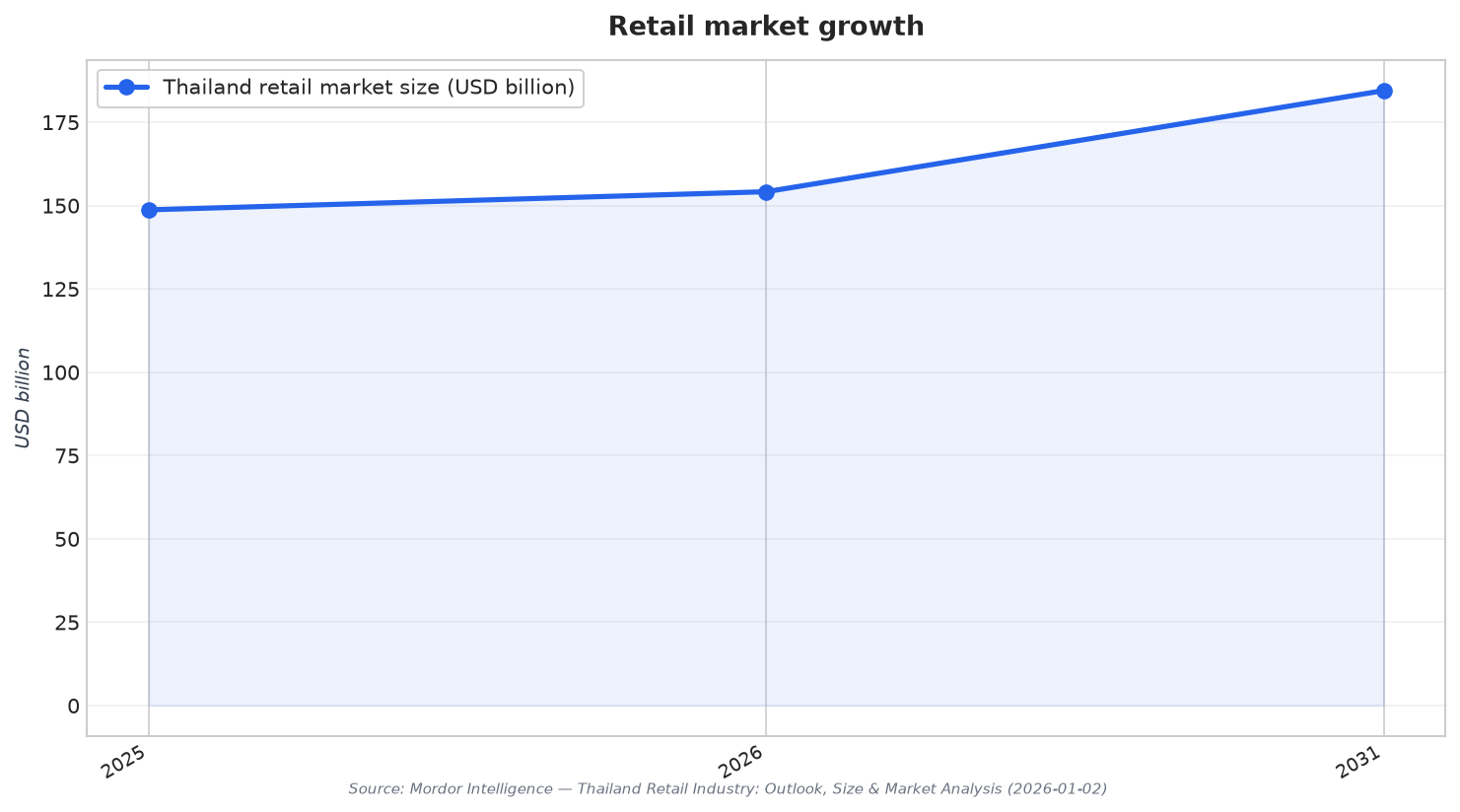
Within this environment, the Thailand convenience store market is deepening its reach by combining format growth with faster, more digital retail journeys. The broader retail outlook provides context: Mordor Intelligence projects Thailand’s retail market size to grow from USD 148.73 billion in 2025 to USD 154.17 billion in 2026, and to reach USD 184.5 billion by 2031 at a 3.66% CAGR (2026–2031). Convenience operators are positioning to capture that expansion by building footprints that work as stores, pickup points, and delivery nodes. The most durable strategies appear to be those that align payment adoption, localized inventory, and quick delivery expectations with the realities of provincial demand.
What share did convenience stores hold in Thailand’s retail market in 2025?
How fast is the convenience store segment expected to grow?
How big is Thailand’s quick commerce market, and why does it matter for convenience operators?
What delivery speed band is most common in Thailand quick commerce?
What is one example of logistics investment tied to provincial capability?