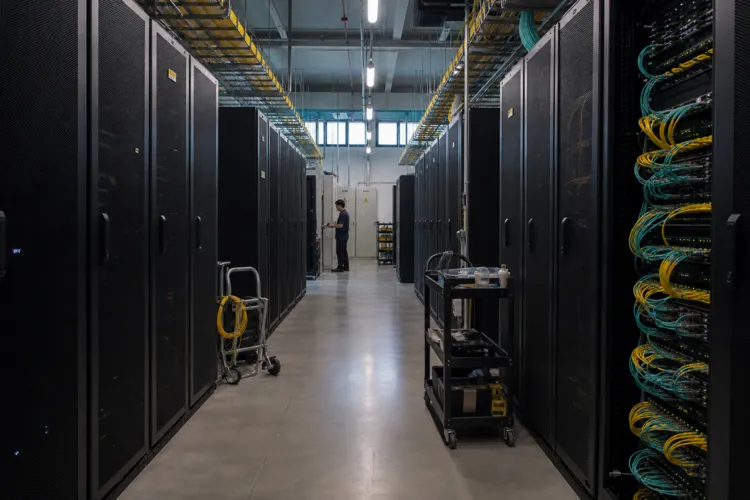
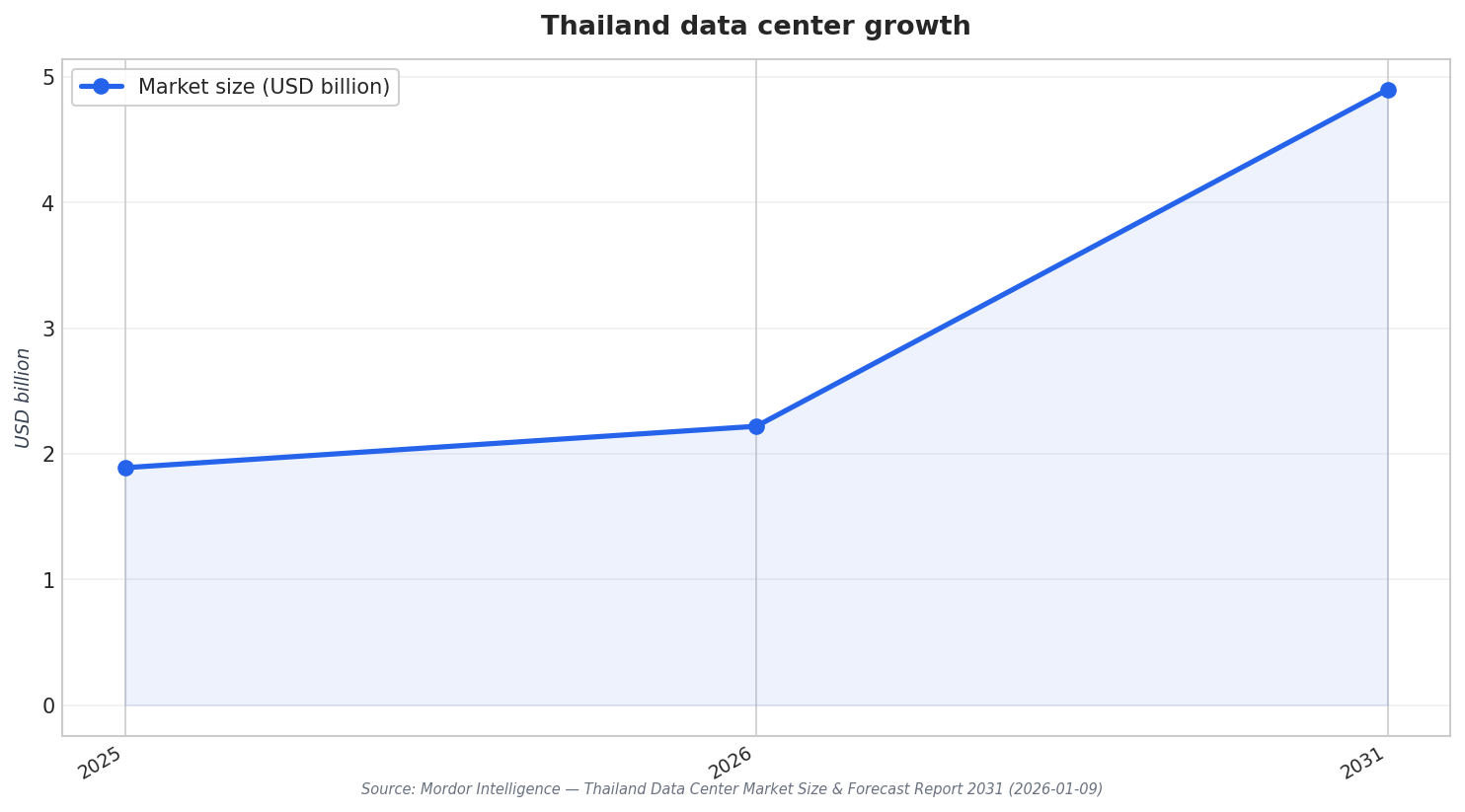
Thailand’s cloud buildout is accelerating as global hyperscalers and data center specialists increase local capacity. The Thailand data center market was valued at USD 1.89 billion in 2025 and is estimated to grow from USD 2.22 billion in 2026 to USD 4.9 billion by 2031, according to Mordor Intelligence. The same report expects market power capacity to rise from 0.77 thousand MW in 2025 to 2.93 thousand MW by 2030. Drivers cited include hyperscaler capital commitments, Thailand 4.0 policy incentives, and aggressive submarine-cable builds, alongside enterprise cloud migration and stronger AI adoption.
Investment-focused tracking also points to a sharply expanding pipeline. A separate Thailand data center investment analysis notes a market value of USD 1.45 billion in 2025, projecting growth to USD 6.29 billion by 2031, at a CAGR of 27.71%. It reports that the Thai BOI approved data center projects totaling 376 MW in 2025. The same source says the pipeline capacity (under construction, announced, and planned) stood at over 2.87 GW as of September 2025, described as 3.7 times more than Indonesia’s pipeline at that time. It also states that Microsoft announced Thailand as the location for its lead regional data center, and identifies Google and AWS among the hyperscalers bolstering growth.
Bangkok Leads, While Policy and End-User Demand Pull Capacity In-Country
Bangkok remains the focal point for new capacity, reinforcing how cloud regions cluster around dense enterprise demand and connectivity. Mordor Intelligence reports Bangkok held a 70.25% share in 2025 and is forecast to expand at an 18.02% CAGR to 2031. The same report shows Tier 3 facilities commanded 85.62% share in 2025 and are advancing at an 18.88% CAGR through 2031, while colocation represented 44.12% share in 2025. It also highlights state-backed mandates that oblige corporations to host regulated workloads in-country and notes BOI incentives of up to 13-year income-tax holidays on projects above THB 750 million (USD 21.7 million) that add local compute.
Demand signals are also shifting toward more local usage patterns and new workload types. Ken Research notes that local customers generate the majority of cloud services demand in Thailand compared with global clients, citing the rise in SMEs, high consumption of online media streaming, and a developing economy. The same source adds that major cloud providers are exploring setting up their own data centers in Thailand to meet end-user requirements, and it links hyperscale demand to content providers, cloud operators, and e-commerce firms needing high-density racks. In ASEAN-wide context, Mordor Intelligence reports public cloud led with a 67.05% revenue share in 2025, while hybrid cloud is forecast to expand at a 15.85% CAGR through 2031.
Seen through a regional lens, the Thailand cloud computing market is being pulled forward by the same forces reshaping ASEAN, but with local regions and domestic capacity now changing the delivery economics. Mordor Intelligence values the ASEAN cloud computing market at USD 21.78 billion in 2025, rising to USD 48.74 billion by 2031 at a 14.35% CAGR, and it notes hyperscale investments exceeding USD 25 billion in 2024–2025 that strengthened the regional capacity pipeline. It also cites dense network upgrades in Thailand enabling edge-cloud convergence and reports that Thailand’s Metropolitan Electricity Authority has tied 5G grids to cloud analytics for predictive outage management. Separately, SQ Magazine cites a Q1 2026 cloud tracker that identified Thailand among geographies expanding at rates well above the worldwide average.
What is driving Thailand’s cloud surge alongside new hyperscaler regions?
How fast is Thailand’s data center market projected to grow?
Which Thai hub leads data center expansion linked to cloud regions?
What capacity signals show Thailand’s pipeline is expanding?
What is happening in the Thailand cloud computing market compared with ASEAN?