
Client
Issues
Bangkok’s rapid growth had outpaced its transportation infrastructure. The city suffered from daily gridlock on major roads, lengthy commute times, and overcrowded public transit lines that reached only parts of the metropolitan area.
The fragmented nature of transportation options — including buses, an elevated train system (BTS), a subway (MRT), and informal modes like tuk-tuks — meant that commuters often struggled with poor connectivity between different modes of travel.
At the same time, rising vehicle ownership contributed to worsening air quality and increased greenhouse gas emissions, adding environmental concerns to the city’s mobility challenges.
City officials recognized that without decisive intervention, these transportation issues would continue to undermine economic productivity and negatively affect residents’ quality of life.
Solution
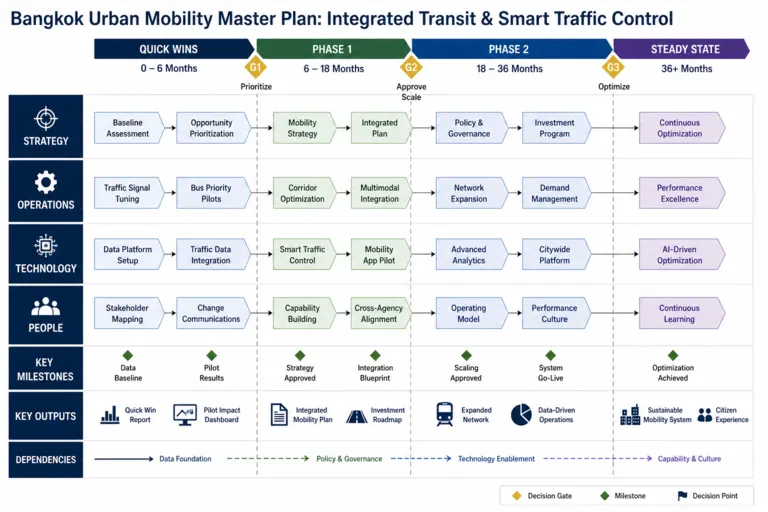
Eurogroup Consulting developed a comprehensive urban mobility master plan for Bangkok. At its core was the expansion and integration of public transit systems, with proposals for new routes and extensions of the BTS and MRT to better serve underserved neighborhoods, as well as dedicated bus rapid transit lanes to improve bus speeds and reliability.
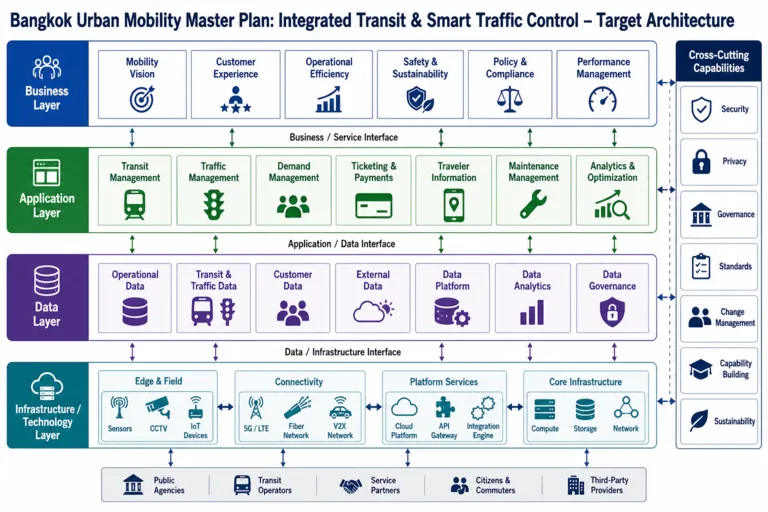
To unify the commuter experience, the plan introduced a single electronic ticketing system and mobile application, enabling travelers to seamlessly switch between trains, buses, and other transit modes using one payment method and access real-time schedule information.
Smart traffic management formed another critical pillar of the strategy. The consultancy recommended deploying intelligent traffic signals that adjust dynamically to congestion levels, along with establishing a central traffic control center that leverages IoT sensors and CCTV data to optimize traffic flow in real time.
Infrastructure for pedestrians and cyclists was also prioritized, with proposals for safe bicycle lanes and pedestrian-friendly zones aimed at promoting non-motorized transportation and reducing reliance on private vehicles.
In addition, public awareness campaigns were planned to encourage residents to adopt the upgraded transit options and embrace alternatives such as car-sharing programs and park-and-ride schemes, supporting a more sustainable urban mobility ecosystem.
Approach
The project began with an extensive data collection effort, mapping traffic patterns, transit ridership statistics, and commuter pain points across Bangkok. This analysis provided a fact-based foundation for understanding congestion hotspots, travel behaviors, and gaps in the existing transportation network.
Eurogroup Consulting facilitated workshops with a wide range of stakeholders, including city planners, transit authorities, citizen advocacy groups, and private transportation providers. These sessions ensured the master plan was inclusive and reflected real-world needs from both policy and user perspectives.
Pilot projects were then rolled out in selected districts. For example, a smart traffic signal system was tested in a congestion-prone neighborhood, while an integrated transit card was introduced to a limited group of users to gather practical feedback on usability and convenience.
In parallel, the consultancy supported coordination between different public agencies to better synchronize bus and train schedules and to establish a central traffic control center. This cross-agency alignment was critical to improving system-wide efficiency.
Throughout the project, regular progress meetings with the Bangkok Metropolitan Administration ensured alignment with city policies and provided a forum to address inter-departmental challenges. Adjustments were made continuously, such as refining bus routes based on pilot data and improving the user experience of the transit mobile application through iterative testing.
Recommendations
Eurogroup Consulting advised city officials to continue prioritizing investments in public transportation infrastructure rather than expanding road capacity. Strengthening mass transit was seen as the most sustainable way to address congestion, reduce emissions, and improve overall urban mobility in the long term.
A key recommendation was to establish a permanent urban mobility task force within the city government. This dedicated unit would be responsible for driving continuous improvements, coordinating across agencies, and integrating emerging technologies in the future, such as electric buses and autonomous vehicle pilot programs.
The consultancy also suggested considering regulatory measures to manage private vehicle usage more effectively. Options included congestion pricing and stricter parking controls in the city center, both aimed at discouraging excessive car use and encouraging a shift toward public and shared transportation modes.
Eurogroup emphasized the importance of transparency and sustained public engagement. Keeping citizens informed about the benefits of mobility initiatives and regularly gathering public feedback would help build trust, improve adoption, and ensure that solutions remain user-centric.
Finally, the consultancy recommended forming partnerships with neighboring provinces to support a regional transit approach. As Bangkok’s commuter belt extends beyond city boundaries, broader coordination was deemed essential for delivering truly effective and integrated mobility solutions across the greater metropolitan area.
Engagement ROI
The implementation of the urban mobility improvements began yielding positive outcomes for Bangkok. Early results showed a reduction in average commute times on pilot bus rapid transit corridors, as dedicated lanes allowed buses to bypass traffic jams.
The expansion of train lines and improved connectivity led to a noticeable increase in public transit ridership, indicating that more commuters were choosing trains and buses over personal cars. Smart traffic systems contributed to smoother flows at previously gridlocked intersections, reducing idle times and vehicle emissions.
Public response was largely favorable, particularly as the unified ticketing app made using multiple modes of transit more convenient than ever. Commuters appreciated the seamless integration of buses, trains, and other transport options with real-time schedule updates.
Over time, these changes are expected to significantly enhance air quality and reduce Bangkok’s carbon footprint. By addressing its transportation challenges head-on, Bangkok set a precedent in Southeast Asia for how a mega-city can leverage smart planning and technology to create a more livable and sustainable urban environment.