
Client
Issues
Merging large banks is a complex endeavor fraught with challenges. In this case, both institutions had overlapping branch networks, similar product offerings, and distinct corporate cultures that needed to be aligned.
There was a significant risk of customer attrition if account holders experienced service disruptions or uncertainty during the merger process. Compounding this challenge, each bank operated on different core banking IT systems, making technology integration a critical and high-risk component, as failures could lead to account discrepancies or payment disruptions.
The merger was also subject to close scrutiny from financial regulators, requiring careful management of compliance obligations and timely, accurate reporting. Internally, employees were concerned about potential redundancies and changes to role definitions, which posed risks to morale and productivity.
At the same time, the banks were under pressure to deliver substantial cost synergies through the elimination of duplicate functions and streamlined operations, while ensuring that service quality and customer trust were not compromised.
Solution
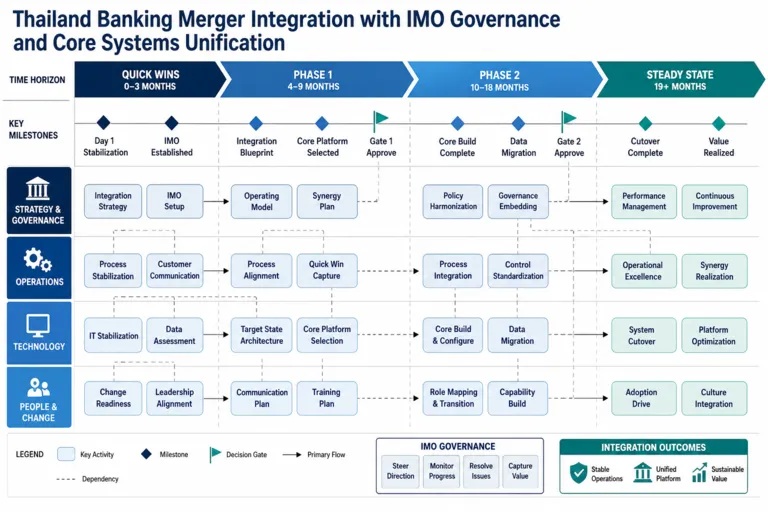
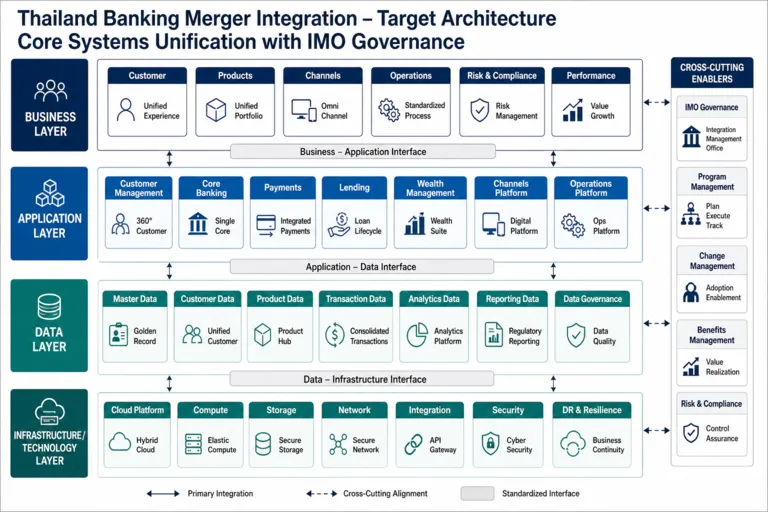
Eurogroup Consulting implemented a comprehensive M&A integration strategy to address these challenges. A centralized Integration Management Office (IMO) was established to coordinate all merger-related activities and act as the central hub for governance and decision-making.
Detailed integration plans were developed for each function, ranging from retail banking and corporate lending to IT, human resources, and risk management. The strategy placed strong emphasis on maintaining customer-facing stability, with both banks continuing to operate under their existing brands in the initial phase while backend systems were progressively integrated and optimized.
A robust IT integration roadmap was defined to unify core banking systems, digital banking platforms, and ATM networks. This roadmap included extensive testing phases to safeguard data accuracy, transaction integrity, and system reliability throughout the transition.
To address branch network overlap, Eurogroup Consulting conducted a comprehensive branch footprint analysis to identify optimal locations. Based on this analysis, a consolidation plan was developed to merge or close selected branches, while reallocating resources to high-growth and underserved areas.
From a human capital perspective, the consultancy supported the design of a new organizational structure and the development of transparent and equitable processes for role reassignment, with the objective of retaining critical talent from both institutions.
Clear and consistent communication formed a core part of the solution. Customers received regular updates on the benefits of the merger, such as access to a broader ATM network and an expanded product offering, while employees were kept informed to minimize uncertainty and maintain engagement.
Approach
The merger project was executed in carefully phased stages. Eurogroup Consulting first collaborated with executive leadership from both banks to define the target operating model of the merged entity, establishing a clear vision for how the new bank would operate in terms of processes, governance, and customer experience.
With this vision in place, joint integration teams were formed, combining personnel from both banks with Eurogroup consultants across key workstreams such as IT integration, retail operations, and risk and compliance. During the pre-merger phase, a clean team was utilized as part of due diligence to identify potential synergies and prepare integration plans while remaining compliant with competition and antitrust regulations.
Following regulatory approval, full-scale integration commenced. Data migration specialists worked to align and transfer customer account data into a unified core banking platform, while finance teams focused on consolidating financial reporting and statements across the merged organization.
Eurogroup Consulting facilitated regular integration steering committee meetings to resolve issues promptly and ensure the program remained on track. A structured tracking mechanism was also implemented to monitor synergy realization, including cost savings from joint procurement initiatives and reductions in duplicated roles.
In parallel, a cultural integration program was rolled out to support people integration. This included leadership-led workshops and townhall sessions aimed at building a shared organizational identity, addressing employee concerns, and fostering engagement throughout the transition.
The overall approach emphasized rigorous planning, transparent communication, and the rapid execution of “quick win” initiatives, such as launching a unified customer support hotline, to build momentum and confidence in the merger process.
Recommendations
As the formal engagement concluded, Eurogroup Consulting provided a set of recommendations to help ensure the merged bank’s long-term success. One key recommendation was to retain the Integration Management Office for at least one year post-merger, allowing it to complete remaining consolidation activities and serve as a central trouble-shooting function for any unexpected issues.
The consultancy also advised leadership to continuously monitor customer satisfaction and respond quickly to any declines. For example, if merger-related technology changes caused temporary ATM or digital banking disruptions, dedicated task forces should be deployed immediately to resolve issues and proactively communicate with customers.
To strengthen cultural integration, Eurogroup recommended developing a unified training and development program that combines best practices from both legacy institutions and reinforces collaboration and shared values across the new organization.
From a strategic perspective, the bank was encouraged to leverage its expanded balance sheet and broader customer base to accelerate investments in digital banking innovation and pursue regional expansion opportunities, taking advantage of its increased scale.
Finally, Eurogroup Consulting suggested conducting a comprehensive one-year post-merger review to assess integration outcomes against original targets. This review would support continued refinement of operations beyond the initial synergy objectives and drive ongoing performance improvement.
Engagement ROI
The merger, supported by Eurogroup Consulting’s orchestration, resulted in a smooth consolidation with minimal disruption to customers. On the official “Day One” of operations, customers were able to access the combined ATM network seamlessly, and within a few months, they benefited from a harmonized portfolio of products and services across all branches.
The careful approach to IT integration proved successful, as the unified online banking platform was rolled out without major incidents and introduced enhanced features for users from both legacy banks.
Significant cost synergies were realized ahead of schedule. Operational redundancies were eliminated, and procurement efficiencies exceeded initial forecasts, contributing to a marked improvement in the bank’s overall efficiency ratio.
Employee retention among high performers remained strong, supported by transparent communication and thoughtful talent integration, which helped preserve critical institutional knowledge during the transition.
In the capital markets, the merged entity’s valuation increased as investor confidence strengthened, reflecting the bank’s improved market position and financial performance.
By successfully blending two major banking institutions into a single organization, the merger set a new benchmark within Thailand’s banking industry and provided the enlarged bank with a solid platform for future innovation and expanded customer service.