
Client
Issues
The healthcare provider grappled with challenges like misdiagnoses, uneven quality of care across facilities, and lengthy patient wait times.
Doctors and staff were inundated with administrative tasks and massive amounts of patient data that were difficult to manage with existing systems. Moreover, the hospital network faced pressure to keep up with global medical advancements and rising patient expectations for faster, more precise care.
Solution
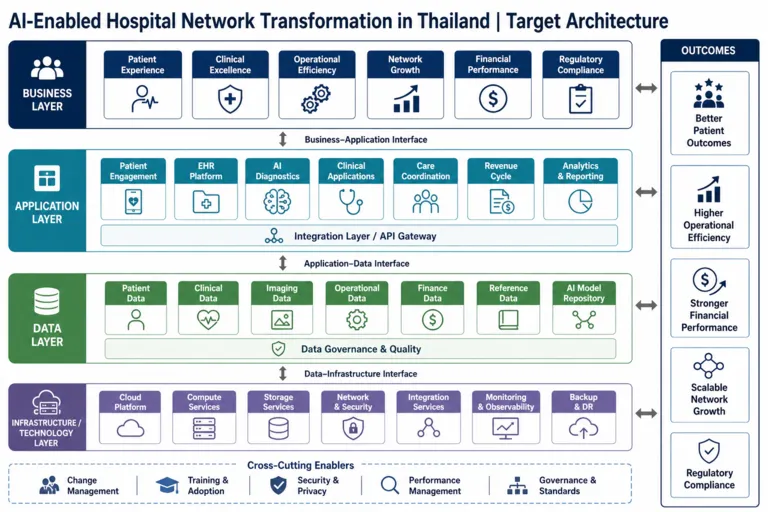
Eurogroup Consulting developed a multi-faceted solution centered on advanced data analytics and AI tools.
A new AI-powered diagnostic platform was introduced to assist doctors in identifying diseases from medical imaging and lab results more accurately and quickly.
The solution also involved implementing an integrated electronic health record (EHR) system across the network, enabling real-time data sharing and analysis.
Machine learning algorithms were deployed to predict patient influx and optimize staff scheduling, and chatbots were set up to handle routine patient inquiries and triage, easing the burden on medical staff.
Approach
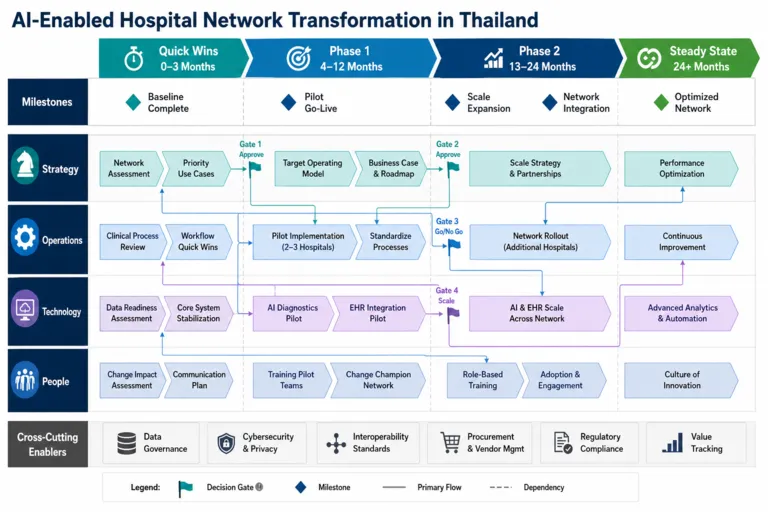
The transformation began with pilot programs in a few departments, such as radiology and oncology, where AI diagnostics could make an immediate impact.
Eurogroup Consulting collaborated closely with the hospital’s IT team and medical specialists to train the AI systems using historical patient data while ensuring compliance with patient privacy regulations.
Regular workshops were held to train doctors and nurses in interpreting AI-driven insights and incorporating them into their decision-making process.
The consultancy oversaw the gradual integration of the EHR system, starting with one hospital at a time, to ensure a smooth transition and allow for adjustments based on feedback.
Throughout the project, change management efforts — including clear communication and user support — were emphasized to build trust in the new technologies among the medical staff.
Recommendations
To fully realize the benefits of AI in healthcare, Eurogroup Consulting recommended that the hospital network continue investing in data quality and IT infrastructure.
Establishing a dedicated health innovation unit was advised, to keep exploring emerging technologies like predictive genomics and telemedicine advancements.
The consultancy also stressed the importance of updating clinical guidelines and staff training programs to reflect AI-enhanced workflows.
Partnering with technology firms and universities for ongoing R&D would help the network remain at the forefront of medical innovation.
Additionally, soliciting patient feedback regularly was suggested to ensure that technology enhancements were meeting patient needs and improving their experience.
Engagement ROI
The AI-driven transformation yielded significant improvements in patient care and operational efficiency.
Diagnostic accuracy in pilot departments improved markedly — for example, AI-assisted analysis helped detect certain cancers at earlier stages, boosting treatment success rates.
Hospital operational metrics also saw gains: average patient waiting times dropped as predictive scheduling balanced supply and demand for medical staff.
By automating routine inquiries and data entry, doctors and nurses were able to dedicate more time to direct patient care, enhancing overall service quality.
The hospital network not only achieved a higher standard of care across its facilities but also solidified its reputation as a pioneer in healthcare innovation in Thailand, attracting both patient trust and top medical talent.