
Client
Issues
Entering a new market presented a range of complex challenges for the automaker. Thailand’s automotive sector was highly competitive, dominated by established Japanese and American brands with deep-rooted dealer networks and strong customer loyalty.
The client needed a clear understanding of Thai consumer preferences, particularly regarding the adoption of electric vehicles (EVs), as supporting infrastructure such as charging stations was still in the early stages of development. Assessing consumer readiness and demand for EVs was therefore a critical consideration.
Establishing manufacturing operations in Thailand also required navigating a complex regulatory environment, including local regulations, tax incentive schemes, and supply chain requirements. This involved decisions around local sourcing of components, managing import duties, and ensuring compliance with industrial and investment policies.
In parallel, the company had to determine the most appropriate market entry mode—whether to pursue a joint venture with a local partner or enter independently—while balancing investment risk, cost efficiency, and alignment with its global strategic objectives.
Given the high stakes, any miscalculation could have resulted in significant financial losses and undermined the company’s broader international expansion ambitions.
Solution
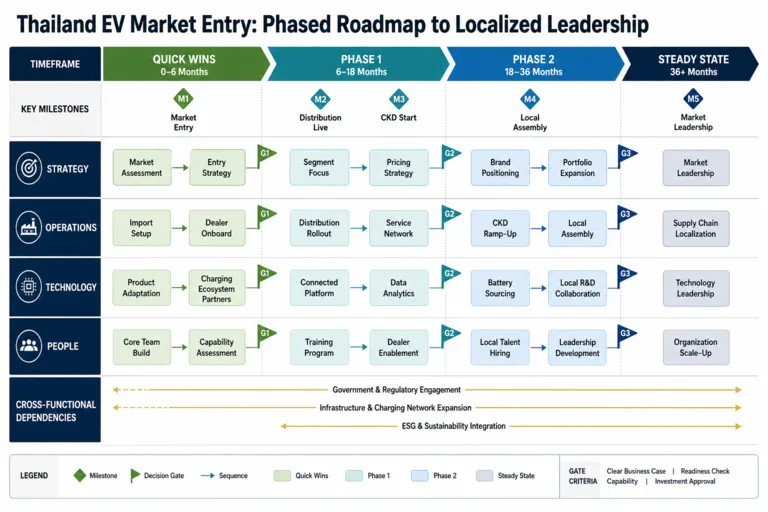
Eurogroup Consulting formulated a comprehensive market entry strategy to address the automaker’s objectives. The strategy adopted a phased approach, beginning with the importation of a limited lineup of electric vehicle (EV) models to test market response and build initial brand awareness, followed by the gradual localization of assembly and production.
Extensive market analysis was conducted to identify the most attractive customer segments in Thailand. The focus was placed on urban, middle- to high-income professionals who demonstrated a strong interest in eco-friendly technologies and innovative mobility solutions.
The strategy also included a detailed plan for establishing a distribution and retail presence. Eurogroup recommended launching flagship showrooms in Bangkok and other major cities to position the brand as premium and technologically advanced, while simultaneously partnering with a reputable local dealership group to ensure comprehensive nationwide after-sales service coverage.
On the manufacturing side, the plan highlighted opportunities to leverage incentives offered by Thailand’s Board of Investment (BOI) for EV production. A location analysis was carried out to identify a suitable site for a future assembly facility, taking into account proximity to ports, access to skilled labor, and the presence of established automotive supplier clusters.
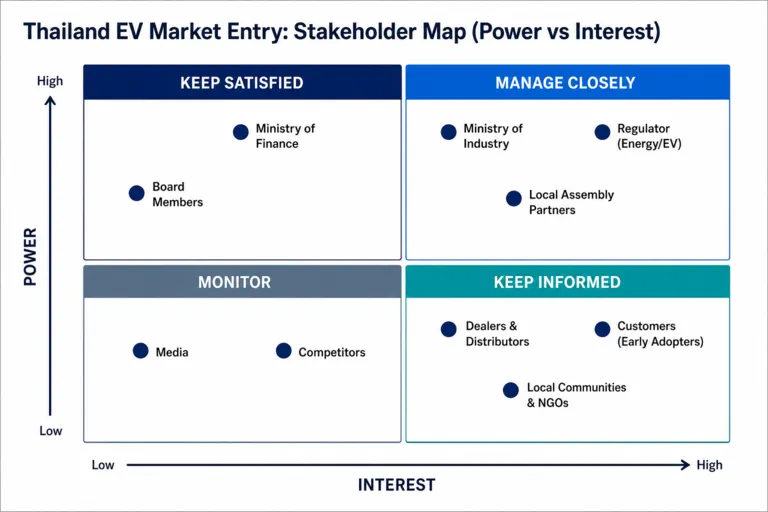
In addition, the strategy outlined approaches for engaging with Thai government agencies to support the development of EV infrastructure and create a favorable policy environment. A coordinated market launch campaign was also recommended, emphasizing the automaker’s global reputation for innovation and environmental sustainability.
Approach
The project was executed in close collaboration with the automaker’s international expansion team. Eurogroup Consulting began with an in-depth market study, conducting consumer surveys and focus groups across Thailand to assess attitudes toward electric vehicles and identify potential barriers to adoption, such as range anxiety and brand unfamiliarity.
In parallel, the consulting team analyzed the regulatory environment and engaged with government officials to clarify import regulations, tax incentives, and local content requirements relevant to automotive manufacturing. These insights formed a critical input into the market entry decision-making process.
Strategy workshops were then held with the client to evaluate alternative entry scenarios. One scenario focused on partnering with a local automaker through a licensing arrangement or joint venture, while another explored a fully independent greenfield entry. Each option was assessed across dimensions including speed to market, level of control, investment requirements, and risk exposure.
Based on these discussions, the strategy was refined to pursue an independent market entry supported by targeted local alliances, particularly in charging infrastructure development and vehicle distribution. During the implementation phase, Eurogroup Consulting supported negotiations with a leading Thai automotive distributor to establish nationwide service centers.
The consultancy also worked closely with the client’s engineering teams to plan the future assembly plant, ensuring that facility design and sourcing strategies incorporated components from local Thai suppliers in order to meet incentive program criteria. Throughout the engagement, Eurogroup provided regular updates to the automaker’s global headquarters, ensuring alignment between the Thailand entry and the company’s broader ASEAN expansion strategy.
Recommendations
Upon finalizing the market entry strategy, Eurogroup Consulting delivered a set of strategic recommendations aimed at securing the automaker’s long-term success in Thailand. A key priority was early investment in consumer education and electric vehicle infrastructure. Eurogroup advised partnering with local energy and utility companies to accelerate the expansion of charging station networks, helping to reduce consumer concerns around EV usability and range limitations.
The consultancy also recommended a phased product introduction strategy. The automaker was advised to launch with a mid-range EV model that balanced affordability with a premium brand positioning, allowing the company to build market acceptance and brand recognition before introducing higher-end luxury models.
Eurogroup emphasized the strategic importance of local talent development. Recruiting and training Thai engineers, technicians, and management staff would not only strengthen operational capabilities but also signal a strong, long-term commitment to the Thai economy and workforce.
In addition, the consultancy highlighted the need for proactive government and stakeholder engagement. It was recommended that the automaker actively participate in Thailand’s emerging EV industry forums, sustainability programs, and public–private initiatives. Such involvement would enhance brand credibility while enabling the company to stay close to regulatory developments and potentially influence policy in a favorable direction.
Finally, Eurogroup advised establishing a structured feedback loop following the initial vehicle launches. Systematically gathering customer insights and continuously monitoring competitor activities in Thailand would allow the automaker to refine its offerings, adjust its go-to-market approach, and respond swiftly to changes in a highly dynamic and competitive market.
Engagement ROI
The strategic market entry plan laid a strong foundation for the automaker’s successful expansion into Thailand. Within the first year of launch, the company’s electric vehicle models received a positive response, particularly among young professionals in Bangkok, resulting in higher-than-anticipated sales during the initial import phase.
The opening of flagship showrooms generated significant media coverage and high foot traffic, effectively strengthening brand visibility and awareness. These showrooms played a critical role in positioning the automaker as a premium and forward-looking player in Thailand’s evolving automotive landscape.
By the second year of operations, construction of a local assembly facility had commenced, aligned with rising market demand and supported by government incentives for EV production. This strategic move was expected to deliver long-term cost efficiencies through reduced import tariffs and the development of a localized supply chain.
In parallel, the automaker’s active involvement in expanding charging infrastructure — including partnerships with shopping malls and highway rest areas — helped lower adoption barriers for consumers. These initiatives encouraged broader acceptance of electric vehicles and positioned the brand as a pioneer in Thailand’s green mobility transition.
As a result of the carefully planned and executed market entry, the automaker emerged as a credible and competitive new player in the Thai automotive market. The approach effectively mitigated risks, optimized capital investment, and established a scalable platform for future growth, positioning Thailand as a strategic hub for expansion into other regional markets.