
Client
Issues
The agribusiness faced several challenges across its value chain. Upstream, the company relied on a network of smallholder farmers, and inconsistent farming practices resulted in irregular supply volumes and varying quality of raw materials. A lack of forecasting and coordination meant that periods of surplus harvest overwhelmed processing capacity, while off-season periods left factories underutilized.
During processing, outdated equipment and inefficient processes led to higher-than-desired waste and energy consumption, placing pressure on margins. The company also had limited supply chain transparency, an issue of growing importance for international buyers who are increasingly focused on food safety and ethical sourcing.
Downstream, the distribution of finished products involved multiple intermediaries, driving up logistics costs and reducing control over how products reached retail shelves. At the same time, siloed data systems across procurement, production, and sales made it difficult for management to gain a clear, real-time view of operational performance and respond quickly to emerging issues.
Together, these inefficiencies prevented the company from reaching its full profit potential and hindered its ability to meet rising international demand for consistent quality and end-to-end traceability.
Solution
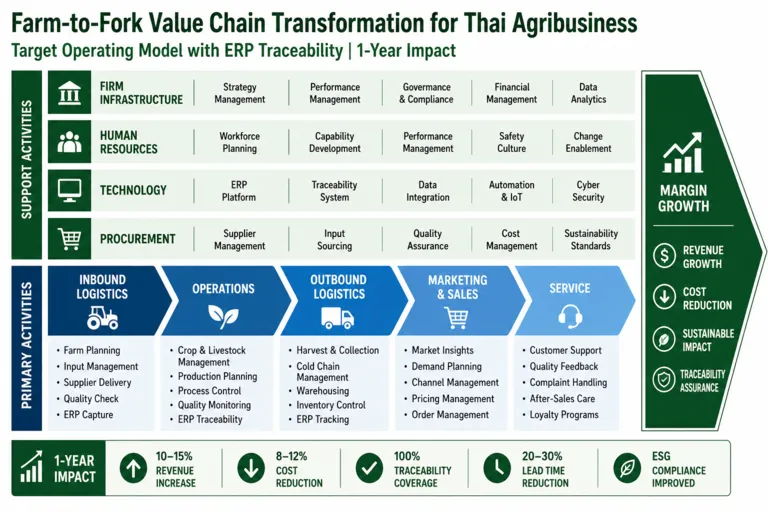
Eurogroup Consulting undertook a comprehensive value chain analysis and transformation project. The engagement began with mapping every step of the company’s value chain, from farm procurement through to end-customer delivery, and identifying key pain points and bottlenecks at each stage.
To address upstream challenges, the consulting team introduced a structured contract farming program. Selected farmers received training and resources to adopt modern and sustainable farming techniques that improved yield consistency and raw material quality. In return, the company provided purchase guarantees and agronomist support, aligning farmer incentives with the company’s quality and supply requirements.
On the processing side, the solution recommended investing in modern food processing equipment to reduce waste and improve energy efficiency, such as more efficient peeling and cutting machines. Lean manufacturing principles were also applied to streamline factory workflows and minimize downtime between processing batches of different crops.
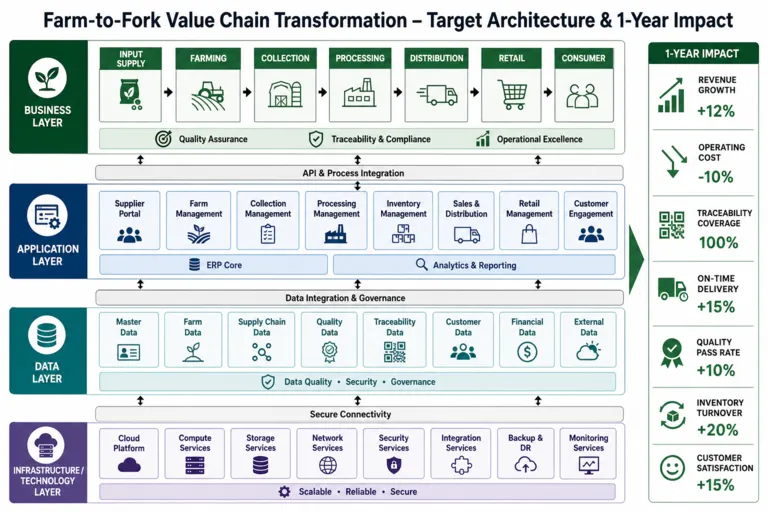
To enhance traceability and coordination, an integrated supply chain management system in the form of an ERP platform was implemented. This enabled real-time tracking of inventory from raw material intake through production to final shipment, while supporting better demand forecasting and production scheduling aligned with expected harvest volumes and sales orders.
For distribution, Eurogroup proposed optimizing the logistics network by reducing the number of hand-offs. This included working with a single third-party logistics provider for exports and exploring more direct distribution models for the domestic market, such as partnerships with retail chains or selective online sales channels.
The solution also emphasized quality certification and branding. By obtaining internationally recognized food safety certifications and positioning the products as traceable and ethically sourced, the company was able to add value and strengthen its appeal to both consumers and overseas buyers.
Approach
The project was executed in phases, starting with data collection and extensive stakeholder consultations. Eurogroup Consulting’s team visited farming communities to interview farmers and assess agricultural practices, while also conducting on-site diagnostics at processing plants to gather data on throughput, waste levels, and equipment performance.
Through collaborative workshops with the company’s procurement, production, and distribution managers, the consultants validated key pain points and jointly identified potential improvement opportunities. Based on this analysis, several pilot programs were launched.
One pilot involved a group of fifty mango farmers in an export-focused region, where the new contract farming model and training program were tested. Another pilot at a processing facility trialed lean workflow changes to measure efficiency gains achievable through process improvements even before the installation of new equipment.
The ERP implementation followed a phased approach. Initial modules for inventory and procurement were rolled out first to ensure accurate data capture from farming operations and raw material intake, before expanding the system to cover production and sales processes.
Eurogroup Consulting also coordinated comprehensive training sessions for employees on the new system and operated parallel processes for one harvest season to identify and resolve issues prior to full deployment. Throughout execution, regular progress reviews with senior management ensured alignment, while key performance indicators such as raw material yield, processing waste rates, and order fulfillment times were closely monitored.
Real-time adjustments were made as needed, including refining harvest collection schedules in the pilot region to prevent raw material oversupply from exceeding processing capacity.
Recommendations
At the conclusion of the project, Eurogroup Consulting provided several forward-looking recommendations. One key recommendation was to gradually scale up the contract farming program to cover a majority of the company’s raw material needs, while investing in long-term partnerships with farming cooperatives to secure supply stability and support community livelihoods.
The company was also advised to continue upgrading its processing technology, including exploring automation in packaging, to further improve operational efficiency and accommodate increasing production volumes.
Another recommendation was to establish a small in-house analytics team to fully leverage data generated by the new ERP system. This team could analyze insights such as which farms consistently deliver the highest-quality yields or which distribution routes are the most cost-effective, enabling ongoing value chain optimization.
Eurogroup Consulting highlighted the importance of actively marketing these operational improvements. Pursuing organic or fair-trade certifications where applicable, and promoting product traceability—such as through QR codes on packaging that communicate the farm-to-fork story—could significantly strengthen the brand’s positioning in international markets.
Additionally, the consultancy suggested implementing structured feedback mechanisms with end customers, particularly international buyers such as supermarket chains, to regularly capture input on product quality and delivery performance. This would help ensure the value chain continues to evolve in line with market expectations.
Finally, the company was encouraged to explore opportunities for vertical integration in distribution, including the potential establishment of a regional distribution center in key export markets, to gain greater control over logistics costs and service levels.
Engagement ROI
The transformation of the agribusiness’s value chain delivered significant and measurable benefits. Within one year, farmers in the pilot region who participated in the program achieved a 15% increase in crop yields along with more consistent quality, providing the company with a steadier supply of premium-grade raw materials.
Following the adoption of lean practices and the installation of new equipment, processing plants reported a substantial reduction in waste. Improved raw material utilization resulted in approximately a 10% increase in output from the same input volumes, while lower energy consumption helped reduce overall operating costs.
The implementation of the integrated ERP system enabled better forecasting and production scheduling, allowing the company to align processing activities more closely with harvest cycles and customer orders. This reduced overproduction and spoilage, and significantly improved on-time delivery performance.
From a financial perspective, the optimized value chain led to stronger profit margins and enhanced the company’s reputation for reliability among international buyers. Several key customers cited improved traceability and consistent product quality as factors in their decision to increase order volumes.
In summary, by systematically analyzing and improving every stage from farm to fork, the Thai agribusiness strengthened supply stability, operational efficiency, and market positioning, successfully translating value chain improvements into sustainable business growth.