
Client
Issues
The beverage producer faced a classic challenge of a mid-sized company with a popular product but limited distribution capabilities. Its in-house distribution was limited to a few provinces, resulting in missed opportunities to serve demand in other regions where consumers were aware of the brand through social media but couldn’t easily purchase it.
The company had been approached by a couple of big retailers interested in carrying the product, but without a robust supply chain and partnership strategy, it struggled to reliably meet large orders. Additionally, entering new channels like convenience stores or export markets would require navigating complex logistics and compliance requirements that the company had little experience with.
There was also concern about maintaining brand identity and negotiating fair terms when partnering with much larger companies (for example, ensuring its products receive adequate shelf space and marketing support in a partner’s portfolio).
In summary, scaling up without the right partnerships could lead to overextension, while not scaling at all meant leaving significant growth potential untapped.
Solution
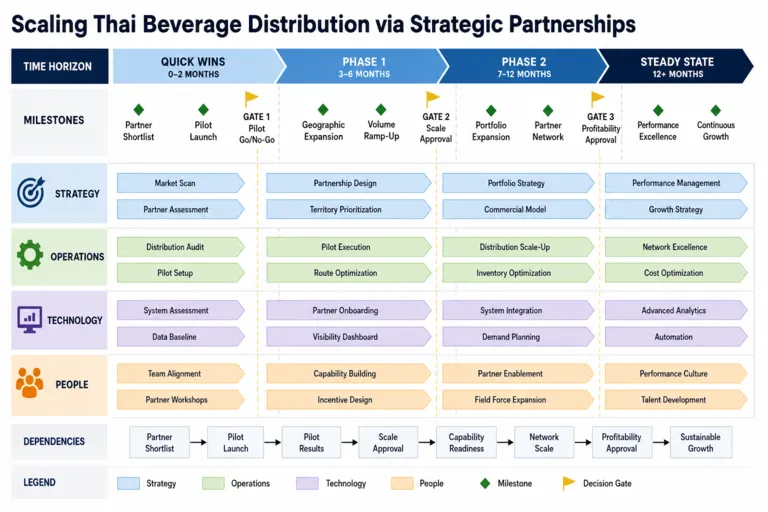
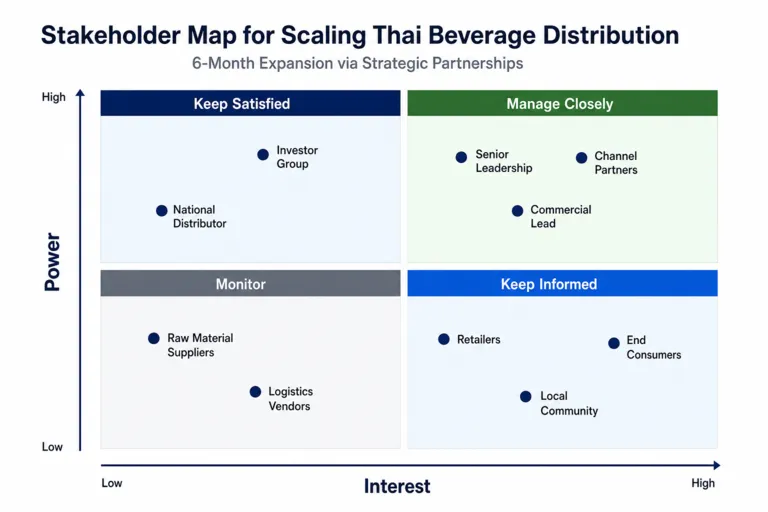
Eurogroup Consulting developed a distribution expansion strategy centered on strategic partnerships. The solution began with identifying the right partners by mapping the distribution landscape: potential partners included national-level beverage distributors, large retail chains (supermarkets and convenience stores), and export-focused trading companies. The consultancy performed a fit analysis, assessing which partners’ networks and brand portfolios aligned best with the client’s product positioning and growth goals.
With a shortlist of high-potential partners, Eurogroup crafted partnership proposals highlighting the mutual benefits — for the client, increased reach; for the partner, an attractive new product to add to their lineup with growing consumer demand. The strategy involved a mix of partnership models.
Domestically, it recommended entering a distribution agreement with one of Thailand’s leading FMCG distribution companies that could take over warehousing and delivery of the beverages nationwide. For retail presence, the plan targeted a pilot program with a major convenience store chain to stock the beverages in a few hundred stores, accompanied by joint marketing promotions to ensure the product sold well and justified broader rollout.
Internationally, the solution explored a strategic alliance with a regional beverage brand that had distribution in other ASEAN markets: a co-branding or licensing deal could allow the Thai company’s drinks to be produced or bottled under license abroad, leveraging the partner’s established supply chain.
Eurogroup also outlined the internal adjustments needed – such as ramping up production capacity and implementing quality control enhancements – to meet the higher demand that successful partnerships would generate.
Approach
The consulting team’s approach was hands-on in facilitating the partnerships. They began by strengthening the client’s case for partnership by refining sales data and marketing materials to demonstrate the product’s success and potential. Eurogroup then reached out to targeted partners through its network and arranged introductory meetings. They guided the client through negotiations, helping to define terms that covered distribution territories, pricing, minimum order quantities, and marketing commitments.
In parallel, an internal task force at the client company was set up to ensure readiness for expansion. This included upgrading the production line by adding a second shift and modernizing some equipment, as well as extending the shelf-life of the beverages through improved packaging, both of which were important for wider distribution. The consultancy drafted Memorandums of Understanding (MOUs) and eventually final contracts, ensuring key points such as forecast sharing, inventory management responsibilities, and performance review intervals were clearly stated.
A pilot phase was coordinated for the domestic distribution partner, with a limited geographic rollout launched first. This approach allowed both sides to iron out logistics and gauge sales performance. Eurogroup monitored the pilot closely, collecting data on stock movement, product sell-through rates, and any issues in the logistics chain.
They facilitated regular check-ins between the client and partners to maintain alignment and quickly troubleshoot problems, such as a partner’s truck shortage that briefly delayed deliveries and was resolved by adjusting the dispatch schedule. As confidence built, the distribution network was scaled up step by step, using the lessons learned from the pilot stage.
Recommendations
As the distribution partnerships took shape, Eurogroup Consulting made several recommendations to maximize ongoing success. It was advised that the client maintain a dedicated partnerships manager role to act as the primary liaison with each partner, monitor the relationships, and ensure agreements are upheld.
The consultancy also recommended implementing a joint business planning process with major partners. This would involve quarterly meetings to share sales forecasts, plan co-marketing activities such as seasonal promotions or new product launches, and proactively address any operational bottlenecks.
Diversification of partnerships was suggested as a long-term strategy. While the initial focus was on one key national distributor and one convenience store chain, over-reliance on a single partner could be risky. Expanding to additional regional distributors or international partners in different markets would help spread risk and open up new growth avenues.
Eurogroup emphasized the importance of brand consistency. They recommended providing partners with detailed brand guidelines and training their salesforce on the unique selling points of the beverages to ensure the product is well represented in the market.
Additionally, the client was encouraged to invest in demand generation in newly entered markets. This could be done through social media campaigns or in-store tasting events arranged with partners, helping to create consumer pull and support the distribution push.
Lastly, building feedback loops was highlighted as a critical success factor. Gathering data and input from partners, such as customer feedback and channel-level sales analytics, would enable the company to refine product flavors, packaging sizes, and other elements to better fit each market segment.
Engagement ROI
The strategic partnerships facilitated by the project rapidly expanded the beverage company’s market presence. Within six months of signing the national distribution agreement, the client’s products went from being available in five provinces to over fifty, dramatically increasing sales volumes.
The convenience store pilot proved successful, with high sell-through rates that led to the beverage being rolled out chain-wide to all outlets of the retailer. This made the product a ubiquitous choice for consumers across Thailand.
As a result of increased demand, the company’s production output doubled, and economies of scale improved unit costs, boosting profit margins. Revenue grew substantially, and importantly, this growth was achieved without the heavy capital expenditure that would have been required to build a comparable distribution network independently.
The partnership model also opened doors internationally. One strategic alliance enabled the beverages to enter two neighboring countries, where early sales figures indicated strong product–market fit.
Moreover, the client maintained control of its brand image by carefully selecting partners and actively nurturing those relationships. The beverage line was well promoted by partners and often highlighted as a featured local brand success story.
Through expanding horizons with strategic partnerships, the Thai beverage company transformed from a regional player into a national and emerging international brand. The approach demonstrated how leveraging the strengths of established partners can accelerate growth, create mutual value, and allow a company to punch above its weight in competitive markets.