
Client
Issues
The retail chain was facing flattening sales growth and observed that customers, particularly younger ones, were drifting to competitors and online shopping alternatives. Management suspected that in several areas—such as product pricing, store ambiance, customer service, and digital integration—their offerings were not as compelling as those of leading competitors, but they lacked concrete data on where they lagged or excelled.
Additionally, the company’s online and offline channels were not well integrated, while competitors were offering seamless omnichannel experiences, such as buy online and pick up in store or easy returns across channels. There were also internal perceptions that certain operational aspects, including checkout speed and inventory variety, were behind industry peers, but no systematic benchmarking had been conducted.
Without a clear and data-driven picture of its competitive position, the retailer risked falling further behind more agile and innovative players in the industry.
Solution
Eurogroup Consulting designed a comprehensive competitive benchmarking and improvement project to address these challenges. The first step was to identify key performance indicators (KPIs) and areas for comparison, including pricing strategy, product assortment, store layout, customer service metrics, loyalty program effectiveness, e-commerce functionality, and supply chain efficiency.
The consulting team then gathered data on competitors through multiple approaches. Mystery shopping exercises were conducted at both the client’s stores and competitor locations to evaluate the customer experience first-hand, while public data—such as pricing of popular goods, promotional campaign frequency, and financial performance indicators—was analyzed. Customer surveys and focus groups were also used to capture consumer perceptions of the client compared with competitors.
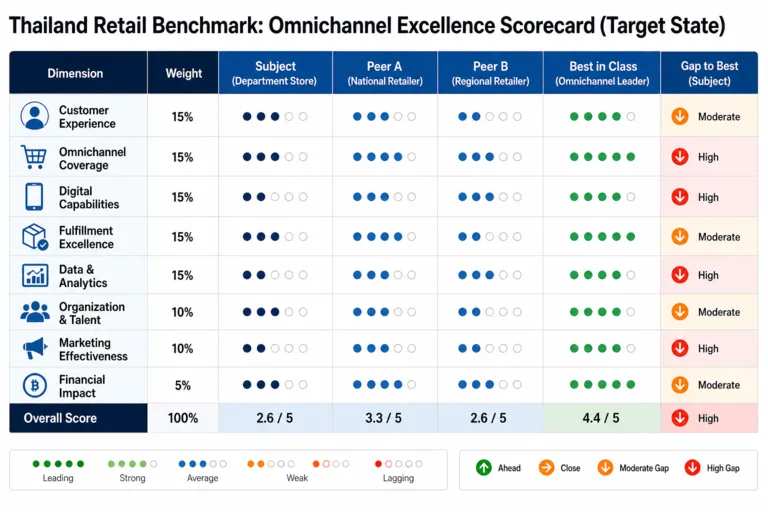
The benchmarking analysis highlighted several performance gaps. For example, it revealed that a major international competitor offered a wider range of organic products and a more modern store ambiance, while an e-commerce rival provided faster home delivery and a more user-friendly mobile app.
Based on these insights, Eurogroup Consulting worked closely with the client to develop targeted improvement initiatives. One solution involved revamping the loyalty program to align with successful competitor schemes by introducing a tiered rewards system and personalized discounts.
Another initiative focused on a store modernization plan, including updates to lighting, signage, and merchandising techniques to enhance the overall shopping atmosphere. On the digital front, the plan proposed integrating inventory systems so that in-store and online stock levels reflected real-time availability, enabling features such as click-and-collect and hassle-free returns across the entire store network.
Approach
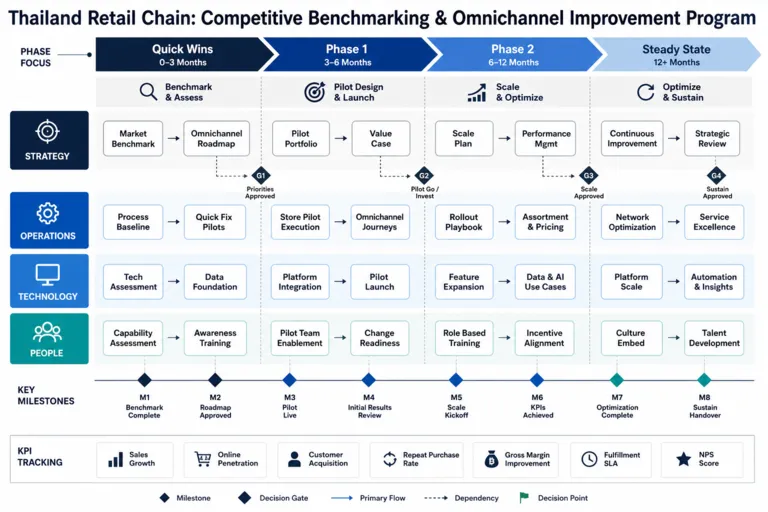
The project was carried out in iterative phases. Initially, Eurogroup Consulting collaborated with the client’s management to select a set of direct competitors and aspirational industry leaders, both within Thailand and across the broader Asia-Pacific region, to benchmark against.
Data collection took place over several weeks. The consulting team visited a sample of stores at different times, including peak weekends and off-peak hours, to measure factors such as queue lengths, staff responsiveness, and shelf stock levels. At the same time, they tested the client’s and competitors’ online shopping processes, from ordering through to delivery, to benchmark speed and convenience.
The raw findings were compiled into a detailed benchmarking report featuring scorecards and rankings for each performance area. In a series of workshops with the client’s department heads, Eurogroup facilitated discussions to interpret the data and identify root causes behind performance gaps.
For example, where checkout times were slower, the analysis explored whether this was driven by outdated point-of-sale systems, cashier training, or staffing levels. Potential solutions were brainstormed and then prioritized based on their expected impact and feasibility.
Eurogroup subsequently supported the formation of cross-functional teams within the client’s organization to pilot selected improvements. One pilot involved redesigning a flagship store’s layout to replicate effective features observed in competitor stores, such as clearer navigation signage and dedicated experience zones for electronics.
Another pilot tested a new digital capability that allowed customers to view in-store inventory online and reserve items for pickup. Throughout implementation, the consultancy established a tracking mechanism to measure progress against the same KPIs used in the initial benchmarking.
Regular review meetings with the executive team ensured continued alignment and that resources were focused on the most critical initiatives.
Recommendations
Upon completion of the benchmarking and initial improvements, Eurogroup Consulting provided recommendations for sustaining competitiveness. It was advised that the retailer establish an ongoing competitive intelligence unit or structured process to regularly monitor competitors’ activities, customer feedback, and market trends, enabling the company to remain proactive rather than reactive.
The consulting team also recommended scaling successful pilots across the organization. For example, store layout enhancements could be rolled out to all major outlets, while the integrated online–offline inventory system could be fully implemented across regions.
Investing in employee training was emphasized, particularly in customer service excellence and the use of digital tools, to ensure staff were equipped to consistently deliver an enhanced customer experience comparable to or better than that of competitors.
Additionally, the company was encouraged to explore partnerships and innovations that competitors had not yet adopted, in order to leapfrog the competition. These included experimenting with in-store technologies such as smart mirrors or mobile self-checkout, as well as developing exclusive product lines through strategic partnerships with local producers.
The importance of brand differentiation was also highlighted. Eurogroup recommended refining brand messaging to emphasize the chain’s unique strengths, such as its long-standing reputation for quality and deep local market knowledge, to complement the operational improvements.
Lastly, the retailer was encouraged to periodically repeat benchmarking studies, including comparisons outside the retail industry—such as hospitality or e-commerce best practices—to continuously identify new sources of inspiration and opportunities for improvement.
Engagement ROI
The competitive benchmarking initiative and subsequent improvements delivered positive results for the Thai retail chain. Within months of implementing the changes, customer satisfaction scores captured through surveys began to rise, reflecting improved shopping experiences both in-store and online.
The pilot store that underwent layout and service upgrades experienced a noticeable increase in foot traffic and sales compared with stores that had not yet been updated, validating the effectiveness of the improvements.
The enhanced loyalty program led to higher customer sign-ups and an increased rate of repeat purchases, as shoppers responded positively to more attractive rewards and personalized offers.
On the digital side, the integration of inventory systems and improvements to the website and mobile app resulted in faster delivery times and fewer stock-out incidents. This narrowed the gap with e-commerce competitors and drove significant growth in online sales as a share of total revenue.
Importantly, the retailer’s management gained a clearer and more data-driven understanding of the competitive landscape and their own performance. By knowing where they stood and continuously tracking progress, the organization developed a more agile and outward-looking culture.
In a dynamic retail market, the chain shifted from playing catch-up to moving ahead of the curve in key areas, laying a strong foundation for sustained competitive advantage and long-term growth.